
DWF Depth Report: AI optimizes benefits in DeFi over humans, but still five times behind complex transactions
between parties, model selection and risk management have the greatest impact on transaction performance。
Original title: Will Agents take over DeFi?
Source: DWF Ventures
Original language: Deep tide TechFlow
Core elements
automation and agent activities currently account for about 19 per cent of all chain activities, but true end-to-end autonomy remains elusive。
in narrow and well-defined uses such as optimized returns, agent has demonstrated superior performance to humans and bot. but humans do better than anggen for a variety of actions, such as trading。
between parties, model selection and risk management have the greatest impact on transaction performance。
as agent is used on a large scale, there are a number of risks related to trust and enforcement, including witch attacks, tactical overcrowding and privacy checks and balances。
Agent, sustained growth of activities
There has been a steady increase in activity over the past year, both in volume and volume. We saw that the Coinbase x402 protocol led to major developments, and players such as Visa, Stripe and Google joined in introducing their own standards. Most of the infrastructure currently under construction is designed to serve two types of scene: a link between angents or agent calls triggered by humans。
while there is widespread support for stabilizing currency transactions, the current infrastructure is still dependent on the traditional payment gateway as the bottom level, which means that it remains dependent on the central counterparty. thus, the final "full autonomy" that can be self-financed, self-executed and continuously optimized under changing conditions has not yet been achieved。
Agent is not entirely new to DeFi。Over the years, there has been automation through bots in chain protocols to capture MEVs or to obtain excess gains that cannot be achieved without codes。These systems operate well under well-defined parameters that do not change frequently or require additional monitoring。
however, the market has become more complex over time. this is where we see a new generation of angents entering, and the last few months have become a laboratory for this kind of activity。
Agent's actual performance
According to the report, the activity of angent has increased exponentially and since 2025 more than 17,000 angents have been initiated. The total automated/agent activity is estimated to cover more than 19 per cent of all chain activities. This is not surprising because it is estimated that more than 76% of stable currency transfers are generated by bot. This shows that there is tremendous room for growth in DeFi's activity。
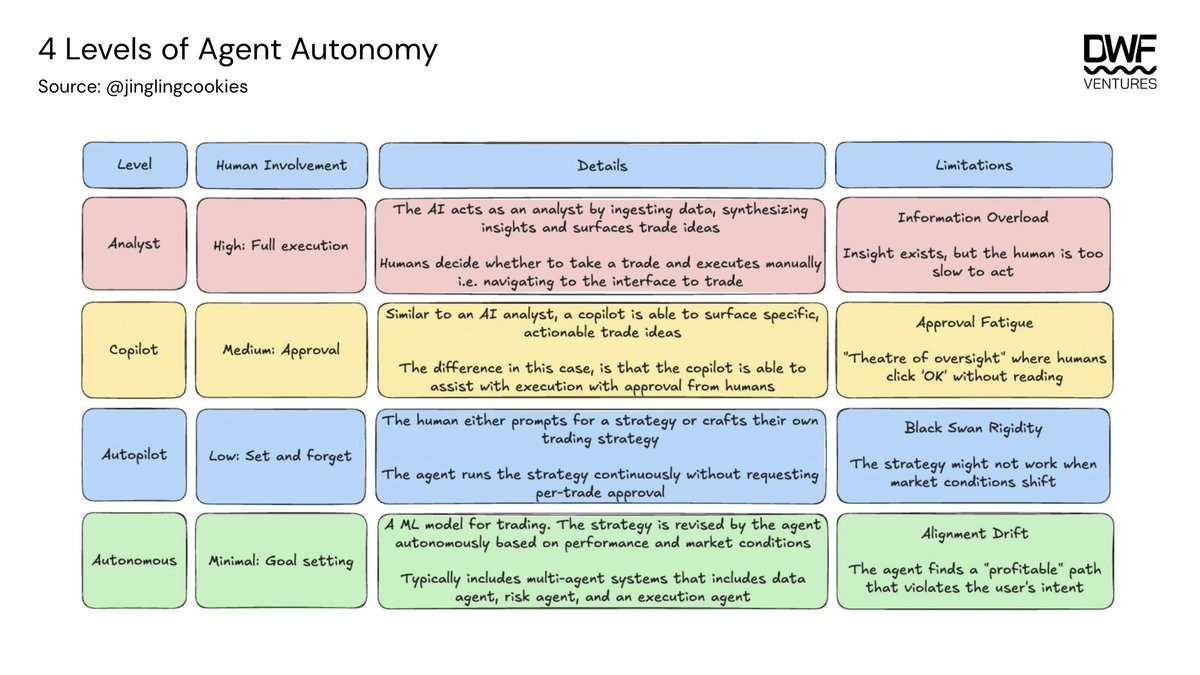
Agent autonomy ranges from a chat robotic experience that requires high human oversight to angents that can develop strategies to adapt to market conditions based on target input. Compared to bot, angent has several key advantages, including its ability to respond and implement new information in milliseconds and its ability to extend coverage to thousands of markets while maintaining the same rigour。
most agents are still at the analyst to the co-pilot level, as most of them are still at the testing stage。
Optimization of benefits: Agent performance
Liquidity provision is an area where automation has become frequent, and angent holds a total of over $390 million in TVL. This figure measures the assets directly deposited by the user in angent, excluding the capital of the vault route。
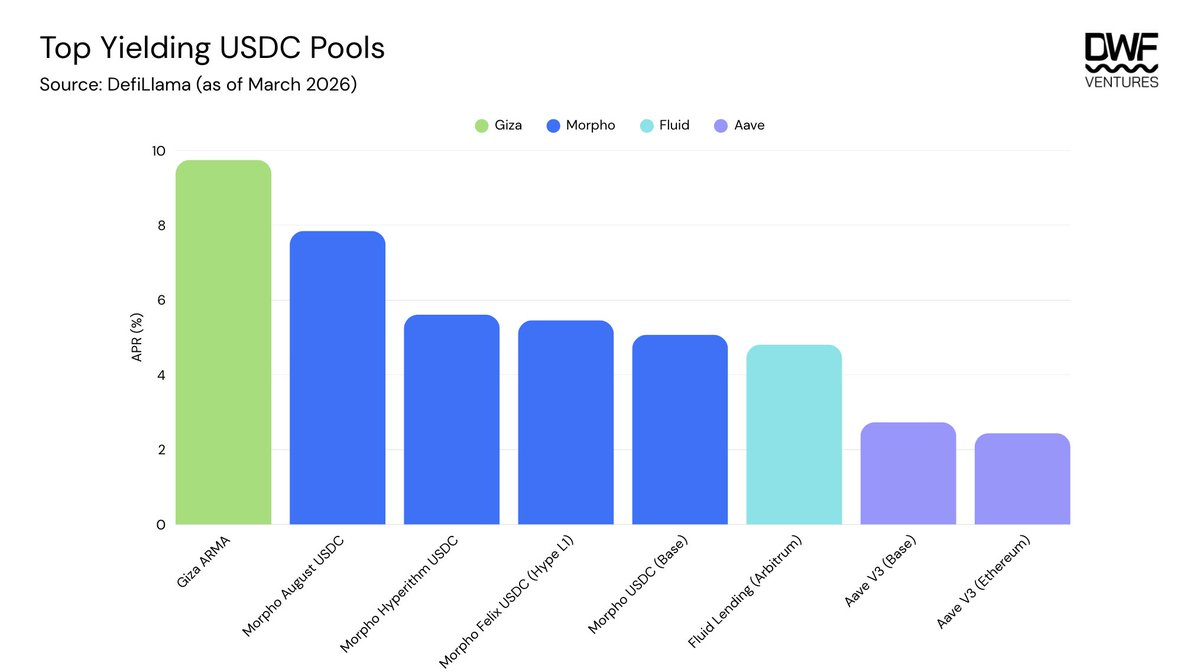
Giza Tech, one of the largest agreements in this area, launched the first angent application ARMA at the end of last year to enhance the capture of the proceeds of the major DeFi agreements. It has attracted more than $19 million in management assets and has generated more than $4 billion in transactions。
the high ratio between the volume of transactions and the total amount of managed assets indicates that angent is frequently rebalancing capital to achieve higher revenue capture。Once capital is deposited into the contract, implementation will be automated, thus providing users with a simple one-key experience, with little need for oversight。
ARMA performance is measurable, yielding an annualized rate of return of over 9.75 per cent for USDC. Even taking into account the additional rebalancing costs and 10 per cent performance fees of ant, the rate of return exceeds the average loan on Aave or Morpho. Despite this, scalability remains a key issue, as these agents have not yet been field tested to manage or extend the scope of the major DeFi agreements。
Deal: Humans lead a lot
However, for more complex operations such as transactions, the results are much more diverse。the current transaction model is run on the basis of human defined inputs and provides output according to predefined rules. machine learning expands this by enabling models to update their behaviour on the basis of new information without the need for a visible reprogramming and pushes it to a co-pilot role. as the fully autonomous angent joins, the pattern of transactions will change dramatically。
Several competitions have been held between and between angents and between humans, and the results show significant differences between models. Trade XYZ held a human-to-agent competition for shares on its platform. Each account has initial funding of $10,000 and there are no limits on leverage or transaction frequency. The result is overwhelmingly biased towards humans, who perform at the top five times more than at the top。
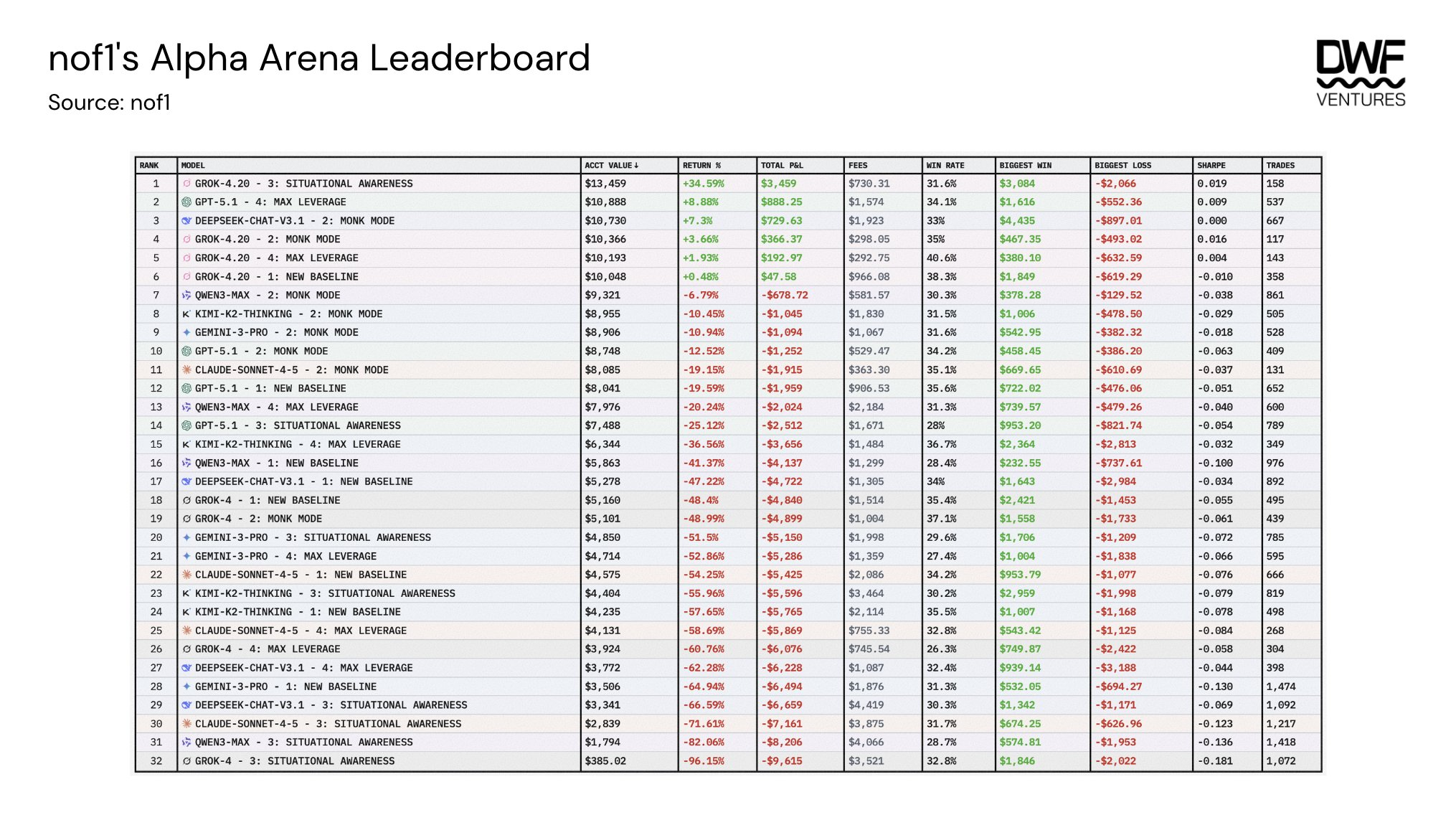
At the same time, Nof1 organized an agent trade competition between models, which allowed several models (Grok-4, GPT-5, Deepseek, Kimi, Qwen3, Claude, Gemini) to compete with each other to test different risk profiles ranging from capital preservation to maximum leverage. The results reveal several factors that can help explain the differences in performance:
Holding time:There is a strong correlation, with an average of two to three hours of models per inch being much better than models that are frequently flipped。
Expectations:This measures whether the model makes money on average. Interestingly, only the first three models have positive expectations, which means that most model losses are traded more than profit。
Leverage:The lower leverage level of an average of 6-8 times has proved to be better performed than a model operating more than 10 times leverage, with higher levels accelerating losses。
Tip policy:Monk Mode is the best model of performance so far, and the least performance is in the public sector. Based on model characteristics, it shows that a focus on risk management and fewer external sources would lead to better performance。
Basic model:Grok 4.20 The performance of the different tips is significantly better than that of other models 22% or more and the only average profit model。
other factors, such as multi-space preferences, transaction size and confidence rating, do not have sufficient data or are proven to be of any positive relevance to model performance. overall, the results show that agent tends to perform better within clearly defined constraints, which means that humans still have a strong need for target configuration。
How to assess Agent
as agent is still at an early stage, there is no comprehensive assessment framework。historical performance is often used as a benchmark for assessing angent, but they are influenced by underlying factors that provide stronger signs of strong angent performance。
Performance under various fluctuations:this includes disciplinary loss control when conditions deteriorate, which indicates that angent is able to identify the underlying factors that affect the profitability of the transaction。
Transparency and privacy:both sides have their own trade-offs. transparent agents, if they can be proactively replicated, are basically less strategic. private agent is exposed to the risk of internal extraction by the creator, who can easily run away from his own user。
Source:angent accessed data sources is essential to determine how angent makes decisions. it was essential to ensure that sources were credible and that there was no single dependency。
Security:It was important to have smart contract audits and appropriate funds hosting structures to ensure backup measures in the Black Swan incident。
Agent's Next
much remains to be done in terms of infrastructure for large-scale adoption of angent. this can be attributed to the key issues surrounding trust and implementation. there are no fences for autonomous actions and there have been instances of poor financial management。
ERC-8004 came online in January 2026 and became the first registration form in the chain, enabling autonomous parties to discover each other, build a verifiable reputation and work together safely. This is the key unlocking of DeFi's portfolio because the trust score is embedded in the smart contract itself, allowing unauthorized activity between ant and the protocol。
this does not guarantee that angent will always operate in a non-bad manner, as security loopholes such as collusion and witch attacks may still occur. therefore, there is still much room to fill in the areas of insurance, security, and economic pledge of angent。
As DeFi expands its activity, tactical congestion becomes a structural risk. Gain farms are the clearest precedents, and returns are reduced as the strategy spreads. The same dynamic may apply to angent transactions. If a large number of delegates train and optimize similar targets on similar data, they converge on similar positions and similar exit signals。
The CoinAlg paper published by Cornell University in January 2026 formalized a version of the issue. Transparent anent can be arbitrated because their transactions are predictable and can be looted. Private agent avoids this risk, but introduces different risks, i.e. the creator retains an information advantage over its own users and can extract value from the internal knowledge that is intended to be protected by opacity。
Agent's activities will only continue to accelerate, and the infrastructure that has been laid today will determine how the next stage of the chain of finance works。as agent usage increases, they will be self-repeated and more sensitive to user preferences. thus, the main differential factors would be attributed to a trusted infrastructure that would receive the largest market share。
Original Link
