
Native accounts abstract + Quantum Threat: EIP-8141 why is it not the top of Hegotá
EIP-8141 is an attempt to sink the account abstract, Gas payment and signature flexibility directly to the level of the agreement。
Last week, the EIP-8141 was formally discussed at a meeting of the Ether House Core Developers, and as a result, it was surprising that the proposal for Vitalik to stand personally was not classified as a "headline function" for Hegota, but rather as a "consider inclusion" status。
This week, the Google Quantum AI team released a new white paper indicating that, under its given hardware assumptions, the physical quantum ratio estimate required to break CCDLP-256 was 20 times lower than before. It doesn't mean the quantum attack is near, but it's a real reminderIf the account system does not have the flexibility to change validation logic in the future, much of today ' s discussion of wallet experience may eventually turn into a security issue。
EIP-8141 IS STILL TOO HEAVY, ALTHOUGH FROM THE REALISTIC PERSPECTIVE OF MOVING FORWARD WITH THE AGREEMENT, ESPECIALLY IN TERMS OF CLIENT ACHIEVEMENT, THE SECURITY OF THE TRADING POOL AND THE COMPLEXITY OF VALIDATION, AND THERE IS NOT YET ENOUGH SOLID CONSENSUS。
BUT AT THIS POINT IN TIME, EIP-8141 SEEMS TO BE WORTH DISCUSSING AND LOOKING AT MORE AND MORE。
I. EIP-8141. WHAT IS THE SOLUTION
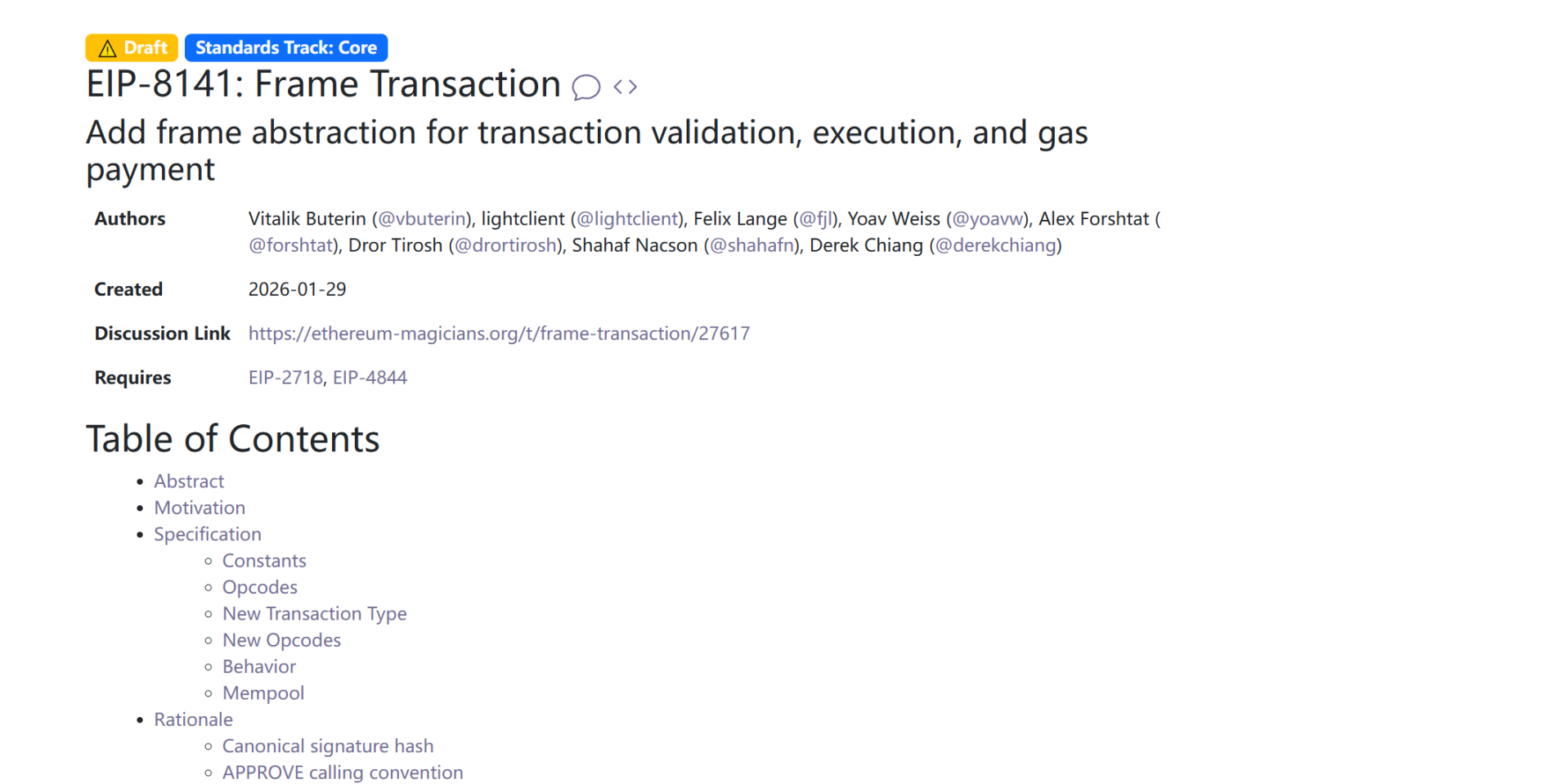
EIP-8141 is driven by core contributors such as Vitalik Buterin and Timbeiko, officially known as Frame Transports。
To sum up in a more comprehensible phrase, what it wants is not to add a separate wallet function, but rather to try to remove any account from the level of the agreement from being bound by a single ECDSA signature path, but rather to have a more flexible validation and enforcement logic.
This also means that multiple signatures, Gas sponsorship, key rotation, social rehabilitation, and even future access to anti-quan signature programmes are no longer just a layer of capacity outside the wallet, but have the opportunity to become a "generic member" of the ETA system。
IF YOU LOOK AT THE SURFACE, EIP-8141 DISCUSSES A SET OF CAPABILITIES THAT SEEM VERY SPECIFIC:Pays in stable currency Gas, synthesizes multi-step operations into a transaction, supports more flexible signature methods, and even leaves space for future antiquant signatures。IT CAN BE SAID THAT MANY OF THE IMPROVEMENTS THAT HAVE BEEN EXPERIENCED OVER THE YEARS, FROM ERC-4337 TO EIP-7702, AROUND WALLETS, ARE ESSENTIALLY MAKING ACCOUNTS NO LONGER A PRIVATE KEY, BUT AN ENTRY POINT FOR CUSTOMIZING RULES。
The problem is that these improvements do make wallets more and more like smart accounts, but they never really touch the bottom of the default account model of Ether。
IT IS WELL KNOWN THAT UNDER THE CURRENT SYSTEM, TAIFUNG ACCOUNTS ARE BROADLY DIVIDED INTO TWO CATEGORIES. ONE IS AN EXTERNAL OWNED ACCOUNT, THE MOST FAMILIAR EOA, CONTROLLED BY A PRIVATE KEY, WHICH CAN INITIATE A TRANSACTION ON ITS OWN INITIATIVE, BUT LACKS PROGRAMMABLE CAPACITY; THE OTHER IS A CONTRACTUAL ACCOUNT, THE SMART CONTRACT ITSELF, WHICH CAN IMPLEMENT COMPLEX LOGIC BUT CANNOT INITIATE A TRANSACTION ON ITS OWN。
This leads to the ability to initiate transactions and to be tied to a single private key signature for a long time. As long as this premise remains unchanged, it is difficult for many users today to find the capacity that they ought to have, such as flexibility to change signature rules, to have Gas replaced, to restore control over accounts after the loss of their private key, or to smooth the future migration to a new password system, to become the real default capacity of the account。
If you've used the imToken or other Web3 wallets, you probably have experienced these pains, such as a bunch of USDCs in your wallet, but without ETH, you can't make a deal (because Gas can only pay with ETH); you lose all the money and can't restore it; a "authorization + exchange" operation has to sign twice, confirm twice, etc。
The problem is not that the wallet product is not good enough, but rather that it is designed with the Taifeng Account Model itself。
FROM THIS POINT OF VIEW, THE EVOLUTION OF THE LAST TWO YEARS HAS BEEN VERY CLEAR, WITH ERC-4337 RUNNING ACCOUNTS IN ABSTRACTION AT THE APPLICATION LEVEL WITHOUT MODIFYING THE PROTOCOL; EIP-7702 FURTHER CONFIRMS THAT THE EOA IS NOT COMPLETELY UNEXPANDABLE, AT LEAST ON A TEMPORARY BASIS, TO GAIN SOME OF ITS ABILITY TO APPROACH SMART ACCOUNTS。
THAT IS TO SAY, INSTEAD OF TRYING TO BE AN ABSTRACT ACCOUNT, THE TAICHA HAS BEEN APPROACHING THE MATTER IN A MORE MODERATE AND CONSERVATIVE WAY. AND THE EMERGENCE OF EIP-8141 MEANS THAT THIS PATH HAS REACHED A NEW NODE. IT IS NO LONGER SATISFIED WITH THE ABILITY TO STACK ANOTHER LAYER OF SMART ACCOUNTS OUTSIDE THE EXISTING SYSTEMAttempts to embed accounts in the abstract directly into the transaction model itself, allowing them to have programmable validation and execution logic from the start of the protocol layer。
AND THAT'S WHY EIP-8141 WILL REHEAT TODAY. ON THE ONE HAND, THE UPPER-LEVEL WALLET EXPERIENCE HAS COME CLOSER AND CLOSER TO THE ABSTRACTION OF THE ORIGINAL ACCOUNT, WHICH WILL SOONER OR LATER NEED TO BE FOLLOWED; ON THE OTHER HAND, THE LONG-TERM PRESSURE OF QUANTUM COMPUTING IS SHIFTING THE "ACCOUNT'S FLEXIBILITY TO CHANGE SIGNATURE" FROM A DISTANT TECHNICAL ISSUE TO A REALITY THAT MUST BE CAREFULLY CONSIDERED。
II. EIP-8141 HOW DOES IT WORK
In the final analysis, EIP-8141 introduced an entirely new type of transaction - Frame Transport - with transaction type number 0x06。
IF THE BASIC LOGIC OF TRADITIONAL TAIFENG TRANSACTIONS IS THAT ONE TRANSACTION CORRESPONDS TO A CALL, WHAT EIP-8141 WANTS TO DO IS TO DISMANTLE A TRANSACTION INTO A SET OF “FRAMES” THAT CAN BE IMPLEMENTED IN THE ORDER OF THE RULES, THUS REMOVING THE THREE THINGS THAT WERE BOUND TOGETHER FOR AUTHENTICATION, PAYMENT AND EXECUTION。
Each frame has three modes of implementation:
- VERIFY (validation frame): is responsible for verifying the validity of transactions, it runs the account 's customised validation logic and, if adopted, calls the newly introduced APPROVE code to authorize execution and assigns the Gas cap。
- SENDER (TRANSMITTING FRAME): PERFORM PRACTICAL OPERATIONS SUCH AS TRANSFERS, CALL CONTRACTS, ETC. THE CALLER ADDRESS IS THE SENDER OF THE TRANSACTION。
- DEFAULT (entry frame): a system entry address as a caller for deployment contracts, validation of Paymaster, etc.
The purpose of this mechanism is not to make the transaction more complex, but rather to disassembly it from the account operations for the first time, and to submit it to the original protocol。
After all, who validates the transaction, who pays the Gas, who does the real thing, is basically tied to the same account, and..UNDER THE DESIGN OF EIP-8141, THESE THINGS CAN BE BROKEN DOWN INTO DIFFERENT FRAMES, EXECUTED IN A CLEAR SEQUENCE, AND THAT IS WHY THE ACCOUNT NO LONGER RELIES ON A SINGLE PRIVATE KEY TO "SIGN AS A WHOLE" BUT BEGINS TO HAVE A FORM CLOSER TO THE PROGRAMMABLE IMPLEMENTER。
As a concrete example, assuming that you want to complete a Swap with USDC payment of Gas, the matter can theoretically be organized into a complete frame process: first, that the signature and execution authority be verified by the account, then that the payer or Paymaster verify the conditions under which he or she is willing to bear the costs, then that the cost of the corresponding asset be paid, and then that the real swap operation be carried out。
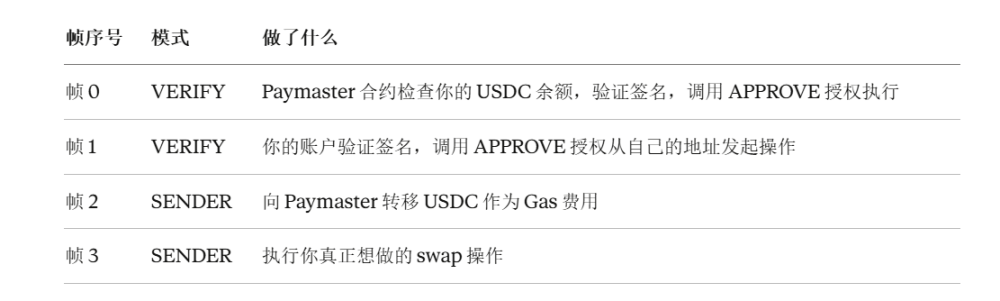
As a result, Gas payments and primary transactions can be integrated into the same atomic process, either fully successful or rolled back。
FOR USERS, THE MOST INTUITIVE CHANGE IS THE MANY OPERATIONS THAT HAD TO BE BROKEN DOWN IN TWO OR THREE STEPS AND THAT HAD THE RISK OF FAILURE IN THE MIDDLE, AND THAT COULD BE MORE LIKE A COMPLETE MOVE IN THE FUTURE, SO THIS ATOMITY IS ALSO ONE OF THE KEYS TO EIP-8141 TO SOLVING THE PROBLEM OF FRAGMENTATION EXPERIENCED BY USERS。
What does that mean for wallet users? In terms of results, the most visible changes are at least four levels:
- Gas payment is abstract:The presence of a stable currency in the wallet no longer means that you have to prepare a little extra ETH to operate, and that the future payment of Gas by Dapp, Paymaster or other sponsors will become more primitive
- Multistep operation merged:A process such as "Authorization + Swap" "Authorization + Pledge" is now often required for multiple signatures and has the opportunity to be packed into a more complete operation
- Account security rules are open:Multiple signings, social rehabilitation, daily limits, time locks, key rotations, which are no longer just additional high-level functions provided by a wallet product, are beginning to offer opportunities to build on a more primitive account logic
- THE SIGNATURE SCHEME MUST NO LONGER BE LOCKED BY THE ECDSA SINGLE PATH:This allows for the future migration of accounts to different password systems, including the back-quant signature programme, which for the first time has the possibility of a hierarchy of protocols
iii. Why isn't hegotá the top
A point that can be easily ignored, but is critical for wallet users:EVEN IF EIP-8141 EVENTUALLY LANDED, THE CURRENT SYSTEM OF ACCOUNTS WOULD NOT BE OVERTHROWN AS A WHOLE。
Even if you're using an existing Web3 wallet like imToken, you don't have to migrate because it's compatible backwards, and the existing EOA address can continue to be used, just choose the "upgrading" account validation logic at the right time。
But in turn, it is precisely because it has been changed deep enough that it has not been a direct flagship function of Hegotá in the latest round of discussions. However, according to the EIP Campion process of 2026, the meaning of the CFI is not denied, but is at the stage of serious consideration, but not yet on the final board。
IN OTHER WORDS, THE CORE DEVELOPERS DO NOT REJECT EIP-8141’S DIRECTION, BUT, WHILE RECOGNIZING ITS VALUE, CONSIDER IT STILL TOO HEAVY。
After all, the original account is not as abstract as the ERC-4337, which can be gradually driven by a few wallets, infrastructure, and applications. Once it enters the protocol layer, it means that all executive-level clients will have to seriously achieve, test, and synergize, which will naturally raise the push threshold and make core developers more conservative when planning fork。
So what happens next? It can be seen in two lines:
- EIP-8141, SINCE IT IS IN CFI STATUS, INDICATES THAT IT IS STILL BEING EVALUATED ON AN ONGOING BASIS, THAT THE AUTHOR OF THE PROPOSAL WILL CONTINUE TO COMPLETE THE KEY DETAILS ACHIEVED AROUND THE SECURITY OF THE TRADING POOL, THE CERTIFICATION RULES AND THE CLIENT, AND THAT SUBSEQUENT ACD MEETINGS WILL REVIEW WHETHER IT HAS FURTHER ADVANCED CONDITIONS
- If these uncertainties continue to be condensed, it will have the opportunity to enter into a more substantive integration phase in subsequent upgrades; if not, it may well be deferred to a later promotion cycle
In fact, EIP-8141 is not the only original account abstraction proposal, much less an off-the-shelf late quantum signature programme, which cannot directly address quantum calculations, but its importance is that it provides, for the first time, a negotiated layer of exports for the account to exit the ECDSA single path.
FROM THIS POINT OF VIEW, THE REAL VALUE OF EIP-8141 IS NOT THAT IT IS THE ONLY ANSWER, BUT THAT IT PLACES THE QUESTION OF WHAT THE ABSTRACT END OF THE ORIGINAL ACCOUNT SHOULD LOOK LIKE ON THE TABLE OF THE ETA FOR THE FIRST TIME。
IT IS NOT THE ONLY SOLUTION, BUT IT IS INDEED ONE OF THE MOST AMBITIOUS AND CLOSE TO THE UPPER LIMIT OF THE IMAGINATION OF THE WHOLE AA。
Whether or not EIP-8141 finally catch up with Hegotá, the discussion itself has at least shown one thing:
Instead of waiting for the problem to ferment in situ, the Ether Workshop is paving the way for the next-generation system of accounts in a daily fashion。
