
How hard can it be for Jane Street to make $40 billion a year
Oppenheimer is alive today, and he may not be able to answer Jane Street's third round of interviews. Topic
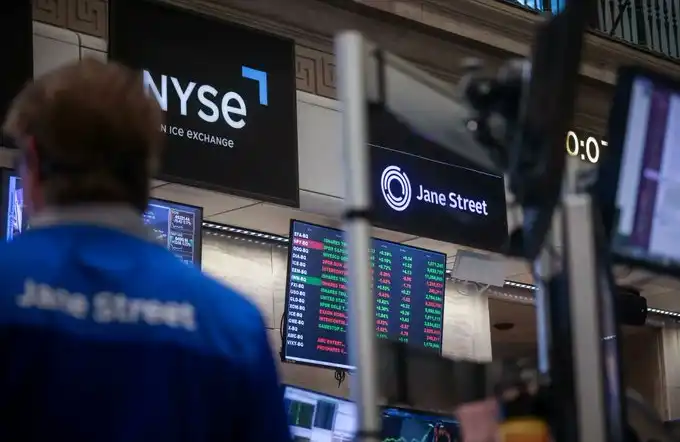
The most discussed on Wall Street this week was Jane Street。
3500 employees, without bank plates, without consulting fees and with no investment bank business. By trade alone, $39.6 billion was collected throughout 2025. More than Morgan Chase. Over Goldman Sachs. More than any agency in Wall Street history。
Based on a 65-70 per cent profit margin, the company ' s per capita profit is about $8 million to $9 million. Of all the companies with over 1,000 employees, the world's first. Citadel Securities, 1800 people next door, with a per capita profit of 3.6 million; Hudson River Trading of 6.6 million; and even Nvidia, a company that is being fed by the world, with a per capita profit of 2.9 million。
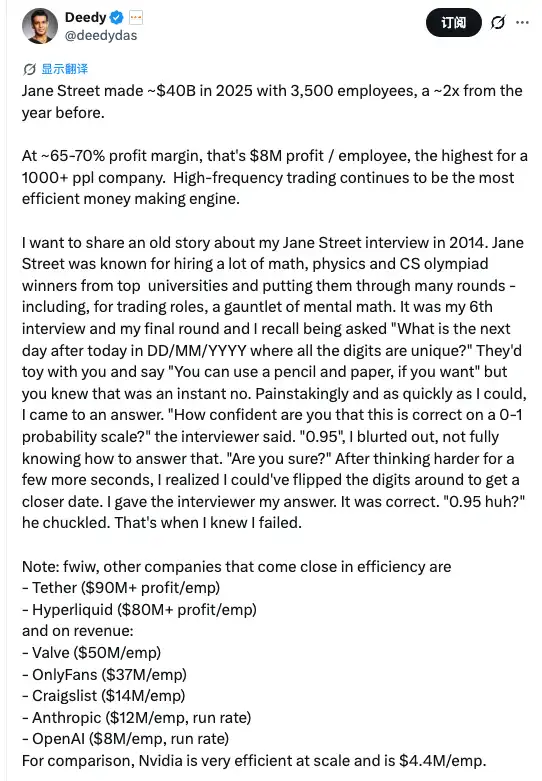
So this week, the entire Twitter financial community was talking about the same thing: how did Jane Street get these guys in
The hardest company on Wall Street
Jane Street is no stranger in the currency ring。
The first job for the FTX founder, SBF, was Jane Street intern. SBF's ex-girlfriend Caroline Ellison, who later left a chicken hair in Alameda, was also born here. SBF later repeated in Michael Lewis's book that the market thinking framework he learned in Jane Street determined almost all his trading instincts for later FTX and Alameda。
Many of the founders and projectors of the money ring had an intersection with Jane Street before the transfer was made for encryption, but the vast majority of them were "interviewed" rather than "accessed " 。
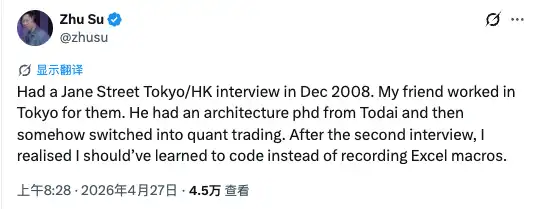
Zhu Su, founder of Triple Capital, also wrote: "In December 2008, Jane Street was in Tokyo and Hong Kong. My friend was in their Tokyo office, and the doctor of Architectology was converted to quantify. I figured out one thing after the second round. I should learn programming, not Excel."
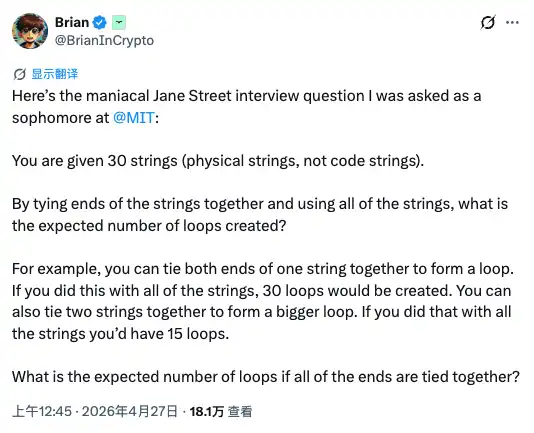
The head of growth of the Monad Foundation referred to a question he had been asked in his second year of MIT, saying, "How crazy is that interview so far?" Glider Finance Co-founder Brian is also following up on Jane Street and a long-spreaded code lock。
A lot of senior players in the encryption ring passed by the company at some point in time。
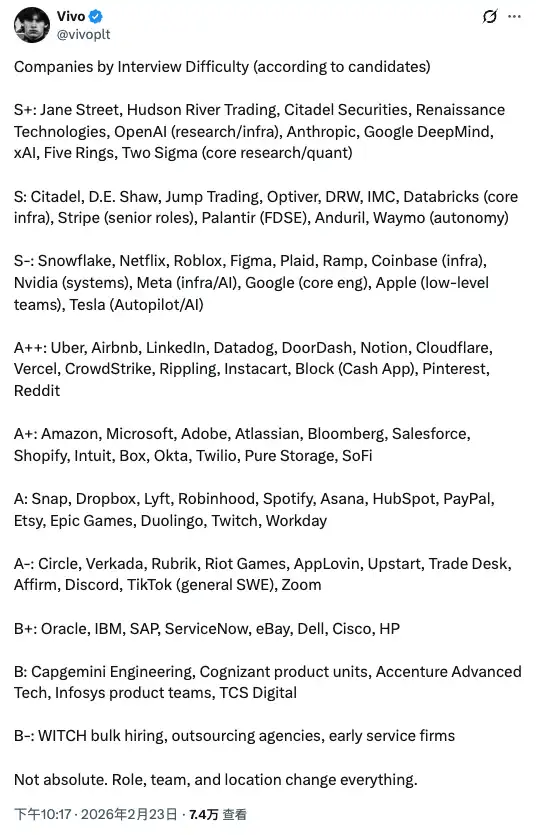
And Jane Street's company is hard to interview across Wall Street. Following the ranking of the candidate @vivoplt's difficulty list, Jane Street is the top of the difficulty S+, alongside the top AI lab。
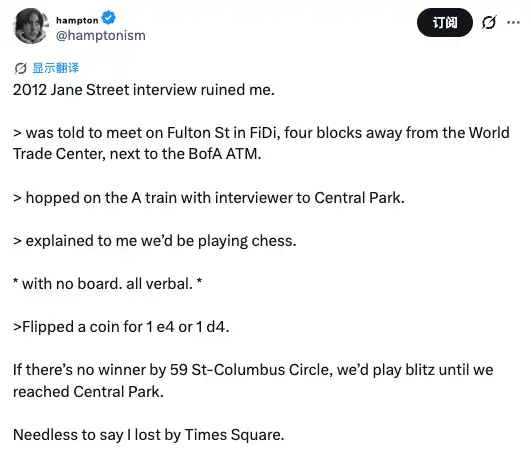
A friend of mine, Hampton, remembers the interview in 2012. It's kind of like black humor: about Fulton Street in the Financial District, next to the US Bank ATM next to the World Trade Center. The interview officer then took him to the A-line subway and headed for Central Park. She played chess with the interviewer on the subway. But there's no board, all oral. 1.e4 or 1.d4. If the Columbus Circle on 59th Street doesn't break out yet, it's going down to Central Park. Hampton said he lost at one stop in Times Square。
Another investor, Alex Song, recalled his participation in the Jane Street interview in 2010: "The worst interview in my life." In an hour, the brother across the street explained to me the rules of some kind of card game and gave me one hour to find the strategy of winning. This is definitely not a Putnam math competition, but it's worse than D.E. Shaw, QVT, DRW
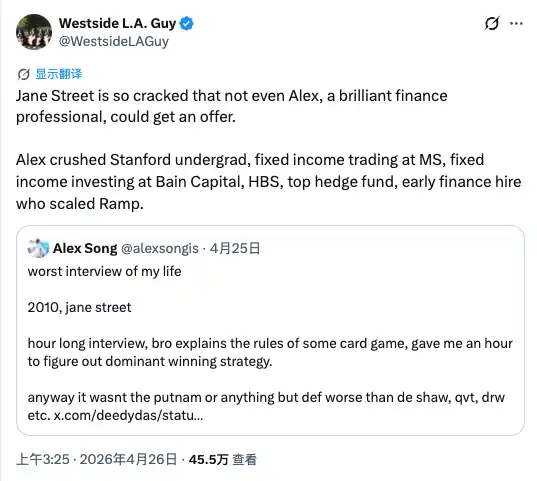
This is Alex, who was later crushed by Stanford Benco, Morgan Stanley's fixed-income deal, Bene capital's fixed-income investment, Harvard MBA, top hedge fund, Ramp's early financial recruiter, Jane Street。
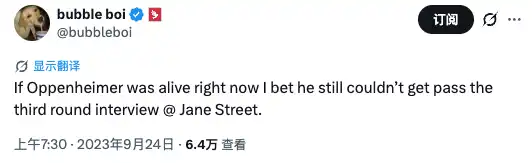
The interviewer said, "This is still the hardest interview process in the investment bank, and you can get ready for other companies, and Jane Street can't get ready for it." "If Oppenheimer is still alive, I bet he's still not gonna make it through Jane Street's third round of interviews."
The interview
Listening to stories is no fun. Below are a few topics that have been repeatedly discussed on Twitter, and the authors have chosen a few different ways, and readers can try them themselves, and see how many can be made。
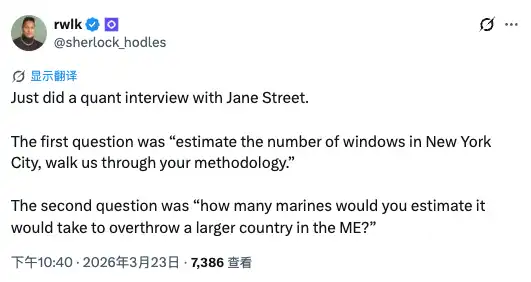
Title one: "How many windows do you have in New York City
Topic two: "How many marines do you estimate it will take to overthrow a large country in the Middle East?"
Title III: "A safe has six digital passwords. The password lock will indicate whether we have correctly entered four or more digits, but only a six-digit full pair will actually open. What is the best strategy to find the password with a minimum number of attempts?"
Title four: "You have 30 real ropes." How many rings do you expect to form when you tie all 60 ends up at random? For example: a rope is tied up = 1 ring; 30 roots are like this = 30 rings. Both ends of the ropes = 1 large ring; 30 two links = 15 rings
TITLE V: "WHAT IS THE DATE OF THE NEXT MOST RECENT DAY AFTER TODAY WHEN ALL FIGURES WILL NOT BE REPEATED?" FORMAT DD/MM/YYYY. HOW SURE ARE YOU?"
Topic six: "What is the integer of the square root closest to 1420?"
Topic 7: "I have a relative who is a professional baseball player. What is the real probability of this?"
Title VIII: What is the number of the smallest, all digits composed of 1 and 0 and capable of being divided by 15
Topic 9: "How far is the corner between the clock and the pin at 3:15 pm?"
Topic 10: "You have the opportunity to race for a treasure box." The real value of the box is between 0 and 1,000 dollars, and you have 100% confidence in it in this zone. If your offer is equal to or higher than the real value of the box, you get it at your price; if it's lower, you won't get anything. At the same time, you have a friend who would buy it from you at 1.5 times the real value of the box. How much should you report?"
Topic 11: "I'll throw 20 dice now." How much will you pay to play this game once? Now change the rule: for each round, you can either take the current number of dice or throw it again. There are 100 rounds. What's your best strategy? What's this game worth?"
title xii: "the blackboard says 100 words. the first sentence says, "a maximum of 0 of the 100 words is true." the second sentence says, "a maximum of one of these 100 words is true" the next sentence says, "a maximum of n-1 of these 100 words is true". the 100th sentence says, "up to 99 of this 100 sentence is true." so, what's in 100 words really true?"
Topic 13: "I throw 4 coins, what is the expected number of positives?" Now give you a chance to throw all four again. What's the expectation
Topic 14: "Two teams of equal strength play seven four-win series. What's the probability that this series won or won in the seventh race?"
Topic 15: "Assuming you're at a party with a roommate, you've invited another 10 pairs of roommates. During the meeting you asked everyone but yourself: "How many have you shook hands?" Everyone knows they haven't shook hands with their roommates; everyone gives you different answers. So how many times did your roommate shake hands?"
Topic XVI: "100 prisoners are held in 100 separate cells. There is only one light room in the prison, where only one prisoner is allowed to enter, light or turn off. Prisoners are called into the light room at random and the number and sequence of admissions are completely uncontrolled. Any prisoner can announce at any time that 100 of us have already entered this room. If yes, all were released; if wrong, all were executed. Prisoners can negotiate strategies before the game begins, but they can not communicate after. What's the best strategy?"
Topic XVII: "Assuming I have 10 coins." One of them is a fair coin (50 per cent positive and negative) and the other nine are uneven, but the degree of deviation is unknown. How do you find that fair coin
Topic 18: "A thousand ninjas stand in a circle, each with a knife." One kills two, three kills four, five kills six, and so on, continues to kill one person down the circle until the end. What's his number?"
If you take all the phone interviews ahead, the last level is called Super Day. When you come in, the staff will put 100 poker chips on you. Next is a series of four to six, one-hour technical sessions, all of which will be met with active traders. You're going to bet or sell each of these chips. When SBF entered Super Day, he was told, "No one who lost all the chips has ever got it."
Jane Street, what kind of people do you want
Augustin Lebron, a former trader of Jane Street, worked for many years at the London office and managed the internship programme, including the SBF. After leaving Jane Street, he wrote a book called The Laws of Trading, and in one interview he said a very honest phrase: "As a global sum, maybe one or two thousand new people will be able to enter a really good quantitative trading company."
"I talked to a lot of students. If you ask them why they want to do this, they say math is interesting, AI is interesting, statistics is interesting. But these skills can be used in many other places, so that reason alone cannot be justified. But Augustin Lebron believes that the real answer is usually two: first, it's a high-ranking thing; and second, they actually want to be rich。
So, what kind of person did Jane Street bring in
In interviews, Augustin Lebron made it clear that the criteria for recruitment in these institutions are Raw talent, not knowledge. That is to say, they were trained in the past to do this, for example, to play poker, to do sports games, and to make real money. Some people who have experienced "decision-making without certainty and with economic consequences for decision-making" in their lives。
And the other very typical type of person who comes in and goes out very quickly, even if they're very smart, very good at math, very good at solving problems, but they don't like trading. They care more about solving the math than making money. "In the business of trading, you have to make money."
Some old Jane Streeter also summed up a few common reasons for the candidates to hang: overconfidence; silence thinking, Jane Street strongly stressed thinking out of Loud; refusing to bet, giving you a chance to be a marketer but you rejecting it, which is "you don't want to take the risk"; and, when you get in a bad position, the interview officer will deliberately give you a very bad offer, and if you panic about accepting it, you will prove you shouldn't be invited in. Ignore hidden information in a problem, etc。
And that's probably why Jane Street makes $40 billion a year。
