
Is there really a World Cup spell in the market
Is the World Cup really gonna lead to weakness? And why
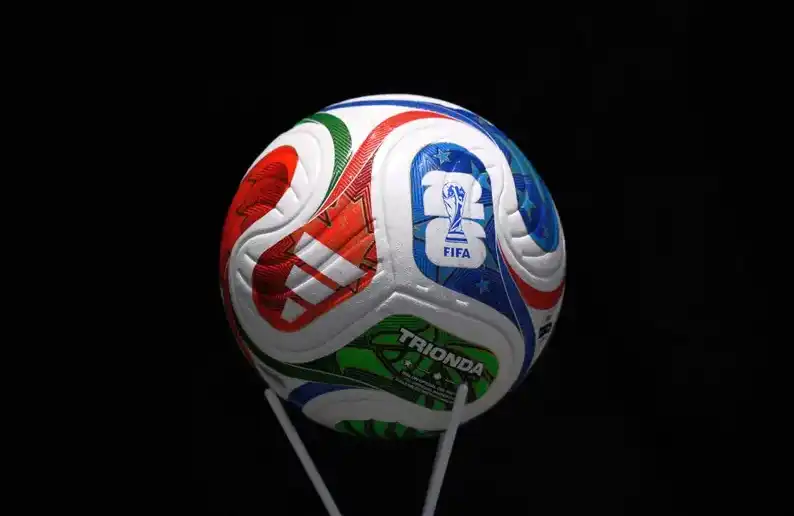
The World Cup will open on June 11th. For a long time, the "World Cup Curse" has been spreading in the market that, during the World Cup, the world's major stock markets tended to show weak performance and the volume of their trade shrunk significantly。
Whether you're ready for beer peanuts and you're ready for a good game, or if you're planning to do it at the same time, we can see if the World Cup spell is real. What are the causes behind the data
From the data, the World Cup spell
HISTORICAL DATA SHOW THAT THE MAJOR GLOBAL STOCK MARKETS GENERALLY PERFORMED POORLY DURING THE WORLD CUP. IN THE CASE OF THE UNITED STATES STANDARD 500 INDEX (S&P 500), THE AVERAGE EXPECTED RETURN OF THE STANDARD 500 INDEX DURING THE 19TH WORLD CUP, 1950-2022, WAS AROUND -1.5 TO -2.11 PER CENT。
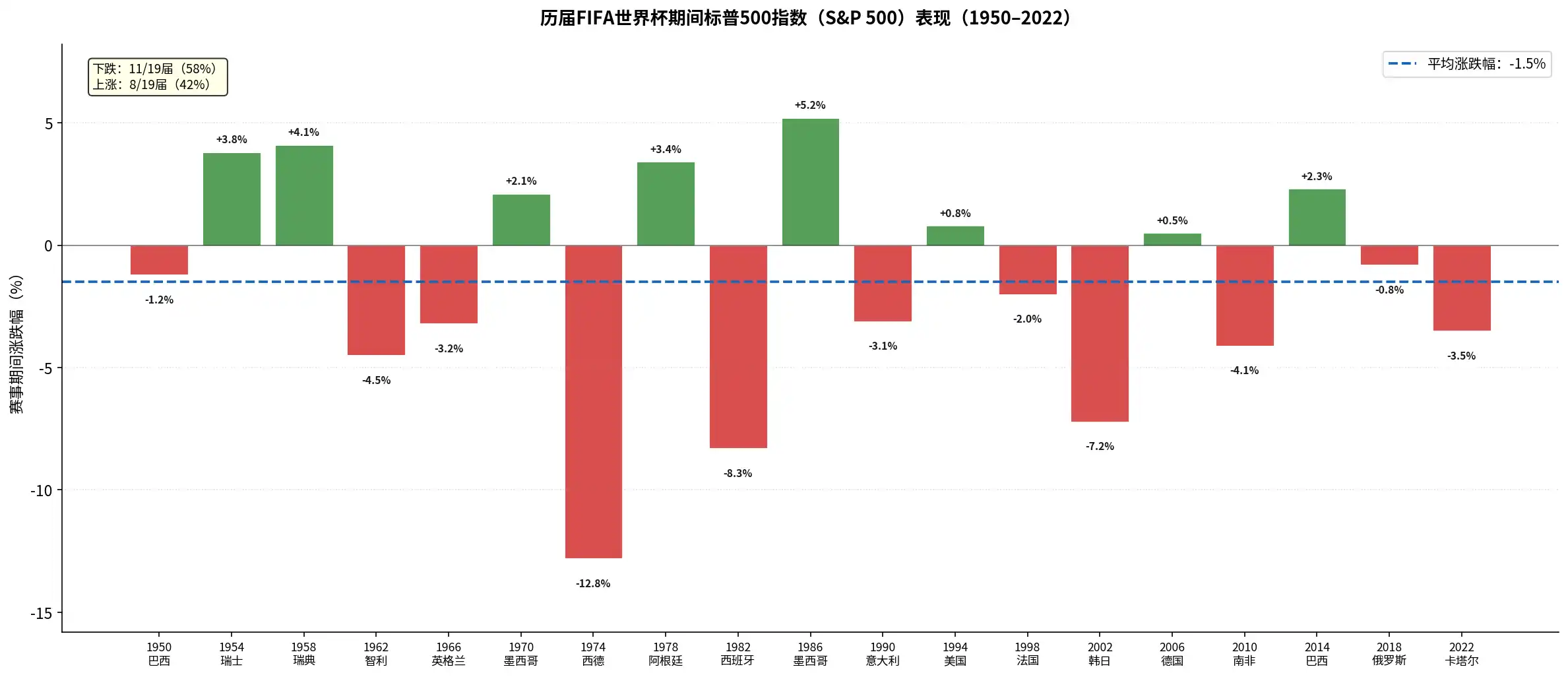
As shown in the figure above, in the last 19 World Cup, the Standard 500 index recorded negative returns 11 times (58 per cent). In particular, in recent years, the United States share has suffered setbacks during the 2010 South African World Cup (-4.1 per cent), the 2018 Russian World Cup (-0.8 per cent) and the 2022 Qatar World Cup (-3.5 per cent)。
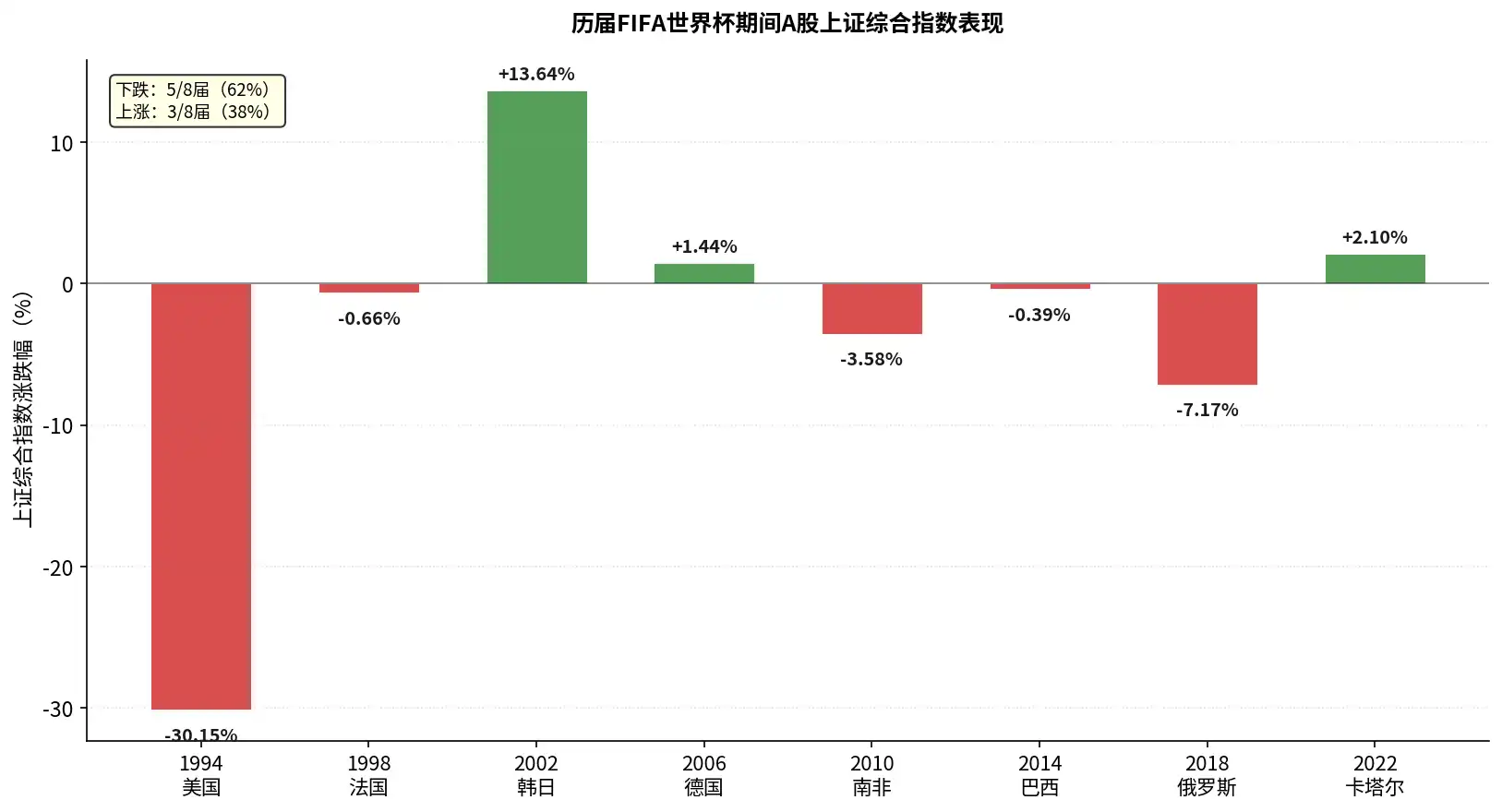
A THE STOCK MARKET HAS ALSO NOT BEEN SPARED. ACCORDING TO STATISTICS, DURING THE SEVEN WORLD CUP SESSIONS SINCE 1994, FIVE DROPS WERE RECORDED, WITH A HIGH PROBABILITY OF FALLING AT 71 PER CENT. AMONG THEM, THE INDEX DROPPED BY 30.15 PER CENT DURING THE 1994 UNITED STATES WORLD CUP AND BY 7.17 PER CENT DURING THE 2018 RUSSIAN WORLD CUP. ONLY IN 2002 (INCENTIVED BY GOOD POLICY) AND 2006 (IN A SUPER-COW CITY) RECORDED AN INCREASE。
And look at the encrypted money market:
- During the 2010 South African World Cup: an increase of about 15 per cent
- During the 2014 Brazil World Cup: by about 7.1 per cent
- During the 2018 Russian World Cup: by about 16.5%
- 2022 Qatar World Cup: an increase of about 4.3 per cent
There's data. Let's analyze the reasons。
The cause of the World Cup Curse
Did the World Cup really have a huge impact on market conditions? It has an impact, but not much。
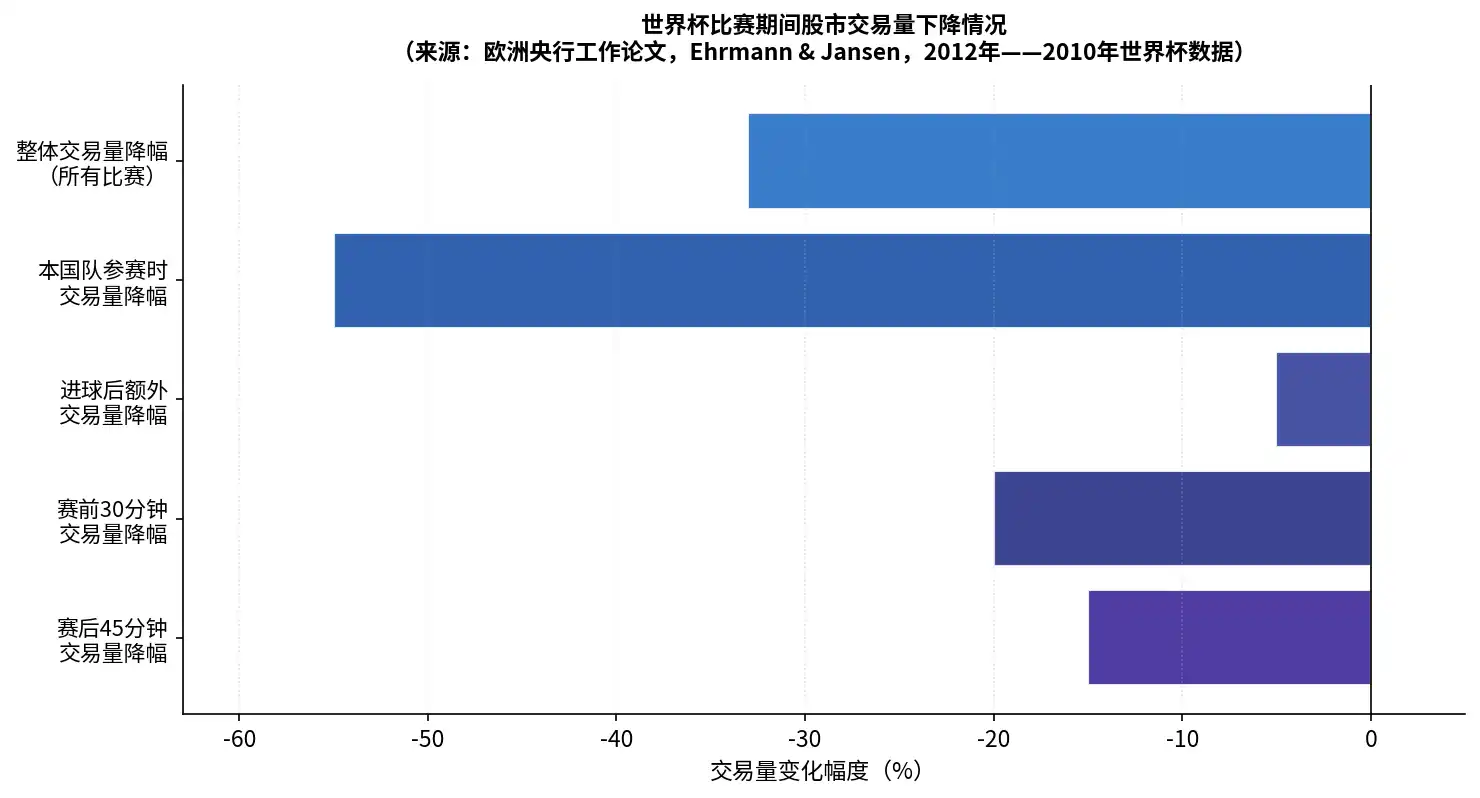
FIRST, LOOK AT THE INFLUENTIAL PARTS. THE EUROPEAN CENTRAL BANK (ECB) PAPER ANALYSED MINUTES OF TRADE DATA FROM 15 INTERNATIONAL STOCK EXCHANGES DURING THE 2010 WORLD CUP. THE STUDY FOUND THAT DURING THE WORLD CUP, STOCK MARKET TRADING DID DECLINE:
- The overall volume of transactions fell by about 33 per cent from normal levels
- When the national team races, the volume drops by 55%, the number drops by 45%
- Key events in the game (e.g. goal) will cause a further 5% drop in trade
The results of the competition will also affect the mood of national fans. The study found that when a country ' s national team loses the game in the World Cup, the stock market tends to show significant negative abnormal returns (up to 49 basis points) on the next trading day. Indeed, this negative sentiment resulting from the loss of competition can spread to investment decisions, leading to market sales。
But why say it doesn't matter? "Sell in May and go away." The stock market itself is seasonal, and the period from May to October is usually the weakest stage of the year (especially June-August). The traditional Summer World Cup (June-July) has just fallen in this light-season window。
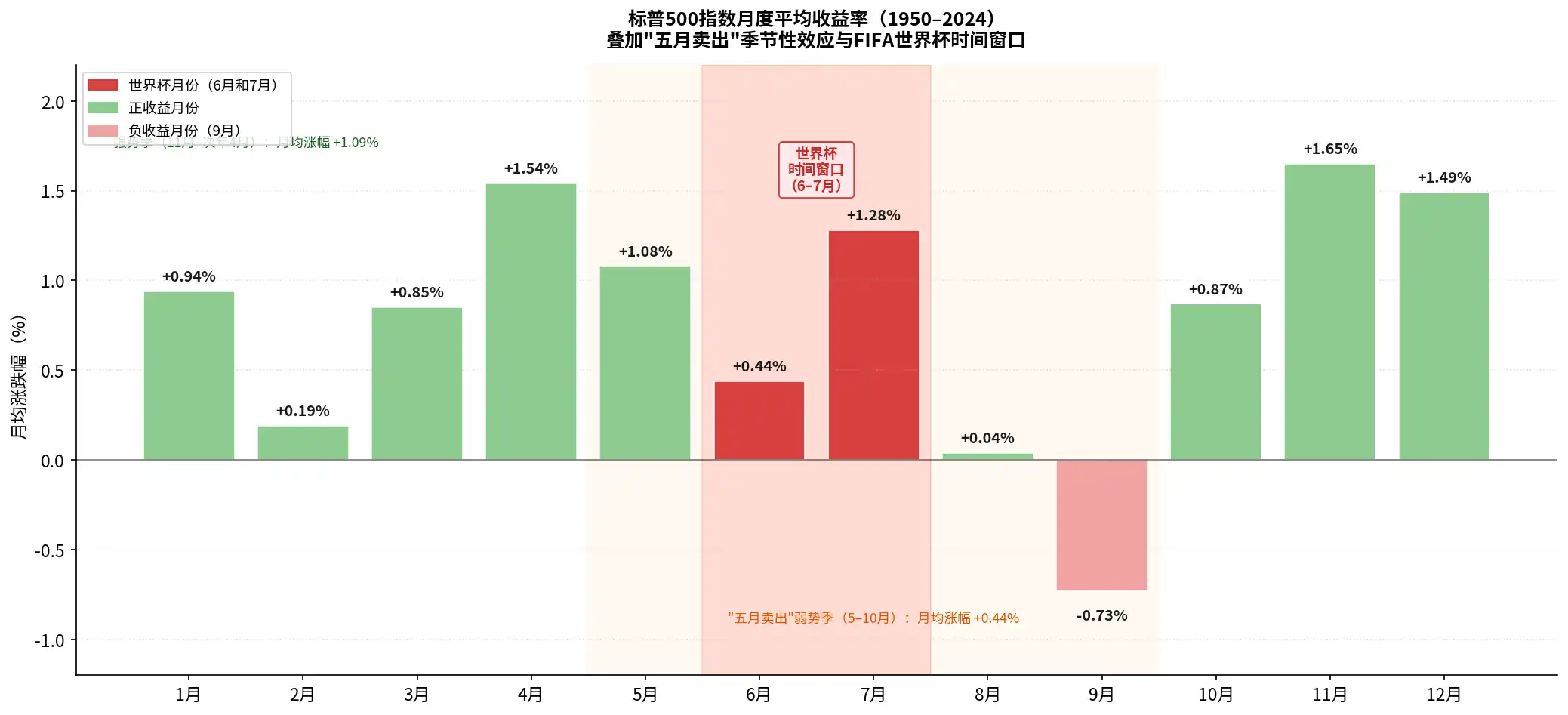
As shown in the figure above, of the average monthly rate of return for the year, June (+0.44 per cent) and August and September are often the months in which the year ' s performance was the most modest and even negative. This means that the traditional Summer World Cup (usually held between mid-June and mid-July) falls just as close to the most dynamic window in the stock market in a year。
The 2022 Qatar World Cup was the first in history to be held in the northern hemisphere during the winter (November-December). This special schedule provides a "control variable experiment" to validate this theory。
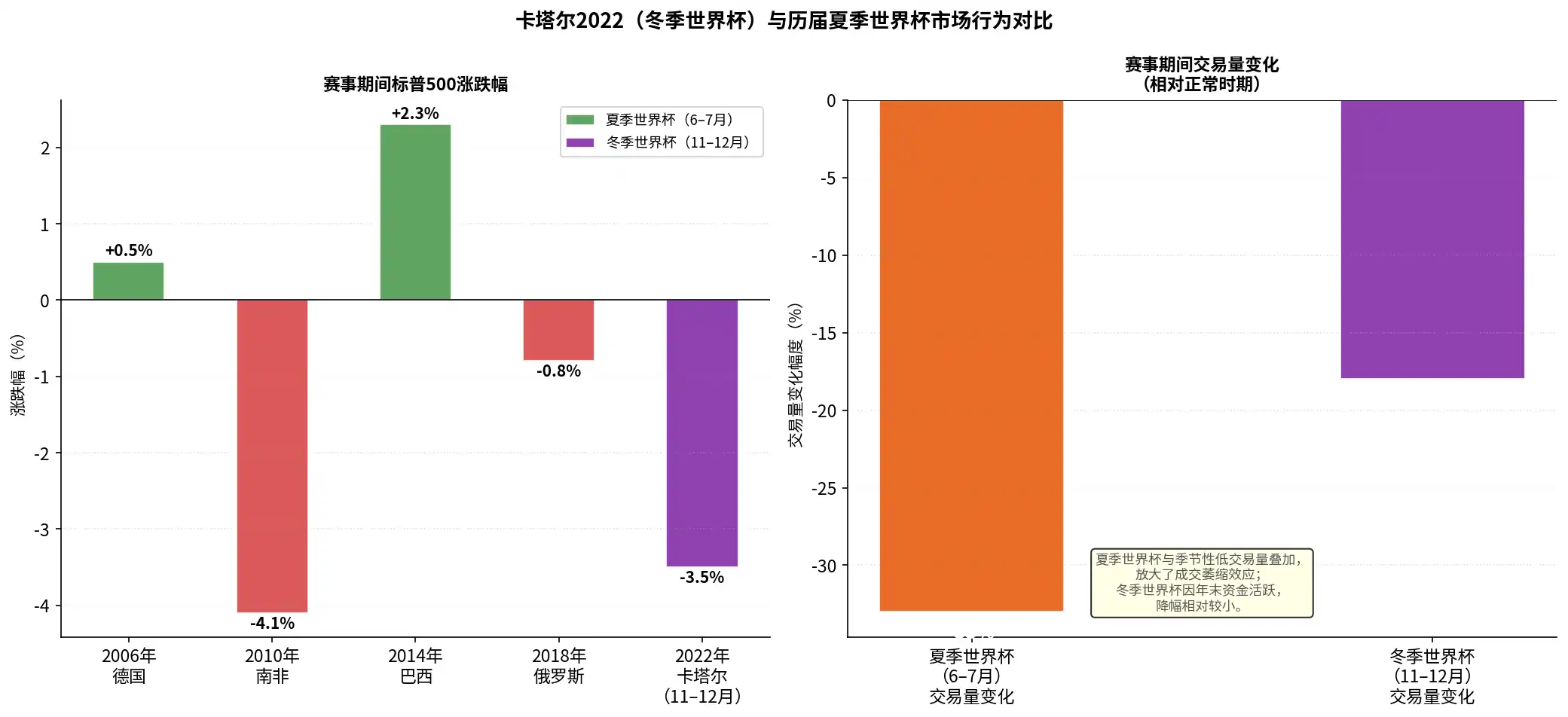
Although during the Qatar World Cup the standard 500 fell by 3.5 per cent (mainly dominated by the macro environment at the time by the US Federal Reserve ' s sharp interest rate hike), the decline in trade during the winter World Cup (about 18 per cent) was significantly smaller than in the traditional Summer World Cup (-33 per cent). This suggests that the pull-out effect on market liquidity will be reduced when the World Cup is out of the summer season. This also contradicts the fact that a large part of the World Cup spell is attributable to the seasonal valley of June-July itself。
An encrypted currency market is more proof than a stock market that the World Cup has little impact on the market. From the birth of Bitcoin to the present, during the four World Cups, it was possible to find more immediate catalysts:
- 2010 South African World Cup: On May 22, 2010, there was a familiar story: programmer Laszlo Hanyecz bought two pizzas with 10,000 bitcoins, completing the first real commodity deal in the history of Bitcoin, which gave it an initial consensus of real value. On the third day after the end of the World Cup (17 July 2010), the famous Mt. Gox Exchange officially went online, marking the entry of Bitcoin into the age of organized trading。
- During the 2014 Brazilian World Cup: Bitcoin at this time is in the bear market after the 2013 collapse of Bull City (high-point breakthrough $1100). In February 2014, the world ' s largest Bitcoin Exchange, Mt.Gox, was declared bankrupt for the loss of hundreds of thousands of bitcoins as a result of hacker attacks, devastating the entire industry. During the World Cup, market sentiment remained fragile. In addition, on June 27, the United States Department of Justice publicly auctioned nearly 30,000 bitcoin seized from the Silk Road, further exacerbating the market's pressure and uncertainty。
- During the Russian World Cup in 2018: the bear city adjustment period after the completion of the cattle market in 2017. At that time, the ICO bubble burst and global regulation was tightened. While the World Cup was going on, the encryption market continued. On June 22, the Korean mainstream exchange Bithumb lost $30 million in hacking. In early July, the US SEC again postponed/rejected several bitcoin ETF applications。
- 2022 QATAR WORLD CUP: EARLY NOVEMBER 2022 (ONE WEEK BEFORE THE OPENING OF THE WORLD CUP), FTX CRASH. AT THE SAME TIME, ON DECEMBER 13, THE FED ANNOUNCED AN INCREASE IN INTEREST RATES BY 50 BASIS POINTS, AND MACROECONOMIC LIQUIDITY CONTINUED TO TIGHTEN, ADDING TO THE SITUATION。
it should also be taken into account that bitcoin, as an asset traded around the globe for 7x24 hours, is relatively less affected by the seasonal effects of traditional leave periods and that the “half-of-a-year cycle” is strong. the effects of the world cup can be said to be largely insignificant in the face of macro mobility and its own cyclical nature。
Investment opportunities during the World Cup
Over the past two decades (2006-2026), with advances in science and technology and changes in consumption habits, the map of the beneficiary industries of the World Cup has changed。
We used to watch the World Cup on TV, and during the 2006 and 2010 World Cups, traditional colour power and top box manufacturers often received significant excess returns。
By the time of the Russian World Cup in 2018, however, while traditional television broadcasting rights still accounted for a large share of revenue, the excess earnings of colour and electricity companies had fallen to zero. By 2022, the domestic lottery market had not increased or declined during the World Cup, the volume of the industry had fallen, and the stock prices of the relevant listed companies had been lost。
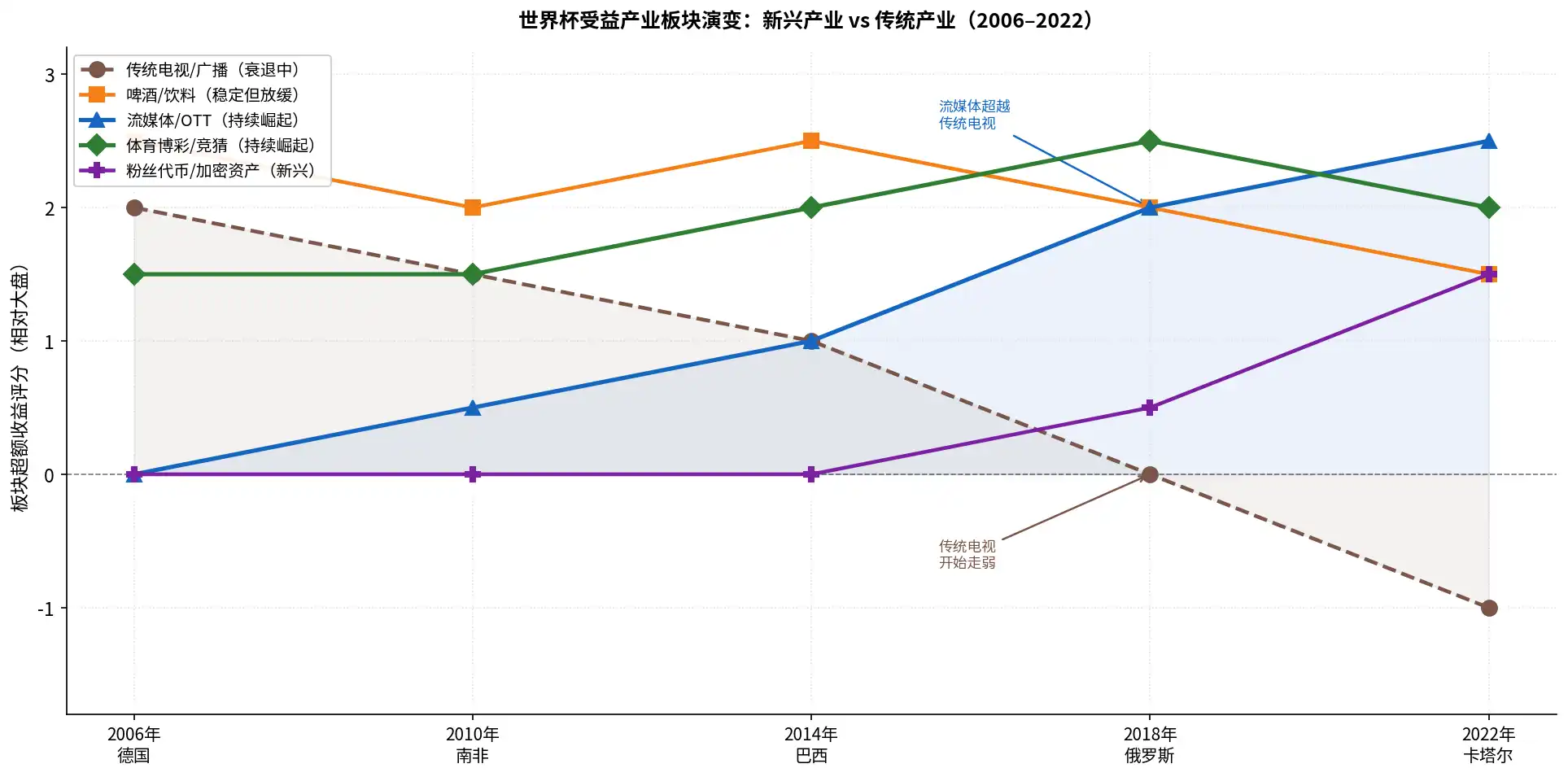
Fluent media have officially replaced traditional television as a central channel for the World Cup. In 2022, the World Cup in Qatar reached an all-time high in the media. If you look at the ratings of the World Cup, perhaps more attention should be paid to the flow of media companies that have exclusive transmission rights and can translate into income。
Beers and sports items (e.g. Nike, Adidas) are classic consumer goods for the World Cup, and their plates have performed well throughout the World Cup, but they have also faced the challenge of slowing growth in recent years。
Data from the Investment Bank Jefferies show that during the 2006 and 2010 World Cups, global beer sales increased by 3.6 per cent. However, IWSR data show that global overall beer consumption actually declined by 3 per cent between 2014 and 2024, with the younger generation more inclined towards low alcohol or non-alcoholic drinks。
In other words, the beers stock in the Budweiser and Qingdao are not out of the question, but the new beverage stock, the new-style bar that is more popular with young people, and so on, may be good。
Young people may also prefer a ballboard card to a sneaker, which instead highlights the advantages of the chain. In the case of Grail, a platform of fragmentation cards in the Base chain, the price of the C-Roca token has risen almost 100 times since May 5, and the price of the Mbapeca token has increased almost 300 times since May 5。
Sport fairs are also part of the classic World Cup, but market growth is also forecasted to be very rapid, although they are not yet the subject of much better investment forecasts。
Concluding remarks
For the sake of the World Cup experience, it's a good choice to get out of the market and relax。
In 2010, Israeli economists Guy Kaplanski and Haim Levy published a study in the Journal of Finance and Quantitative Analysis, which included more than 261 references:
“The average return on the United States stock market during the World Cup period was -2.58 per cent, while the average return on all trading days over the same period was +1.21 per cent. The most natural investment strategy is to make empty stocks before the World Cup begins, which will further reinforce the downside effect of stock prices.”
While there have been no famous events that were cleaned up directly as a result of the World Cup, the World Cup window period is indeed a bad time period. Whether or not the specific reasons for market events are directly linked to the World Cup, enjoying the World Cup itself is perhaps the best defensive gesture in a period of weaker market mobility。
