
The Mask Wire is here
Four years ago, the "Western Super App" ambition finally fell。
Original by Jo Wing
Original source:See you on Wall Street
Mask conceived three years of super-app ambition and finally landed from vision to product。
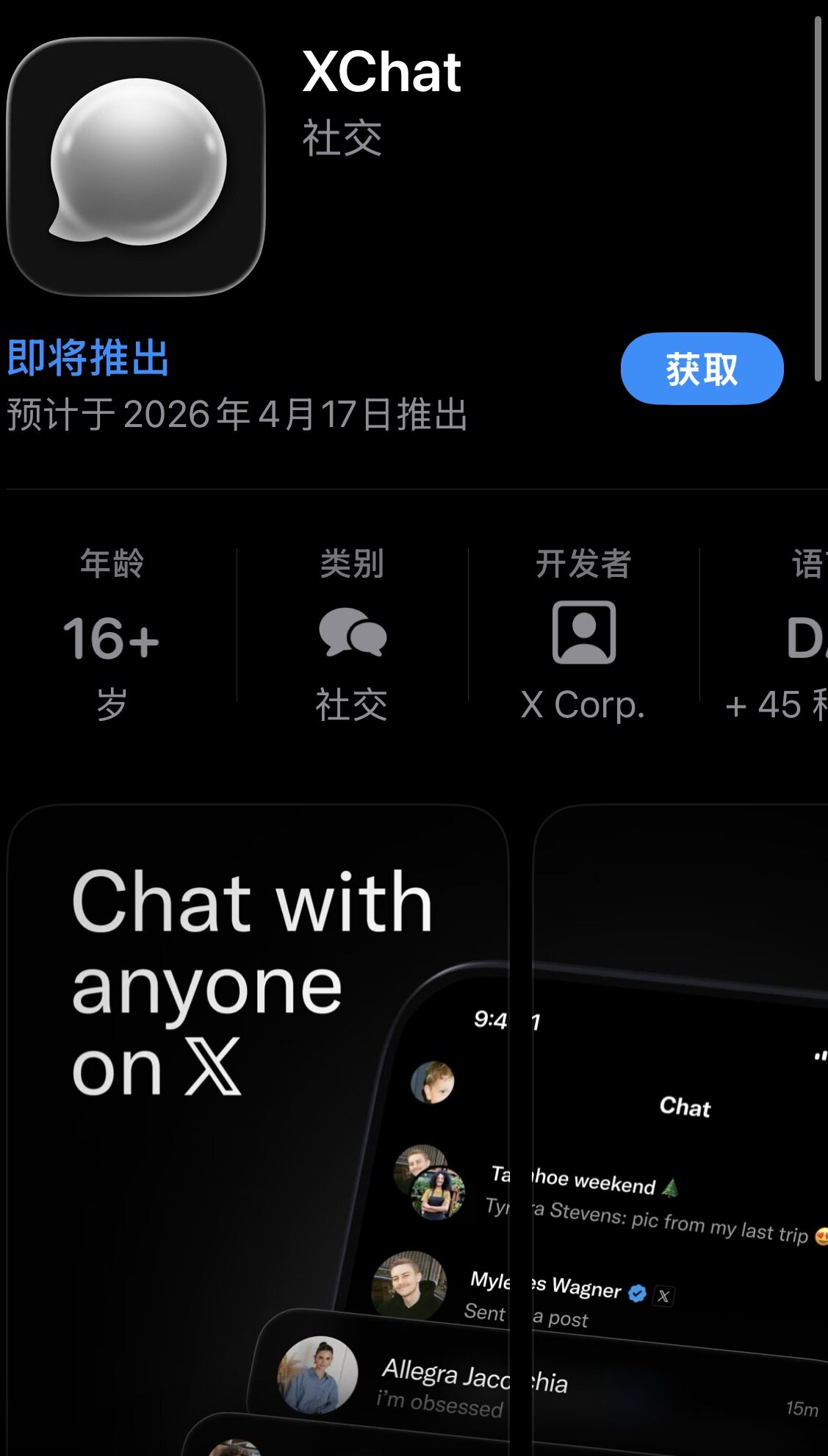
On April 11, the Mask-based X platform officially announced that XChat, an independent encrypted communications application, would land Apple Store on April 17 and be available for download to users worldwide。
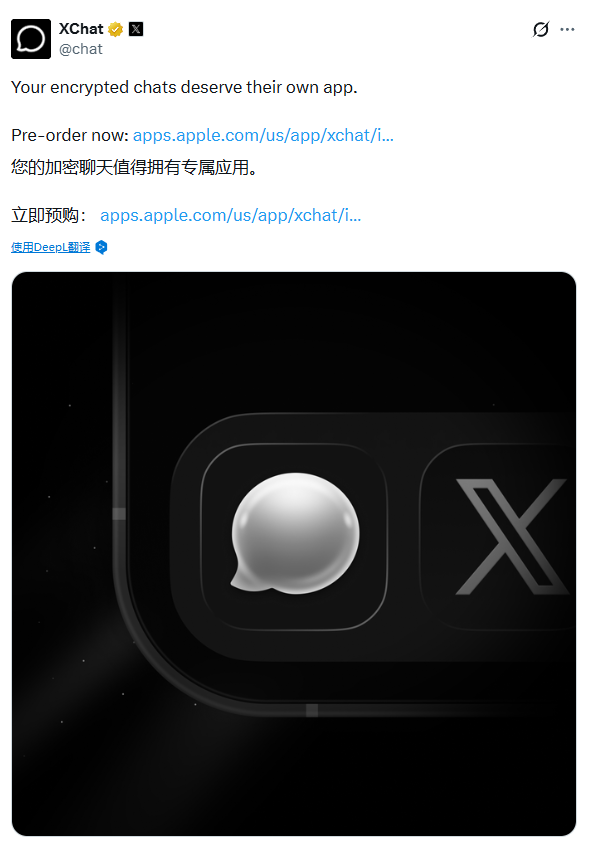
This application is based on end-to-end encryption, deep integration of the Grok AI large model, registration without cell phone numbers, and direct binding of X account log-in — which is widely regarded by the outside world as a key step in Mask's plan to create a “Western version of the micro-letter”。
It is a matter of concern that XChat supports Chinese and that App Store of mainland China can also be downloaded via direct link appointment. The application required equipment upgrades to iOS/iPados 26.0, and the Android version was expected to be rolled out later。
Four years of commitment: from a tweet to a product
Mask's public commitment to the Super App model dates back to 2022 when $44 billion was spent to complete the Twitter acquisition. He has expressed, in many public places, a high level of acceptance of micro-credit models – Chinese users need only one App to complete all their daily needs for socialization, payment, shopping, travel appointments, while Western users have to switch over and over again a dozen fragmented applications。
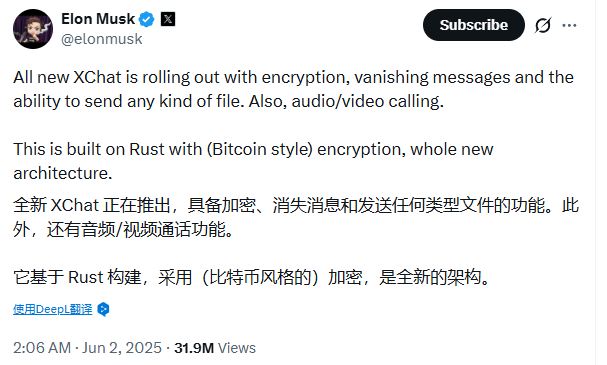
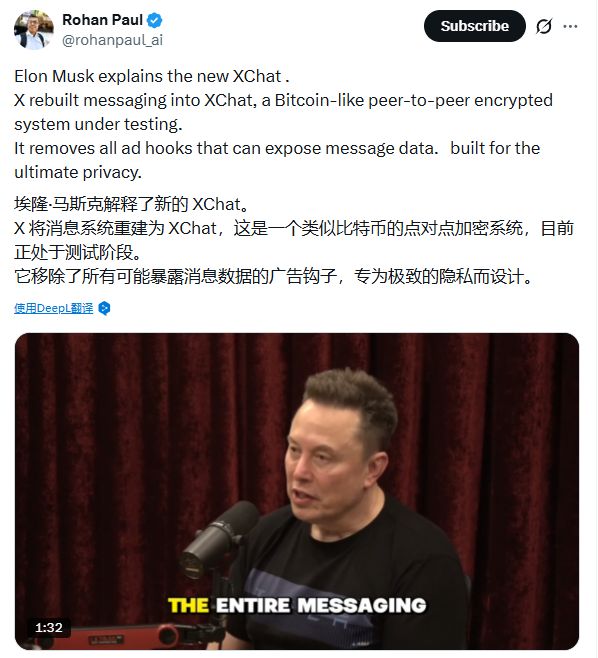
Last June, Mask announced the XChat development plan at platform X, explicitly referring to the core functions of encryption, reading and burning, file transfer in any format, audio and video calls, and disclosing that the application is based on Rust language, using a "bitcoin-style encryption" structure。
In previous podcasts, he further criticized the existence of commercials such as the WhatsApp, which are known to have enough information to advertise and essentially to monitor users。
Technical base card: whether encryption structures fulfil privacy commitments
The core technology selling point of XChat lies in the design logic of its encryption system. Application of Rust language development - this programming language is known for memory security, and technological giants such as Microsoft and Google have moved parts of the core system code to Rust to reduce the risk of security incidents caused by memory gaps。
AT THE LEVEL OF ENCRYPTION ARCHITECTURE, THE "BITCOIN-STYLE ENCRYPTION" DESCRIBED BY MASK POINTS TO AN END-TO-END ASYMMETRIC ENCRYPTION SYSTEM. UNDER THIS STRUCTURE, MESSAGES ENCRYPTION KEYS ARE STORED ONLY AT THE LOCAL FACILITIES OF THE COMMUNICATION PARTIES AND THE SERVER IS UNABLE TO INTERPRET ANY CHATS. THIS MEANS THAT EVEN IF X COMPANY SERVERS WERE ATTACKED OR WERE REQUIRED TO PROVIDE USER DATA TO AN OUTSIDE BODY, WHAT COULD BE HANDED OVER WAS SIMPLY AN UNRECOVERABLE ENCRYPTION DISORDER。
There is also an official commitment not to advertise and not to track user data. XChat also has privacy functions such as post-exit incineration, two-way withdrawal, interception diagrams and amplification alerts, which have outperformed most mainstream communications applications in terms of the functional particle size of privacy protection。
Functional matrix: a communications portal that tries to integrate everything
In terms of functional coverage, XChat provides a one-to-one chat and a large group of up to 481 people, supports text, pictures and file transfer in any format, and Premium users can send up to 4GB files one time and support high-resolution video calls。
Access to the X platform ecology is another key design: the user can drag a tweet or video from X directly into the chat dialogue and minimize the operational friction of content sharing. The logic of Mask's construction of the "Super App moat" became clear: When social content, communication records and media consumption are all brought together in the same ecology, the cost of moving users will increase significantly。
In addition, XChat Depth is a large model under xAI, which allows users to call on log directly in the chat interface to process documents, organize documents, plan their processes and answer questions. The chat box thus evolves from a simple text input tool to a private AI assistant with context understanding skills。
However, this is also the functional node with the most external concerns about XChat's privacy - AI's involvement in private dialogue and the manner in which the relevant data are handled, which is not yet fully publicly disclosed。
Competition patterns: looking for space between the three mountains
XChat enters the track of a powerful forest. Signal has built near-religious trust in the private communications user community by targeting open-source, non-profit, non-commercial liquidity pressures; WhatsApp has more than 2 billion live users, and barriers to network effects are extremely difficult to shake; Telegram has a high degree of functional overlap with XChat and has built up a large community user base。
XChat has two different paths for the current bet: the depth integration of the Grok AI and the synergy of the X platform ecology. Whether the former can really change the user's communication habits depends on the actual capability boundaries of Glock and the degree of user acceptance of AI's involvement in private conversations; the latter rely heavily on the size and activity of the X platform itself - And this is precisely the most controversial variable in the world since Mask took over Twitter。
The more long-term blueprint for Mask is to build on the communications function to add payment and service ecology, and eventually to realize what he conceived as the Western version of "everything App". But the current form of XChat is still a long way from this goal, now closer to a combination of a "pure Telegram plus Grok AI" product. Whether the continuous expansion of functionality will maintain the fluidity of applications and avoid the trap of "swollen superapp" will be a key test of XChat's ability to retain users in the long term。
