
Do robots replace humans? He said no
Robots don't replace humans, but rewriting the division of labour
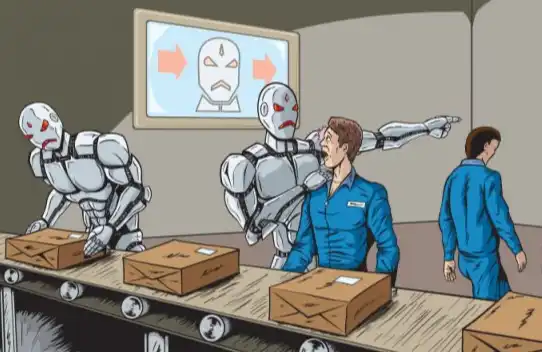
Original title: The Human Advantage in the robotics Review
Original by: Sumir Meghani, Instawork Romanics Labs (IRL)
Photo by Peggy Block Beats
EDITOR: WHEN MOST PEOPLE ARE STILL TALKING ABOUT WHETHER ROBOTS WILL REPLACE HUMAN WORK, THE PAPER ARGUES THAT HUMAN BEINGS ARE NOT BEING REPLACED, BUT ARE BECOMING AN ESSENTIAL INFRASTRUCTURE IN THE "PHYSICAL AI" SYSTEM。
The core bottlenecks in the current industry are not in algorithms or hardware, but in "data and landing capacity". Robots need to complete their training by observing skilled human operations in the real environment, but high-quality, diverse physical world data are extremely scarce, resulting in the so-called 100,000-year data gap. This has also led to the re-emergence of a category of long-neglected capabilities — skilled, mobile and verifiable human labour。
In this framework, the role of human beings has been dismantled: it is the "data source" of the training machine, providing standardized and identifiable operations; it is the "field nodes" that support the operation of the system, carrying out maintenance, maintenance and remote manipulation; and it eventually enters a "man-operator collaboration market" connected to the platform, making it a necessary condition for robotic mass landing。
IN FACT, TECHNOLOGICAL CHANGE WOULD NOT ELIMINATE LABOUR, BUT WOULD RESHAPE THE DIVISION OF LABOUR. FROM ATM TO THE INTERNET, EVERY TECHNOLOGICAL LEAP IS ACCOMPANIED BY ANXIETY ABOUT EMPLOYMENT, BUT IT IS OFTEN CHANGED NOT BY "NO JOBS" BUT BY "HOW JOBS ARE REDEFINED". DURING THIS CYCLE OF TECHNOLOGY REPRESENTED BY HUMAN-TYPE ROBOTS, THE SAME PATH IS BEING REPEATED: MISSIONS ARE BEING DISMANTLED, CAPABILITIES STANDARDIZED, JOBS REORGANIZED AND NEW JOBS CREATED。
The real opportunity lies not in "replacement," but in building a bridge that transforms human capabilities into measurable data, transport systems and collaborative networks。
The following is the original text:
A year ago, I asked a question that may be unusual for the labour market: What happens to professionals on our platform when the robot arrives
Our vision is to create economic opportunities for the global Pros and partners. Today, more than 10 million Pros depend on us for their livelihood, and many of them are already thinking the same thing. We have a profound responsibility for this and must give an answer。
At the same time, we have observed an unexpected phenomenon: Some robotic companies have begun to appear on our app platform, working with our Pros. They need people with professional experience in robotics training missions, as well as a variety of business scenarios — the environment in which robots will be deployed in the future. And what they rely on is the kind of workforce we've been building。
At that moment, everything suddenly became clear: Instawork could provide a human labour force for the "physical AI economy."。
"A hundred thousand years of hard work."
Ken Goldberg summed up the issue as a "100,000-year digital divide": on the one hand, big data for training language models and, on the other hand, very limited and highly specialized data for training robots to perform fine operations in the physical world。
Note: Ken Goldberg is an influential scholar in robotics and artificial intelligence, as well as an artist and interdisciplinary researcher
It is this divide that, despite the billions of dollars that continue to flow into robotic companies, we have yet to see human robots cleaning their rooms in hotels or unloading their cargo in warehouses ... At least not yet。
Our estimate is that the entire industry collected approximately 100,000 hours of training data in 2024; by 2025, this figure had increased to 1 million hours; and by 2026, it was expected to reach 20 million hours. This is an exponential increase, but even so, only 0.04 per cent of the gap has been closed。
AN INCREASING NUMBER OF COMPANIES ARE JOINING THE COMPETITION IN AN ATTEMPT TO BUILD HUMAN OR UNIVERSAL ROBOTICS: THE BASIC MODELLING LABORATORY IS DEVELOPING VISUAL-LINGUISTIC-ACTION (VLA) MODELS, HARDWARE COMPANIES ARE BUILDING PHYSICAL MACHINES AND INTERMEDIATE PLAYERS ARE EMERGING. CAPITAL INVESTMENT HAS REACHED TENS OF BILLIONS OF DOLLARS. ALL THESE PARTICIPANTS FACE THE SAME BOTTLENECK: DATA。
But the point is, we've actually seen it before。
WHEN ATM APPEARED, ALMOST EVERYONE PREDICTED THAT THE BANK CLERK WOULD DISAPPEAR. BUT THE RESULT IS THE OPPOSITE — THE NUMBER OF CLERKS HAS INCREASED. ATM REDUCED NETWORK COSTS AND ENABLED BANKS TO OPEN MORE BRANCHES, WHILE THE ROLE OF THE CLERK SHIFTED FROM COUNTING MONEY TO MAINTAINING CUSTOMER RELATIONS。
This pattern is repeated in every major technological change: the industrial revolution, electrification, the Internet. New technologies do not eliminate jobs, but rather reshape them and create new opportunities。
A new wave is coming, but this time it looks more like ourselves: having arms, legs and eyes。
THE THREE ACTS OF PHYSICS AI
Act I: Training robots
Over the past year, I have actively contacted and consulted some of the best people in the field of robotic learning worldwide — from researchers, lab leaders to entrepreneurs who build smart robots and even complete human-type robots. I am impressed by their generosity in sharing time and insights. Frankly, we weren't part of the industry; but the more I heard, the clearer I saw the space that Instawork could access。
One view has been repeatedly mentioned: robots learn by observing skilled human beings and performing fine physical tasks in the real environment. This means moving from regular cutlery to passing through densely populated warehouses to branding hotel beds. The problem is that it is extremely difficult to collect such data in high quality — you can't just put a camera on a person and start recording. Data must cover diverse environments, tasks and hand movements; and, more critically, those carrying out these tasks must be truly professional. Otherwise, robots trained with "bad knife workers" will only learn "bad knife workers."。
This is essentially a labour force operation: how to recruit skilled workers, train them, guarantee quality of output and manage a distributed labour network in different geographical areas and scenes — what we have been doing. We have over 10 million skill-tested Pros, covering hundreds of task types; we have in-depth relationships with partners that allow us to access real business scenes; and we have data on those who can achieve steady attendance and sustained high-quality work. This combination is one that no data collector company can replicate from zero. In fact, many laboratories have come to us spontaneously, and we are now working with most of the head teams in the field。
Act II: The rise of the robot trainer
One thing is often overlooked: robots need people。
The executives of a leading robotic company told me that they had a key component that needed to be replaced every 4-6 months — not enough frequency to have a full-time technician, but high enough to cause a significant loss once the plane was shut down. With the proliferation of automatic driving, distribution robots and various types of automated deployments, a growing number of companies face similar problems: expansion requires on-site support, but full-time staff in each market is not economically realistic。
We have initiated pilot projects with several robotic companies covering services such as battery replacement, parts replacement and robotic maintenance. At the same time, we have established a robotic certification system for hourly workers — the first attempt in the industry. In the first few weeks alone, over 20,000 Pros have been certified。
At the end of the data collection, the certified Pros will learn how to operate a wearable camera, collect high-quality video, label sensor data -- When robotic laboratories need to record a few hours of bedmaking in a real hotel suite, they get professionals, not "learning by learning". At the technical support end, Pros will have hardware diagnostics, safety codes and maintenance processes for specific robotic systems。
A scenario is envisaged where a logistics company deploys an automated robotic fleet in over a dozen warehouses. At 2 a.m., there was a navigation error in the robot in the Memphis warehouse or a replacement sensor module was required for a device in Phoenix. It is no longer necessary to wait for factory technicians to arrive at the site in a few days, and a certified Instawork Pros can arrive and solve the problem within hours. At the same time, we are developing VR-based remote manipulation training to support laboratories to break the limits of simple on-site recording as data collection expands。
IF BILLIONS OF AI DEVICES ARE TO BE DEPLOYED OVER THE NEXT DECADE, THE OPPORTUNITY LIES NOT ONLY IN MAINTAINING THEM, BUT ALSO IN CREATING NEW OCCUPATIONAL CATEGORIES: ROBOT TECHNICIANS, MOTORCADE OPERATORS, REMOTE OPERATORS, AND EVEN NEW JOBS THAT WE HAVE YET TO NAME。
Act III: The Market for Human Cooperation
LAST YEAR, I HAD LUNCH WITH THE CEO OF A MAJOR GLOBAL HOTEL GROUP. THEY ARE CAREFULLY CONSIDERING HOW TO ENHANCE CONSISTENCY IN ROOM SERVICES THROUGH AUTOMATION. A LARGE NUMBER OF ROBOTIC COMPANIES WANT TO ENTER THEIR HOTELS TO DEPLOY THEIR PRODUCTS, BUT THEY HAVE DIFFICULTY JUDGING -- WHAT'S A "DEMONSTRATION" AND WHAT'S A REAL "BUSINESS RESULT." AND WE ARE FAMILIAR WITH THESE SCENES, PROCESSES AND PAIN POINTS — BECAUSE WE ALREADY SERVE IN THESE PLACES。
We're building a "robots service market" -- linking robotics to the automated companies that are ready to deploy. We are already serving both supply and demand, which means that we are not just a match, but that we can really push down。
The future is not "robots replace human beings" but "robots work with humans". This is exactly what the Instawork Robotics Lab aims to achieve: three capabilities, one platform — training robots, supporting them in the real world, and connecting them to a business scene that really needs them。
Bridges
In every major technological change, the question is never whether new jobs will be created — the answer is always yes. The real question is: who will build the bridge between the present and the future。
We are convinced that skilled human participation is required at every stage of the process — from training first-generation robots to deploying large-scale systems to designing future human processes. We hope that the Pros on the platform will go through the whole process。
In the "Physics AI Revolution," Instawork wants to be the bridge: to build deep experience in the most influential industries; to provide training data for robotic laboratories; to develop certification skills for data collection and on-site operations; and to build a market that links robotics to business needs。
We look forward to the next phase。
[ Chuckles ]Original Link]
