
OKX Exchange OS returns the trading market from "centralization" to "market"
If Web3 solves the problem of who can issue assets, Exchange OS solves the problem of who can create markets。
SOURCE: OKX
Thousands of years ago, the market was right. Two people met at the fair, one with food and one with fabric, and then made a deal without anyone's approval. Markets are spontaneous and pricing rights are in the hands of both parties。
Subsequently, there was an intermediary in the market, with power transferred from each of the stallors to a few large trading places. Stock exchanges, commodity exchanges, regulators, clearing houses determine what is tradable, what is not, who is qualified to open a market and who is not。
After the emergence of the block chain, the user and the user can trade in a point-to-point, and the assets can flow freely along the chain and no longer need to be centrally endorsed. But the reality is that even on the chain, the question of who can create a market is left to a few platforms and agreements. You want to open a permanent contract market? Either build a set of blended engines, a deposit system, a clearing logic, or hand over your market to a platform for approval and for pricing rights and users。
OKX released Exchange OS today, and all I want to do is change it completely:The right to open the market is restored to all。
Exchange OS how to restore the market
Exchange OS is an open protocol infrastructure based on X Layer. Combination, bonds, clearing, clearing, unification of accounts, the core capabilities of these exchanges, Exchange OS, transform them from a closed platform product to a protocol layer that anyone can access. In other words, it is not an exchange, but an infrastructure that can be used to build any exchange。
Let's take a more intuitive analogy: the role of Exchange OS in the financial market, the role of HTTP in the Internet world. HTTP has opened up the communication protocol, which allows anyone to build a website and service without having to build an agreement, build a server, build a router; and Exchange OS, which is the same open floor, where anyone can open a market。
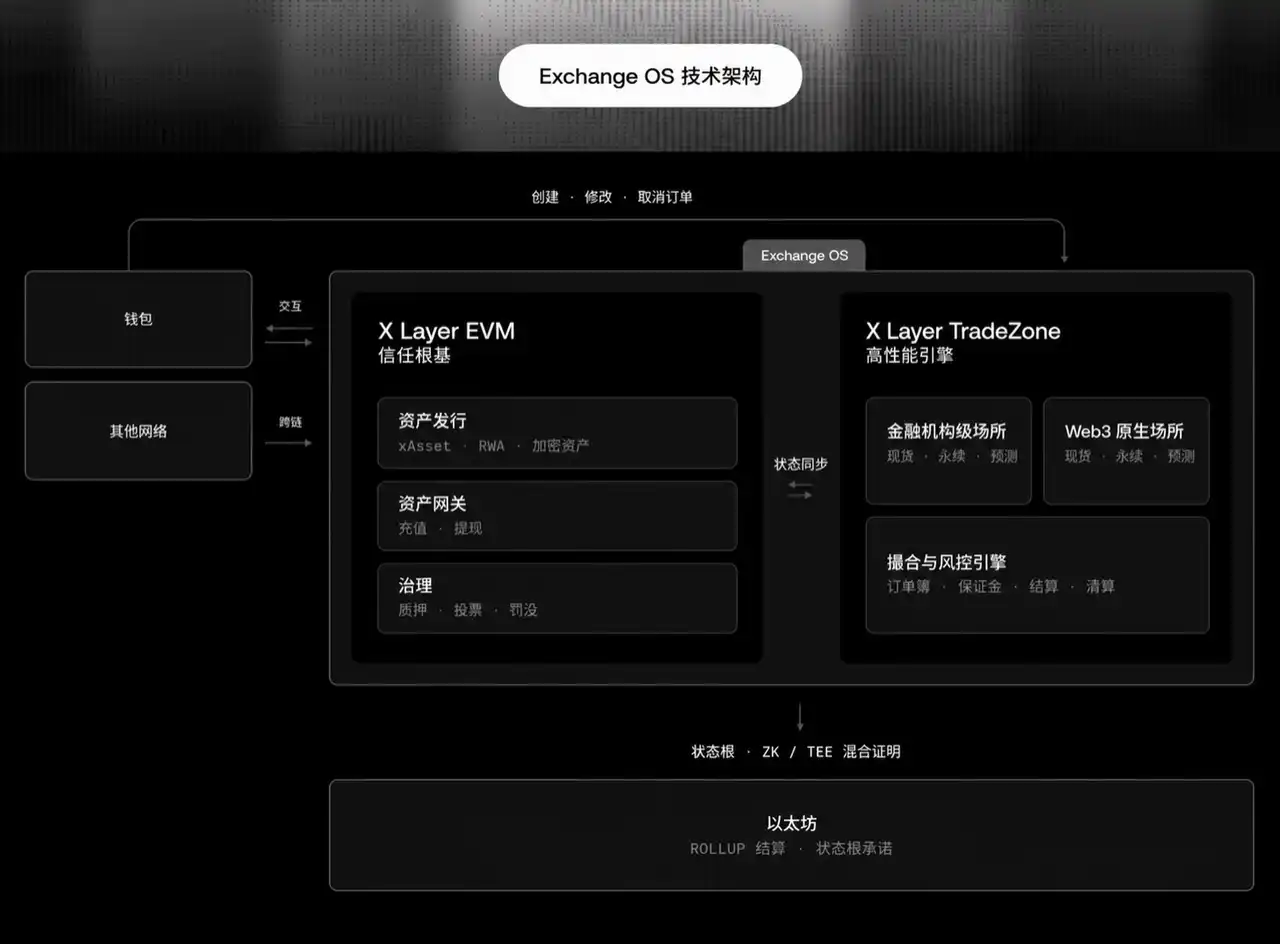
If you want to create a market, as long as you pledge X Layer ' s core assets, you can deploy your own market on Exchange OS, including spot, renewal contracts, forecasting three markets, without applying to anyone, and without waiting for any platform. The core competencies of all exchanges, such as engines, bond systems and clearing mechanisms, have been installed at the protocol level, and you can call directly, save time and energy and focus on the market you want to do
THOSE WHO OPEN THE MARKET CAN BE QUANTITATIVE TEAMS, RWA INSTITUTIONS, NEW PUBLIC-CHAIN PROJECTS, OR ANY INDIVIDUAL WHO DISCOVERS A TRANSACTION DEMAND AND WANTS TO TURN IT INTO A REAL MARKET。
Different deployments can be based on a market in which Exchange OS deploys in different forms. Some choose to embed the market into CEX App, with one key entry for the user, and experience and traditional exchanges; others choose to allow users to use their own safe wallets directly to maintain full chain autonomy. The two patterns are shared behind the same set of agreements, with consistent rules and infrastructure. Deployment can be selected by the operator on the basis of his/her judgement of users and compliance, and OKX provides only infrastructure and does not anticipate or endorse any specific compliance model。
One account runs through all markets
For ordinary users, the most direct change brought about by Exchange OS is the significant increase in account experience。
Today, a dynamic chain trader is often operating in multiple places: to go to Polymarket to participate in the forecast market, to open a perp contract at DEX and to buy cash on the exchange. Accounts were segregated, funds were segregated, bonds could not be used across borders, and once new markets came out, funds needed to be reallocated to new accounts in new markets。
This experience is sort of like a social platform without connectivity: you have a list of attentions in Twitter, another set in X, and a new one in a little red book — re-registered, re-engineered, re-engineered, re-connected, and re-engineered for the same thing. Web3 Society was trying to solve this problem: using the social map of the chain to sink identities and relationships, an identity, a relationship of concern, common to all platforms, you maintain it once, everything works。
Like Web3 socializationExchange OS is doing "unified identities and funds" in the trading worldI don't know. One account, one fund, which can run cash, continue contracts, forecast three markets, and is managed centrally at the level of the agreement. You are involved in multiple markets at the same time, do not need to transfer back and forth, do not need to manage multiple accounts and do not need to repossess money at every new market line. You covered all the markets with your energy to maintain an account。
For professional traders, this implies a fundamental increase in capital efficiency. The same amount of money is no longer tied to the accounts of different platforms, but can serve multiple markets and strategies at the same time. The return of funds to the same level of contractual hedge with the same bond as the corresponding target while participating in a forecast market is almost impossible until today, and is supported in the Exchange OS。
Anything that can be verified can become a market
For those who want to open a market, Exchange OS offers another possibility。
IMAGINE A COUPLE OF SCENARIOS: A USER FOCUSED ON ENCRYPTION, WHO THINKS THAT THE QUESTION OF WHETHER "SOME L1 CAN GO BEYOND THE ETHER HOUSE THIS YEAR" DESERVES TO BE PRICED; A RWA AGENCY, WHO WANTS TO MAKE A TRADEABLE SHARE OF A PRIVATE FUND; AND A QUANTITATIVE TEAM, WHO FINDS ARBITRAGE IN AN ETERNAL CONTRACT WITH A SMALL CURRENCY, WANTS TO OPEN A MARKET。
How can they do that? Either a complete system is built on its own, with huge amounts of engineering and often affordable only by head agencies. The platform either works together, but it has its own auditing logic, go-live cycle, split requirements and is not necessarily willing to be a small market. Despite demand, markets have been delayed。
Exchange OS directly missed this threshold: users can turn hotspot events into forecast markets, communities can turn topics into tradable judgements, and institutions can turn assets into chain markets。Everyone does what they do best, and the infrastructure problem is left to Exchange OS。
In the past, what can be traded is left to the platform to decide. It is mainly the hundreds of coins, occasionally added to a few derivatives, and the small demand often does not wait for a chance to rise. Now, as long as an event is verifiable, theoretically it can become a market on Exchange OS. For the first time, the boundaries of the market are defined not by the platform, but by the boundaries of verifiable events in the real world。
The ecological implications are that the number and variety of markets will no longer be subject to the operational capacity and willingness of a platform, but will be driven by real market demand. Where someone wants to trade, there's a market。
Give the funds to the code
Any article that discusses the opening of markets can't get around a question: is it safe? This problem is particularly acute in the encryption market. Over the past few years, too many platforms have attracted users to deposit their assets in the name of "decentroization" and have finally taken away money in various ways. Users are beginning to realize that a platform that says it's safe and that it's really safe is completely different。
The answer to Exchange OS’s question is that user funds are locked in a contract and no one can access them unilaterally, including those who set up the market and OKX itself. It is not by trusting an institution, but by code and protocol rules. Agreements are open and transparent, and anyone can audit every line of logic。
In the worst case scenario, one of the deployers opened up a poor-quality market rather than running a platform to roll your money away. These two risks are completely different in nature: the former are market risks and the latter are trust risks. Exchange OS eliminates the latter。
At the same time, OkX itself opened a market on Exchange OS, and with any outside deployment, following the same set of rules of agreement. OKX has no back door at the level of agreement, no platform privileges, and no rules can be bypassed to give its own market a green light。
Of course, "anyone can open the market" also means that a mechanism is needed to regulate malicious acts. Exchange OS practice: the market must pledge X Layer ' s core assets, a pledge that is the financial guarantee of the deployer. If the conduct of the deploying party is detrimental to the interests of the user, the Governance Commission may impose penalties on the pledged asset, the severity of which is linked to the degree of malice. The cost of opening a market, as well as the cost of doing evil, is the economic basis on which the whole set of mechanisms can function。
Historical coordinates for Exchange OS
If we want to understand what Exchange OS means, we need to put it on a longer timeline。
FOR MORE THAN A DECADE, THE BLOCK CHAIN HAS PRODUCED A NODE OF REAL CHANGE IN THE STRUCTURE OF POWER. BITCOIN ALLOWS VALUE TO BE TRANSMITTED TO EACH OTHER AND, FOR THE FIRST TIME, IT ALLOWS PEOPLE TO TRANSFER MONEY WITHOUT GOING THROUGH BANKS; IT ALLOWS ANYONE TO ISSUE ASSETS AND TO OPEN UP TO EVERYONE WHAT THE INSTITUTION COULD HAVE DONE, WHICH WOULD HAVE BEEN THE ONLY THING TO DO; IT ALLOWS ANYONE TO CREATE A MOBILITY POOL WITHOUT HAVING TO BE A PROFESSIONAL MARKETER; AND IT PREDICTS THAT FOR THE FIRST TIME THE MARKET WILL BE A TRADABLE OBJECT, EXTENDING THE MARKET’S BOUNDARIES FROM ASSET PRICES TO EVERYTHING THAT HUMAN SOCIETY CAN PROVE. EACH STEP IS TO OPEN UP SOME SORT OF POWER THAT WOULD OTHERWISE BE IN THE HANDS OF A FEW TO MORE PEOPLE。
What Exchange OS wants to do is be the next step on this line: to allow anyone to create a full financial market. Previously, only the head exchange had the capacity to build and operate, and it is now a protocol layer that anyone can access. This is the release of the right to create the market. An analogy to the evolution of the Internet: during the Web1 era, content was produced by a few websites and institutions, and ordinary people were able to browse; by Web2, anyone could write articles and open channels, and the right to create content spread to everyone with the spread of technology; and Web3 extended that openness to the asset level — anyone could issue currency and create a mobility pool, and the threshold for financial participation was significantly reduced。
What Exchange OS wants is the next step on this evolutionary path: turning the "market opening" thing into something anyone can do. If Web3 solves the problem of who can issue assets, Exchange OS solves the problem of who can create a market — this is what the next generation of financial infrastructure should look like。
A market thousands of years ago, anyone can open. Exchange OS did it to put this back on the chain。
Read the Exchange OS White Paper and build with us the future of the trading market。
This paper is from a contribution and does not represent the point of view of Block Beats
