
DON'T GIVE ETH ANY MORE OF THE FEES. THE VAULT LOGIC IS THE FUTURE
AT PRESENT, $250 BILLION OF ASSETS ARE PROTECTED BY THE TAIFENG, BUT ONLY $72 BILLION IS PLEDGED IN ETH, WHICH SHOULD BE WORTH $6,900, BASED ON THE SECURITY FACTOR. 。
Original by:Tom DunleavyVarys Capital Windsor Manager
Photo by Yulya, used with permission
The compilers rate: At present, the market is generally regarded as a traditional enterprise, which calculates the rate of earnings through the fees it incurs and concludes that it is overestimated. However, Tom Dunleavy proposed a very different framework: the fees were not income, but network friction; the Etherfrog was not a company, but a “bank” that protected hundreds of billions of dollars of assets, and ETH was the lock itself. Here is a translation:
TLDR
- Stop staring at the charges to value Etherum. The fees are in fact a stumbling block, and a successful network will certainly try to reduce them to zero. Now ETH ' s fees have dropped from a peak of more than $50 in 2021 to about $0.20, but the volume of transactions has more than tripled. The sharp fall in fees is an indication of the success of the network, rather than of the cold。
- The transfer to Proof of Interests (PoS) made ETH the lock that protected the asset vault. If you're going to attack Etheum, you're going to have to control the ETH that's going in. One third of control can paralyze the network and two thirds of control can distort records. In any case, the costs of doing evil are calculated using ETH and, if done, they are destroyed directly by the system. This tied the value of ETH to the safety of the network. No network operated this way until the pledge mechanism emerged。
- The Etheium chain now contains approximately $250 billion in assets (including stable currency, monetized assets, L2 network cross-chain funds, etc.), but the total value of the pledges used to protect these assets is about $72 billion. It's like protecting a safe with a cheap lock full of gold bars. It is logical that the reasonable price of ETH should be around $6900 (now $2070), and that the price of ETH would have to rise to tens of trillions of dollars before it could afford its security responsibilities。
- It is not correct to say that “Ethelum is like a free Linux system” or “like DTCC”. Because Linux and DTCC feel safe is given by others (e.g. open-source communities with power, or government and bank legal guarantees). But Etheium's sense of security was bought by itself, using its own token ETH. So ETH has to be valuable, and Linux doesn't。
- If ETH fails, then Crypto probably fails。
Fees are not revenue, but friction
Last week, the founder of Banks, David Hoffman, said he finally sold all the ETHs in his hand and blew up the pot in the currency ring. While I respect David's decision, I think the idea of assessing the ETH and other PoS chains is old. I've talked to a lot of people on my show about my new framework, but you don't seem to listen to it (maybe I'm talking about it), so today I'm just going to say it all at once。
NEW THINGS HAVE TO BE SEEN IN NEW WAYS. THIS INTRODUCED A COMPLETELY NEW ETH VALUATION MODEL。
Many consider Etheum as a company, and the fees received are treated as business income. When you look at the fee, you think it's a bad company. It's all upside down. Once you figure it out, you'll never see it like that again。
IN FACT, FEES ARE LIKE TAXES, THE HIGHER THEY ARE, THE LESS THEY ARE USED. IT IS ONLY WHEN THE FEES ARE DROPPED THAT PEOPLE ARE MORE WILLING TO PLAY, THAT THE APPLICATION AND FUNDING OF THE CHAIN WILL INCREASE. DATA IS NOT DECEPTIVE: THE SINGLE FEE FELL FROM MORE THAN $50 IN 2021 TO ABOUT $0.20 TODAY, BUT THE VOLUME OF TRANSACTIONS IS AT AN ALL-TIME HIGH OF MORE THAN THREE TIMES THAT OF 2021, AND NOW L2 COVERS ABOUT 85 PER CENT OF THE TRANSACTIONS. IT'S CHEAPER AND MORE PEOPLE. A SUCCESSFUL SETTLEMENT NETWORK SHOULD HAVE REDUCED THE COST TO ZERO。
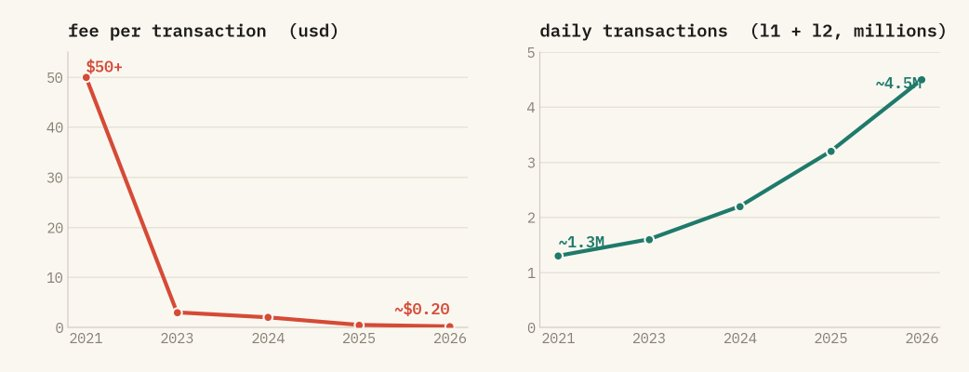
Ethereum’s fees fell sharply, while the volume of transactions rose to a high. It gets cheaper and uses more people. L2 now carries about 85 per cent of the throughput。
So, if fees are the wrong indicator, what is the right indicator
ETHER'S A BIG VAULT. ETH IS THE LOCK
Let's stop using Etheium as a company and treat it as a super-large vault. This vault contains approximately $160 billion in stable currency, $20 billion in RWA (such as US Treasury, IMF and private credit), $35 billion in L2 cross-chain assets, and the L2 network has been designed to inherit the ETA consensus. In addition, there are approximately $12 billion in seal bitcoin, and about $20 billion in DeFi positions, NFTs and chain vaults. The total assets in the chain are estimated at $250 billion and are growing every quarter。
It's not safe. It's the lock. And you were wrong about the value of the lock. On Etheium, this lock was built with ETH。
Under the old PoW system, you use mining hardware to protect the network. The locks are bought from outside. The price of the locks has nothing to do with how much they cost. But now it's PoS, everything's changed. Now you have to buy and control those ETHs. The lock is made of tokens. This means that the level of security in the vault and the market price of the coin have become the same. You can't separate them。
The lock is cheaper than the safe
This is a problem that the market is ignoring. Today, all the pledged ETH used to protect Etheum is worth only $72 billion. But they protect assets amounting to $250 billion. The safe contains more than twice as much money as the lock that protects it。
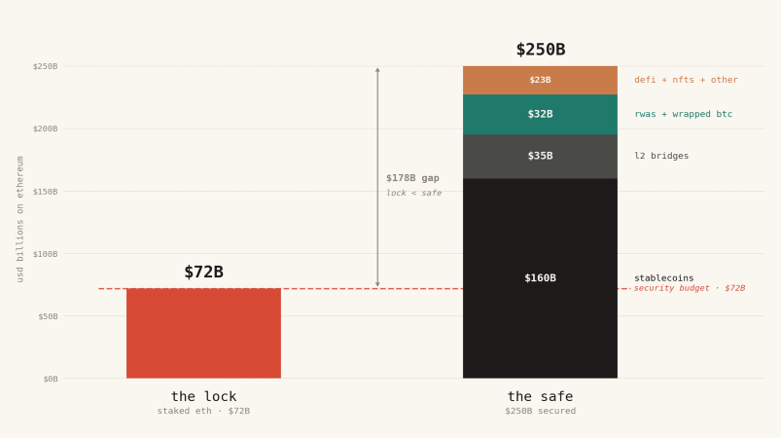
It's too dangerous. If what you're trying to protect is more expensive than destruction, you can't build the vault. In order for Ethelum to secure its protection of the $250 billion, the pledge for defence must be more than $250 billion, not less than a third。
Only about 30% of the ETH is being pledged. Thus, the total market value of ETH is more than three times that of the chain assets (1 divided by 0.30) in order to match the 30 per cent pledge with the chain assets alone. The market value of ETH is now similar to that of the assets it protects (about one-fold). But according to my logic, it should be more than three times. Using the current $250 billion, the reasonable price for ETH should be around $6900, not the current $2070. In other words, the price of ETH should be more than three times that of these assets that it now protects, even if it does not receive a penny. This is very close to the directional model of Tom Lee, Chairman of Bitmine。
“Circle can, however, freeze USDC, so it does not need ETH to protect at all.”
Every time I say that, someone jumps out like that, but it's a big mistake. The reasons are as follows:
It was felt that if Ethelum was attacked, the CIA issuing USDC would simply freeze the addresses of the bad guys and reissue the currency. So the tens of millions should not be counted as Etherum's security responsibility。
But think about it, Circe's freeze mechanism is based on smart contracts, it's implemented on the Ether House and depends on Ether House books. If the Taicha consensus is broken, there will be no accepted chain of honesty, and freezing mechanisms will not work。
Besides, Circe could have built a private database without Etheleum. The reason they chose Etheleum was to see neutrality, deep mobility and compatibility with other projects. Having enjoyed these benefits, the price is that USDC's life is tied to the safety of Etheum. If you want to take advantage, you have to take the risk of dependency。
Moreover, it is always assumed that the attackers were trying to steal USDC. It is not at all true that, if Ethelum collapses, the more than $150 billion will not be stolen, but will be trapped in a chain without consensus and will not be redeemed, and all loans and transactions based on this chain will be in chaos. The value of these assets will not be held by thieves, but will be destroyed. The value that has been destroyed is an important factor in security。
THE ATTACKERS DO NOT EVEN NEED TO STEAL MONEY TO MAKE MONEY. ALL HE HAD TO DO WAS DO AN ETH, DO AN ENTIRE ECOLOGY, OR HE WAS SIMPLY A HOSTILE FORCE, AND HE COULD MAKE A FORTUNE BY PARALYZING THE NETWORK. THE MORE MONEY HE PUTS ON THE CHAIN, THE MORE POWERFUL HE IS TO DESTROY. THAT IS WHY OUR SECURITY BUDGET HAS TO GO UP ALONG WITH THE TOTAL ASSETS OF THE CHAIN, NOT JUST TO GUARD AGAINST THE PIECES OF SILVER THAT THIEVES CAN STEAL。
As long as you put the money on Etheium, you're consuming its security, whether you have that freeze button or not. All the money has to be counted。
"Ethereum is just Linux" or "Ethereum is DTCC."
And there's one of the smart people's favorite rebuttals。
- The first one: Etherum is like Linux. It is the bottom infrastructure, driving the entire Internet, but as an asset it is worthless. Open-source infrastructure is a free public product and earns money from top-run applications rather than bottom-up agreements. So ETH would be the same, extremely important, but worthless。
- The second statement: Etheum, like DTCC, is the infrastructure behind almost all United States securities transactions. DTCC processed $37 trillion in transactions in 2024, with revenues of approximately $2.5 billion but profits of less than $500 million. It is essential and regulated, but its value is only a fraction of the amount traded. The cost of infrastructure is low, even if you can't leave it, even if you deal with more transactions in the future with the Taicha, it only takes a small amount of profit in practice, that is all。
Both statements are wrong in the same place。
The security of Linux and DTCC was borrowed from outside. Linux relies on open-source communities, reputations and decades of code review. DTCC relies on United States law, federal regulators and major banks behind it to secure United States dollars and national debt. Their security is outside the system. This is why the DCTCC can clear up huge wealth without almost any value. It is a member-owned utility that is designed to operate at cost and does not require a valuable token, as trust is provided by Governments and banks。
THERE IS NO SUCH SHELTER IN THE ETHER. NO GOVERNMENT ENFORCES IT. NO MEMBER BANKS SUPPORT IT. THERE IS NO LAW TO CANCEL THE STOLEN SETTLEMENT. THE ONLY BARRIER BETWEEN THE ETA AND THE ATTACKERS IS TO PROTECT ITS PLEDGE OF THE MARKET VALUE OF ETH. ETHERMA MUST PURCHASE SECURITY FOR EACH BLOCK FROM ITS OWN ASSETS ON THE OPEN MARKET。
That is the fundamental difference. Linux is software and no one is required to have a scarce asset to run it. DTCC provides collateral in United States dollars, outside it itself. The Ether's collateral is ETH, which lies in itself. You cannot commercialize it to zero, because safety is not a line code, it is a value that must be locked and placed at risk. You didn't create a simpler Linux. You have built a chain without guarantees, and no one will be reassured to give it a dollar。
So don't compare Etheleum to Linux or DTCC. You should compare it to the dollar and national debt that DTCC holds behind. No one would have used DTCC fees to value the dollar. You will evaluate the clearing house's fees separately and will assess the dollar and national debt as collateral for the system as a monetary basis, valued at trillions of dollars. ETH is not a clearing house. ETH is the collateral for the construction of the clearing house. That's the asset you're buying。
Linux never needed the treasury. The security budget for the Ether Workshop is a treasury, and it is based on ETH。
Looking ahead and the market game
Think about it this way. The model doesn't look at any fees or marketing. It is concerned only with one core issue: how much money will go ahead on Etheium? How much must ETH be worth to protect this money
The currency of stability is now approaching $1 trillion. RWA monetization could also reach an estimated trillions of dollars by 2030. Together with various chain applications, the assets to be protected by Etheleum will soar from the current 250 billion to trillions of dollars. As long as you keep the security factor more than three times the same, you can figure out how high the price of ETH will have to rise as the money grows。
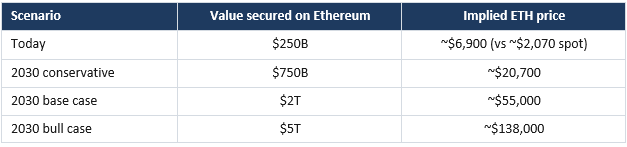
Even if you're more pessimistic, it's okay to lower the security factor. The chain is going up -- this is the variable -- the safety factor, whatever you're counting, it's going up。
“This is blind optimism. The market will never be so priced.”
THIS IS THE MOST PERTINENT COUNTER-ARGUMENT, AND INDEED, I AM TALKING ABOUT HOW MUCH ETH “SHOULD” BE WORTH, RATHER THAN HOW THE MARKET WOULD PAY IT “AT ONCE”. THERE IS NO MECHANISM FOR COMPULSORY ARBITRAGE TO LEVEL THE DIFFERENCE. AND MY LOGIC OF "ETH SHOULD GO UP" HAS INDEED BEEN HIT IN THE PAST FEW YEARS. WE'LL EXPLAIN IT ONE BY ONE。
- ON WHAT CAN BRIDGE THE GAP: THE ETHER WORKSHOP IS NOT A ARBITRAGE, BUT A DEMAND FOR ASSETS VALUED ACROSS THE SYSTEM. ETH IS USED AS A COLLATERAL, A PAIR OF TRADED ASSETS, AND IS PLEDGED TO EARN THE BASE PROCEEDS OF THE NETWORK AS VALUE IS SETTLED IN THE UTENSILS. THIS DEMAND GROWS WITH THE ACTIVITIES IT SUPPORTS. RESERVE ASSETS ARE NOT INCOME-BASED AND THEY ARE PRICED ACCORDING TO HOW URGENTLY IT IS NECESSARY TO HOLD THEM IN THE SURROUNDING SYSTEM. GOLD, VALUED AT OVER $18 TRILLION, PRODUCES NO CASH FLOWS. ETH IS A FINANCIAL RESERVE ASSET ON THE CHAIN, AND THE FRAMEWORK IS MERELY A MEASURE OF HOW LARGE THIS RESERVE MUST BE。
- WITH REGARD TO PLEDGE MULTIPLIERS: MY INTELLECTUAL MODEL USES PLEDGE MULTIPLIERS AS A COMPARTMENT RATHER THAN A FIXED TARGET. UNDER THE CURRENT PLEDGE RATE, THE PARITY (THE ETH OF THE PLEDGE EQUALS THE PROTECTED VALUE) IS APPROXIMATELY 3.3 TIMES. THE REASONABLE RANGE RANGES FROM 1.7 TIMES THE LEVEL OF EASING TO FIVE TIMES THE LEVEL OF RIGOUR, AT WHICH THE COST OF LAUNCHING AN ATTACK THROUGH A TWO-THIRDS PLEDGE MUST BE EQUAL TO THE FULL PROTECTED VALUE. THE PRICE TRACKS THE PROTECTED VALUE UNDER A CERTAIN MULTIPLIER WITHIN THE ZONE. STABILIZING IT ON A SPECIFIC NUMBER UNDERMINES RIGOUR, WHICH IS WHERE RATIONAL PEOPLE CAN DISAGREE WITHOUT DESTROYING THE MODEL。
- With regard to antibodyity, the model does have more than one point of balance and there is nothing decisive in choosing the highest one. Today, it is safe enough to cover below the lower limit because of the poor mobility of obtaining one third of the pledge share, the extreme cruelty of the forfeiture mechanism and the fact that the attacker can be cut off from one another at the social level. This is true, but these defensive measures depend on the success of the attack, not on the adequacy of coverage as risk rises. In protecting $250 billion, weak coverage is yet to be tolerated. Coverage is no longer an academic issue when it comes to $2 trillion or $5 trillion of regulated institutional funds. As adoption rates increase, the gradient for bridging the gap increases in a single way。
FINALLY, THE BEST FACE IS THE PRICE OF ETH OVER THE LAST FIVE YEARS. LOGICALLY, IT SHOULD GO UP, BUT IT ACTUALLY KEEPS FALLING. I THINK THE MOST IMPORTANT REASON IS THAT THERE WAS NOT ENOUGH MONEY IN THE PREVIOUS CHAIN AND THAT SECURITY WAS NOT CONSIDERED A MAJOR PROBLEM. WHEN THERE WERE ONLY 50 BILLION PEOPLE ON THE CHAIN, THERE WAS NOTHING TO WORRY ABOUT; WHEN THERE WERE 175 BILLION PEOPLE, THERE WAS SOMETHING WRONG; AND WHEN THERE WERE 1 TRILLION, THE FIRST QUESTION THAT THOSE BIG INSTITUTIONS WERE ASKING BEFORE THEY CAME IN WAS, "IS THIS CHAIN SAFE?" AND THE ANSWER TO THAT QUESTION DEPENDS ON ETH PRICES. MY MODEL CAN'T PREDICT WHEN IT WILL RISE, BUT IT TELLS YOU THAT, AS THE CHAIN GROWS, THE PUSH WILL INCREASE, AND THAT “THE CHAIN GETS MORE” CANNOT BE DENIED BY EVEN THE BLIND EYE。
It was countered with bitcoin, which was said to have a security budget that was worthless compared to its market value. But bitcoin primarily protects itself. And Etherum protects other people's dollars and assets, which is a lot more important! The trend is already clear: the number of ETH pledges is increasing, compliance products are buying ETH and combustion mechanisms are destroying ETH as the chain is active. This is all evidence of what I said was an increase in demand。
THOSE WHO SIMPLY LOOKED AT THE FEES AND CASH FLOW CONTINUED TO SHOUT THAT ETH WAS OVERESTIMATED. THEY TOTALLY REVERSED THE CAUSALITY. IT'S CHAIN ACTIVITY BEFORE SECURITY. ETH MUST BE VALUABLE IN ORDER TO PROTECT THE WHOLE ECOSYSTEM. THE FEE IS THE STUMBLING BLOCK YOU SHOULD TRY TO ELIMINATE, NOT THE LEVERAGE YOU USE TO VALUE ETH。
