
From Coimbase to Upbit: how a token passes the 28-day route
IN THE BEAR MARKET ENVIRONMENT OF 2026, THE CEX CURRENCY LOGIC IS MOVING FROM "FLOW-DRIVEN" TO "VALIDATION-DRIVEN"。
Original by Xinyang & Ethan@IOSG
Each bear market is quietly reshaping CEX's currency logic. Every currency decision taken by an exchange becomes more prudent and therefore more signal value when liquidity is tightened and the enthusiasm of the diaspora is retreating. From 2026 to mid-May, the system tracked the cash on the Coinbase, Binance Spot, ByBit, OKX, Bithumb, Upbit Six First Line Exchange, and Binance Personal, with a total of 207 currency entries covering 92 independent tokens. The data clearly reveal a core fact: the currency is a highly structured authentication and liquidity route。
Who discovered and priced the project at the earliest? Who's taking over and scaling up liquidity in the middle? Who's done market coverage at the end? Different exchanges play a distinct role in this chain. A token, which runs from the first line to its eventual inclusion in Binance Spot, has often been certified on multiple exchange layers. This report will break down this currency path from three core dimensions:
- Patterns and pathways: division of currency roles among exchanges and patterns of currency flows between exchanges
- The selection logic for Binance Perps: What kind of token is easier to enter Binance Perp
- Price effects: how the timing of the preceding currency determines the location of the investor ' s buy-in, and the difference in the real return after the currencies on different exchanges
For the project participants, understanding this path means a more precise and efficient upward strategy; for investors, identifying differences in location in the path may be one of the most important Alpha sources in 2026。
2026 CEX CURRENCY PATTERN AND PATH
Overview of currencies on exchanges
Total Listings by Exchange
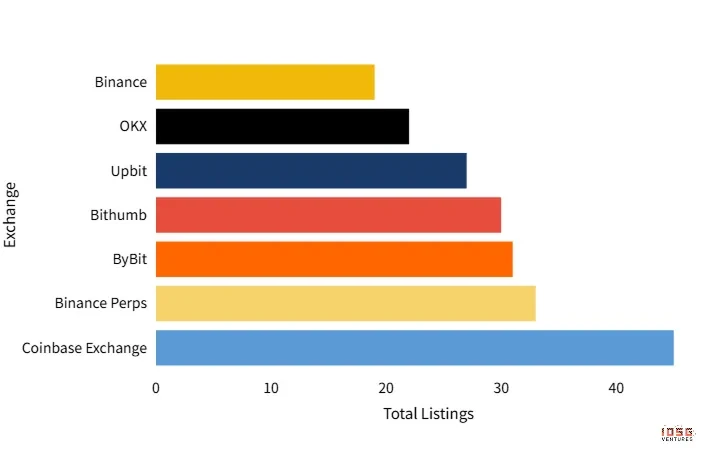
From 2026 to the present, we have tracked new currency data from Coinbase, Binance Spot, ByBit, OkX, Bitumb, Upbit Six First Line Exchange, and Binance Perp, totalling 207 currency entries, covering 92 independent tokens。
The amount of money on the exchange shows a clear hierarchy. Coinbase is first in 45 new currencies, followed by Binance Perps (33) and ByBit (31). Bithumb (30) and Upbit (27) are in the second tier, with OKX plus 22, while Binance Spot has only 19 on line, the smallest number in all observation exchanges。
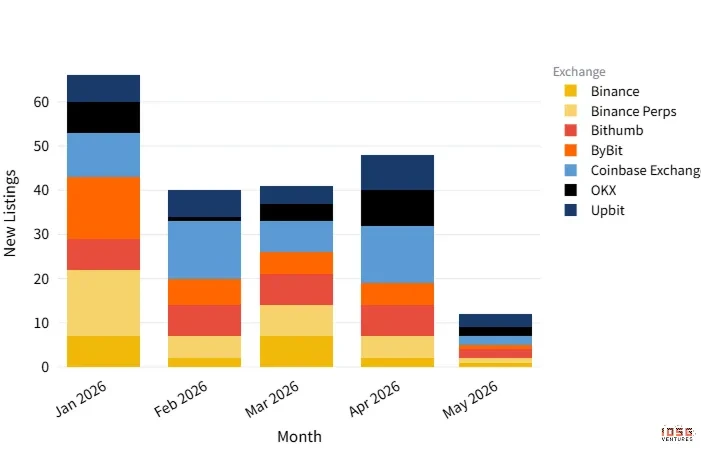
In terms of the monthly rhythm, January was the peak of the year. Of which Binance Perps is on line for 15 tokens and ByBit is on line 14. Since February, the overall pace has slowed significantly, with exchange rates falling to 5-8 per month and entering a more cautious and stable screening phase. Coinbase displays a currency-ceiling rhythm that is at variance with other exchanges, with two peaks in February and April (13 in a single month), showing the rapidness of its independent currency-up。
Monthly Listings by Exchange
Simple quantitative differences reflect only surface dynamics and, more importantly, the deep division between the time and role of the different exchanges in the currency, which will be further dismantled in subsequent chapters。
Fragmentation of the preceding currency roles: Discoverers, filters and confirmers
There is a significant order of precedence in the currency of multiple exchanges. We have defined the first-on-line exchange in the tracking range as "start" and the rest as "following"。
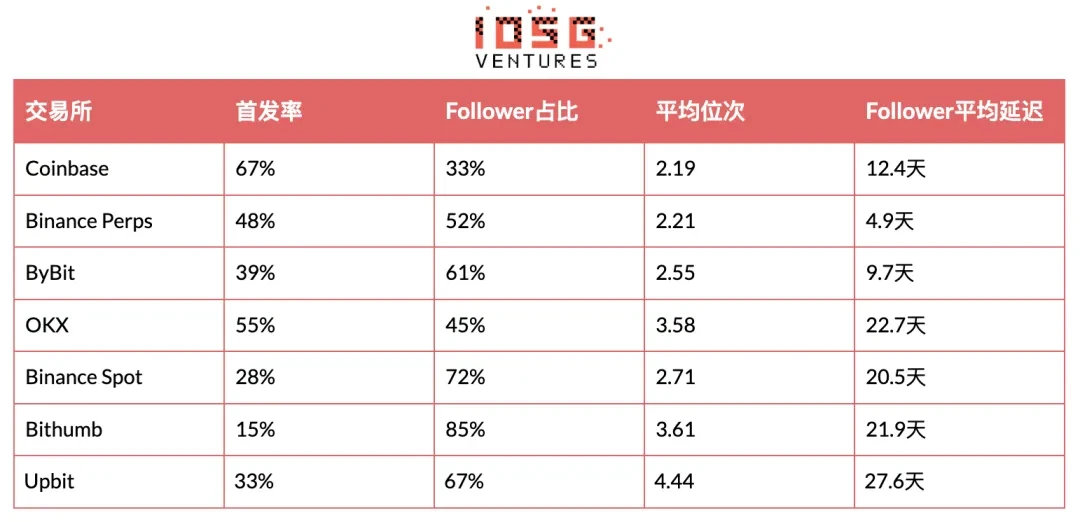
Coinbase was the most prominent currency launch site in 2026, with 67 per cent of the daibis tracking the first edition of the exchange and assuming the function of first round of market price discovery. ByBit (a 39 per cent start-up rate) and Binance Perps (a 48 per cent start-up rate) also maintain a high level of activity, with the three often forming the first stage of the new project line during the same week in intensive contact with the same generation。
The Korean Exchange (Bithumb and Upbit) is systematically at the end of the upper currency path. With a high proportion of 85 per cent in Bithumb, the Upbit averages 4.44, with a high probability of last on-line in all exchanges, with an average delay of about 28 days. This is closely related to the long regulatory audit process in Korea and the preference of local exchanges to introduce features after a broad consensus on the project
A clear funnel division of labour has developed within Binance: it was initiated on its own initiative in half of the cases, and the other half followed up at an extremely rapid pace (on average, 4.9 days) after the spot came online, the fastest response in all exchanges. Its main role is to test liquidity and market demand quickly through the contractual market. By contrast, Binance Spot has the lowest number of currencies (only 19), with a start-up rate of only 28 per cent and a clear preference to wait for the market to be fully validated。
OKX SHOWS A STRONG INDEPENDENT ABILITY TO SELECT CURRENCIES WITH A START-UP RATE OF 55 PER CENT, BUT THE OVERALL AMOUNT OF THE ABOVE CURRENCY IS RELATIVELY RESTRAINED (22), AVERAGING 3.58, INDICATING A HIGHER SCREENING THRESHOLD AND A MORE PRUDENT STRATEGY。
Paradigm of the previous currency
From a sample of tokens covering 3 or more exchanges, the top-currency order is characterized by a high degree of stability: early discoverers, represented by Coinbase and ByBit, were first launched, Binance Perps quickly followed up with validation within a few days, and later Binance Spot selective upline confirmation was completed, and OKX, Bithumb and Upbit provided supplementary coverage mainly at the back of the path。
Typical case: ROBO (Fabric Protocol)
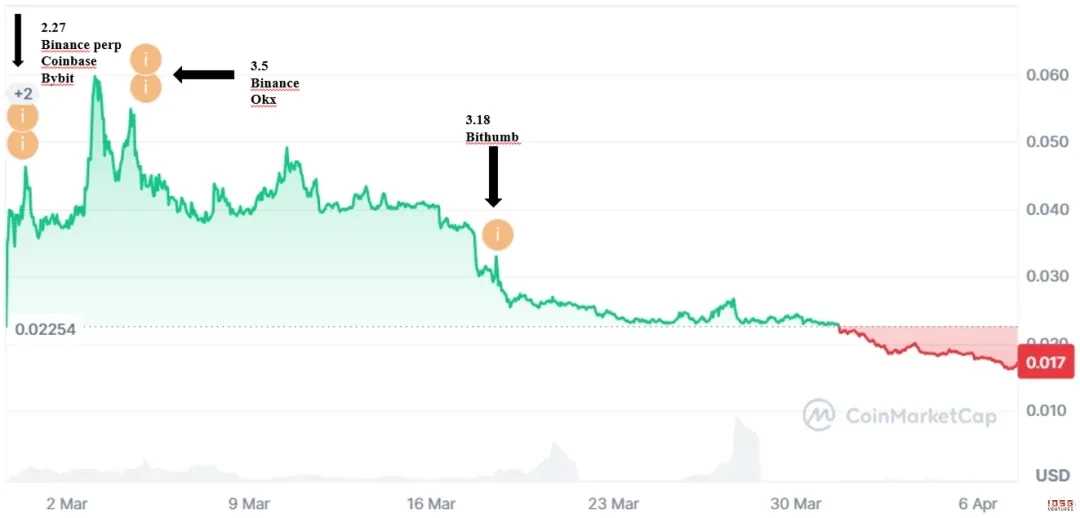
On 27 February, the DePIN project Fabric Protocol (ROBO) was launched online in Binance Perp, Coinbase followed up with ByBit on the same day, with an opening price of 0.022, which rose by more than 80 per cent on the first day, and the opening price of the next day rose to 0.0405, almost double the initial offer. The project, led by Pantera Capital, is worth $20 million, combining the focus block chain with the robotic economy, with Kaito public heat and "AI + Robot" narratives, quickly gaining market attention。
On 5 March, Binance Spot officially went online, ROBO, and the offer was 0.0493. It also became the highest price point for ROBO for the entire cycle. The opening price was lower than the Binance Spot price when OKX entered the site. On 18 March, Bithumb went online, offering an offer of $0.0303, which, although briefly triggered a wave of highs, was followed by a drop in the currency price, which is now lower than the initial opening price。
From the time it was first sent to Bitumb on the line, ROBO walked through a typical 2026 uplink path for about 20 days:
Binance Perps, Coinbase and ByBit launch OKX and Binance Spot confirm at high point Zing Korea's terminal bridge。
ROBO IS NOT ALONE. IN THE SAMPLE OF THE FIRST FIVE MONTHS OF 2026, A TOTAL OF 28 COINS COMPLETED 3 OR MORE EXCHANGES. THE DISTRIBUTION OF THESE CASES OVER TIME SHOWS A PATTERN OF LADDERS THAT ARE HIGHLY CONSISTENT WITH ROBO. THE OVERALL PATH STRUCTURE IS STABLE AND PREDICTABLE, ALTHOUGH THE SEQUENCE VARIES SLIGHTLY DEPENDING ON THE PROJECT ATTRIBUTES。
This path clearly reflects differences in risk preferences among exchanges: Coinbase, ByBit and Binance Perps tend to take early windows proactively, Binance Spot focuses on post-certification security, and the South Korean Exchange and OKX prefer to enter after a full market consensus。
Binance Perps Currency
Binance Perps, an important entry point for derivative markets, has a direct impact on the direction of large-scale inflows of leveraged funds. An analysis of 33 Perps-plus cases allows us to clearly distill the core logic of Binance's selection of tokens in bear city settings。
Forward signals: Coinbase and ByBit online
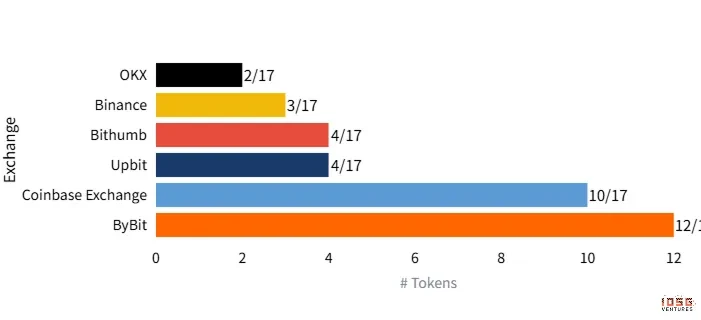
Exchanges Listed Before Perps
Of the 33 tokens that entered Binance Perps, 17 were placed on other spot exchanges before being included in Perps. The tracking of this token shows that Coinbase and ByBit are the main forward signals for Perps。
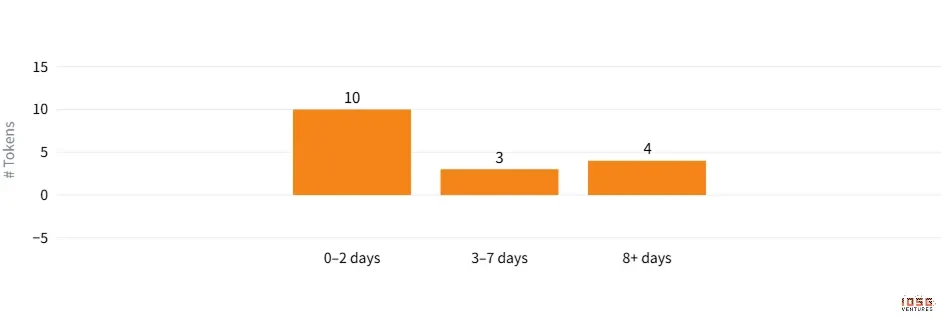
Days from First Spot to Perps
Of these, ByBit, in 71 per cent of cases, preceded Perps and Coinbase reached 59 per cent. More importantly, the speed of response: of the 17 cases followed by currency, 10 were online within 0-2 days of the spot, with an average delay of only 4.9 days. This very fast pace of follow-up shows that Binance Perps is highly concerned about Coinbase and ByBit ' s currency movements and uses them as a reference for important decision-making。
In a larger sample, 75% of Coinbase's online tokens eventually entered Binance Perps, and 70% of ByBit. When a token is supported by Coinbase and ByBit, and price performance is relatively stable, the probability is that it will land in Binance Perps within a week. This is one of the strongest directly observable proxies in the current market。
Price performance is the most critical criterion for the core screening
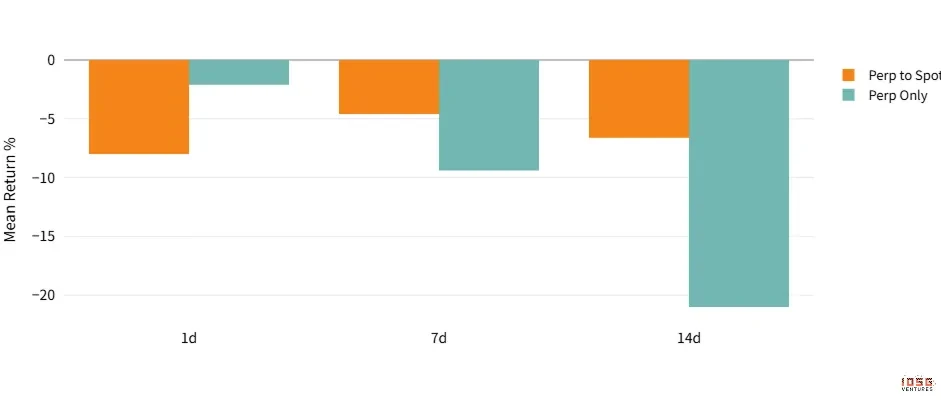
Post-Listing Mean Return
The coinbase and ByBit lines open the FDV, which is generally above $100M and does not constitute a distinguishing factor in itself. The real decision to enter Perps is the price of the last currency。
According to Coinbase and ByBit online but not in Perps, there are three main features:
- One is a project that continues to suffer from weak prices and a lack of market heat after the exchange
- Two are meme coins with excessive speculative properties (e.g. WHITEWHALE, ELON), and Binance's filtering of these tokens is clearly strict on ByBit
- Three is not past Binance Alpha. Alpha, a pre-screening channel for the Binance system, is an important precursor to access Perps。
The impact of price performance is not only reflected in the "capability of perps" but also in the subsequent "perps turn Spot". The data show that the currency that was eventually successfully converted to Binance Spot (Converted Group) was -4.6 per cent for 7 days and -6.6 per cent for 14 days after Perps went online, while the unturned Perp Only Group was -9.4 per cent for 7 days and -21.0 per cent for 14 days. Although both groups show negative returns as a result of the bear market, the price sustainability of the Converted group is significantly stronger, suggesting that Binance has made sustainability an important consideration in the Perps phase。
Effect of the preceding currency prices
The real impact of the above-mentioned currency events on the price of the currency is the subject of the greatest concern of projecters, institutions and traders. We're analysing two core dimensions: Price Production (relative price position at the time of the currency) and Post-Listing Return (7 days after the currency, 14 days, 30 days return)。
Prices were found to be concentrated in the initial window, but entry prices varied significantly from one exchange to another
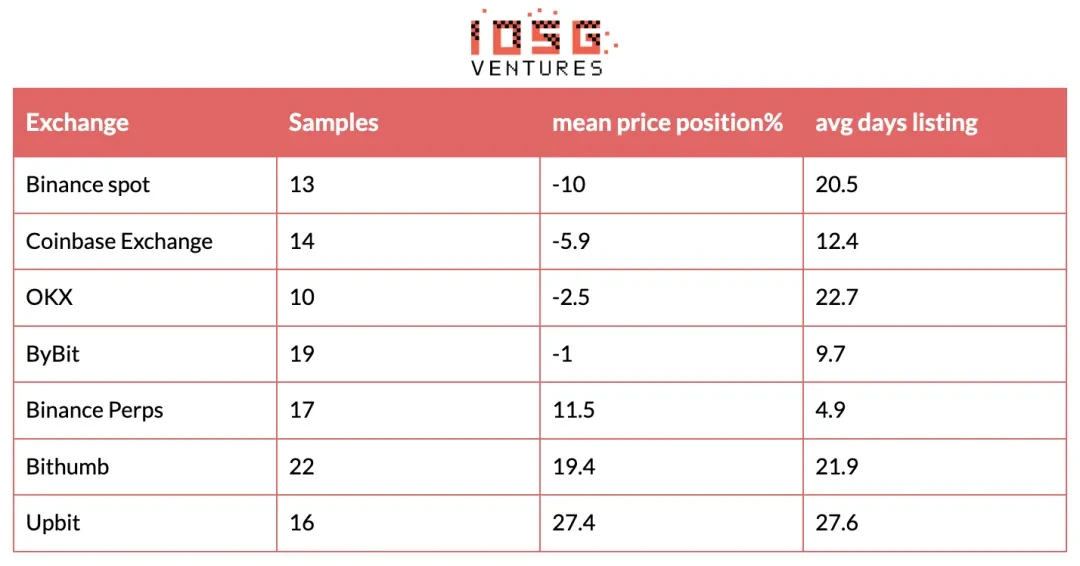
Price Regulation at Listing
Prices were found mainly in the initial window. When ByBit and Coinbase followed, entry prices were roughly the same or lower than initial offers, indicating a rapid convergence of prices between the first series of exchanges。
The average price of Binance Perps as a follower is 11.5 per cent higher than it was when it was first delivered, but thanks to a very rapid follow-up speed (only 4.9 days), it remains relatively early. The Price Project for Binance Spot is -10%, indicating that it tends to go online after price reversals, and instead the user receives relatively better entry prices。
The Korean exchange faces the most unfavourable entry position: Bithumb is on average 19.4 per cent higher and Upbit 27.4 per cent higher. Owing to an average delay of more than three weeks, users are often at a distinctly high level。
2026 Overall currency: liquidity releases rather than growth catalysts
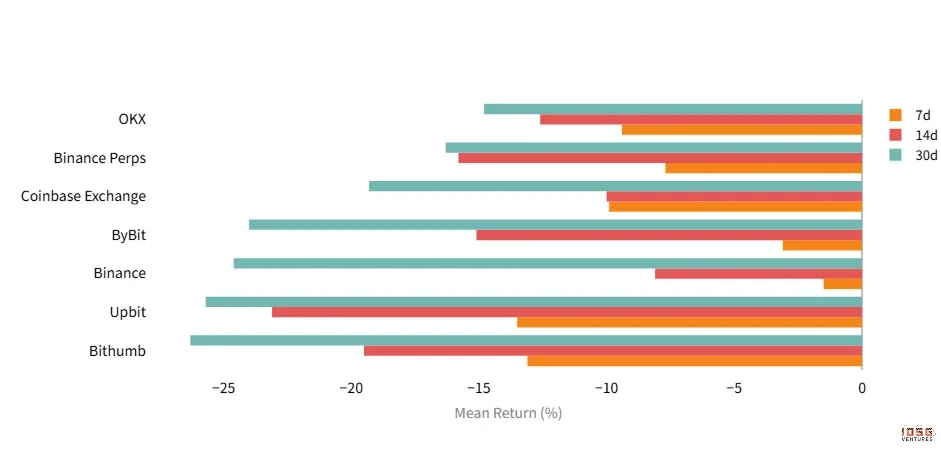
Mean Return by Exchange 7d/14d/30d
In the bear market environment in 2026, prices after the new currency were generally weak, and no single exchange had a positive average return of 30 days。
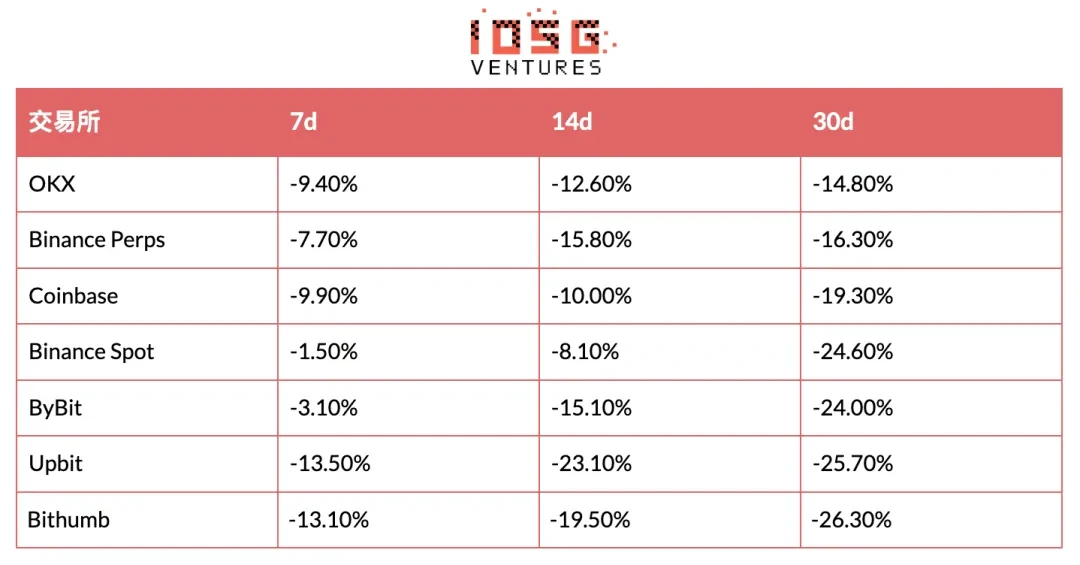
from 7d to 30d, the drops are deepening, indicating that the price downs after the upper currency are not short-term fluctuations, but a continuous downward trend. in the current market environment, the new currency has more of a liquidity-release role — providing exit windows for early warehouse holders (including projecters, investment agencies, early traders) than attracting new and sustained inflows。
The performance of the two Koreas is particularly noteworthy: the 7d return of Upbit is -13.5 per cent and 30d is -25.7 per cent. Combined with its +27.4% price position, means that Upbit users not only entered at the highest price, but also suffered the deepest drop。
Price peaks below the upper currency path
Although the final return after 30 days was generally negative, the initial Peak Return showed a very different distribution structure. Price data on the dismantling of coins show that the time series directly determine the short-term speculative space cap。
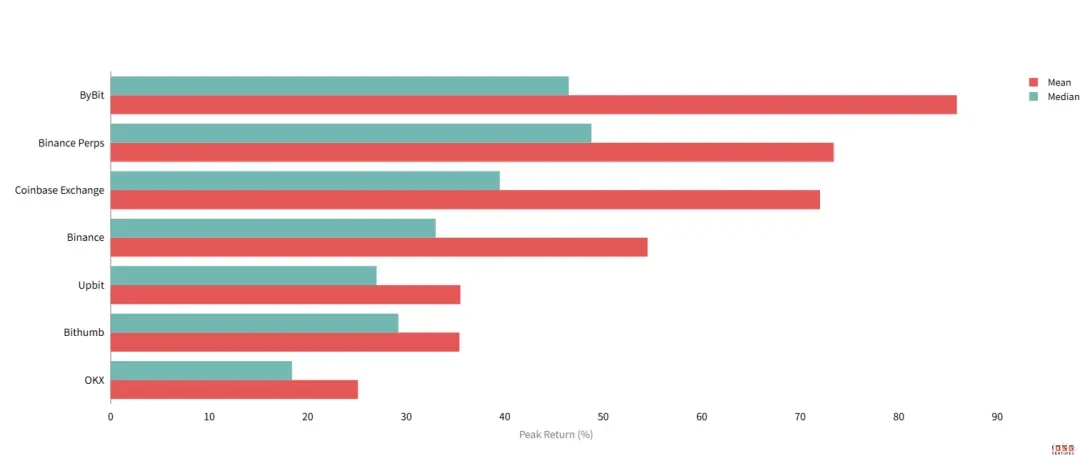
Peak Return by Exchange (14d High)
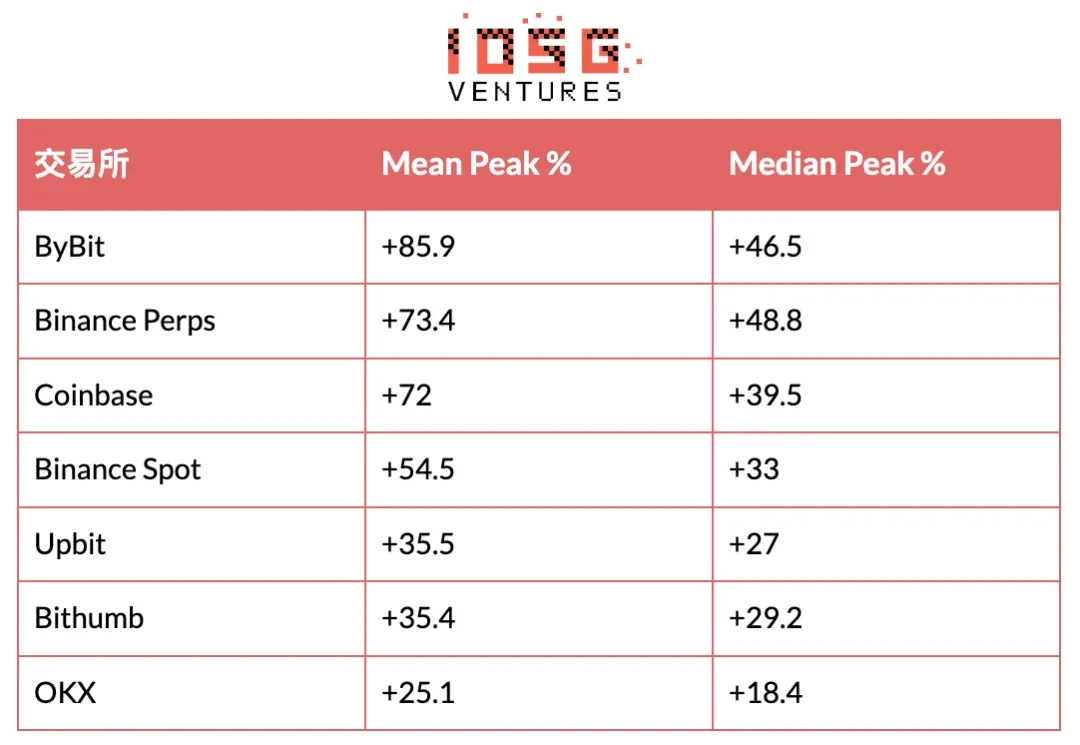
The Institute has an absolute advantage: ByBit has an average peak of +86% and Binance Perps has the highest median (+49%). ByBit, Coinbase, Binance Perps holds the highest price elasticity, which provides an extremely high liquidity premium for early leverage, with ample time to leave at high points, even if then zero。
Last wheel followser space limited: Bitumb and Upbit peaks are suppressed at about +35%, while OKX is only +25%. Due to late entry, the purchase of these platforms is more of a profit drive than a start-up。
This difference attests to the transfer path of mobility: The initial exchange assumed the main price discovery function, providing the best exit liquidity for early warehouse holders; and, over time, the subsequent exchange buys more of the amount of the increase achieved, leading to a decline in marginal utility. For traders, this means that the later the currency cycle goes in, the lower the probability of capturing the excess proceeds。
Exchange choices determine the structure of risk returns
Combining Price Production (entry), Peak Return (peak space) with Mean Return (final return) indicators, users of different exchanges face completely different risk-benefit structures。
Users of the Institute (Coinbase/ByBit) also face negative returns but have the best risk buffer. With the lowest entry prices (-10% ~5.9%) and the highest market-wide peak space (average + 70% and above), even if it fails to escape with precision, the absolute losses from the initial offer are relatively manageable and even have the opportunity to close the gap by making a profit。
In contrast, South Korean users face a typical "high-end interface + depth retreat". They entered at a premium of almost 20 to 27 per cent, but the peak space was overstretched and suppressed at about +35 per cent. This means that the upper space is restricted, while the lower tunnel is opened, which eventually leads to its 30-day fall to the bottom of the entire market。
The situation of Binance Spot is special. Its 30d Return is as low as -24.6 per cent, but the actual principal loss is smaller than the apparent data because it tends to go up 10 per cent after the price is reversed. This is a time-for-space strategy that circumvents sharp fluctuations in the start-up phase, but also carries a longer fall cycle。
This division is particularly visible at the quantitative level. The difference in returns between the Institute and the 14-day period is the most marked: the average number of Institutes is -12.2 per cent, while the number of Institutes is -16.7 per cent, which is 4.5 percentage points due to the choice of the exchange alone. In the market environment of 2026, the currency event has evolved from a "beep dividend" to a stock game. For traders, "where" is better to determine the outcome of investment than "what" is。
Conclusions
In 2026, in the bear market environment, CEX's currency logic was shifting from "flow-driven" to "validation-driven". Instead of simply chasing hot spots, the exchange has built a structured screening and liquidity release path through a clear division of roles: Coinbase and ByBit act as early discoverers, Binance Perps perform rapid validation and liquidity testing, Binance Spot as the final confirmation level, and the Korea Exchange provides exit liquidity at the end of the path. This path is not random, but the result of rational games. It provides a ladder from early exposure to mainstream recognition for high-quality projects and a window for early investors and institutions to exit in batches. At the same time, it clearly illustrates the differences in the situation of different actors:
- Investors should use the currency order of the exchange as an important Alpha signal: focus on the Coinbase + ByBit twin-sided and price-stabilized project as a front for Binance Perps, looking for better entry prices at the start-up window or at the Binance Spot fallback stage, and avoiding a terminal high-end interface in Korea。
- The exchange itself has achieved an ecological balance through differentiated positioning — radicals taking the lead, conservatives controlling risks and ultimately collectively maintaining orderly flows across the currency market。
However, in the context of the current overall liquidity tightening, the above-mentioned currency event has more of a role in re-allocation of stock funds than as a catalyst for incremental growth. As the macro-environment improves in the future, the path may gradually shift from “defensive screening” to “offensive expansion”, with a higher premium on the initial window and a shorter certification cycle. Understanding and following this path does not guarantee that each currency will succeed, but significantly enhances certainty in decision-making. In the encrypted market, information asymmetries persist, while the structured perception of the currency chain is the source of Alpha, which can be transformed into a long-term advantage。
