
Agent investment map from protocol cage to payment ecology
By Jacob Zhao
Smart Commerce refers to a whole-process business system where services discovery, credibility judgement, order generation, payment authorization and final settlement are done by AI. It is no longer dependent on human step-by-step operation or information input, but rather on the automatic collaboration, filing, payment and performance of intelligent bodies across platforms and systems, thus forming a commercial closed loop (M2M Company) between machines and machines。
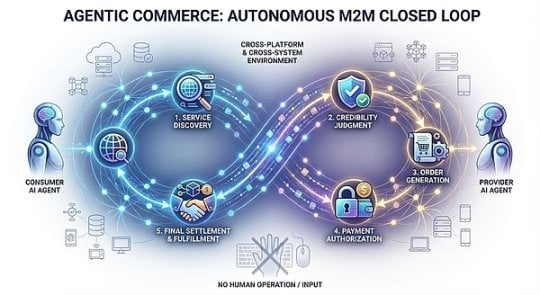
In the area of encryption, the most practical applications are currently concentrated on stable currency payments and DeFi. Thus, in the process of integrating Crypto with AI, the two most valuable paths are: AgentFi, which relies on the existing mature DeFi agreement, in the short term, and Agent Payment, which has evolved over the medium to long term around stable currency settlement, relying on agreements such as ACP/AP2/x402/ERC-8004。
In the short term, smart business (Agentic Commerce) is constrained by such factors as agreement maturity, regulatory differences, and commercial user acceptance, making it difficult to scale quickly; however, in the long run, payments are the bottom anchor of all commercial closed rings, with smart business having the greatest long-term value。
Smart commercial payment systems and applications
The real-world business network is the biggest value scenario in the smart business system. Regardless of how AI Agent evolves, traditional French currency payment systems (Stripe, Visa, Mastercard, bank transfers) and fast-growing stable currency systems (USDC, x 402) will coexist over the long term and together form the bottom of intelligent business。
traditional french currency payments vs stable currency payments
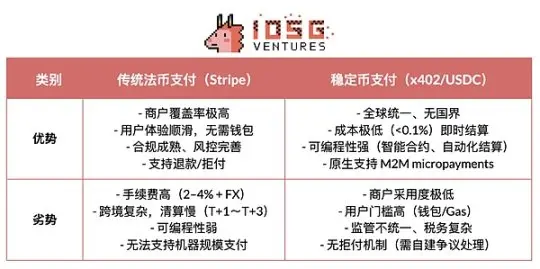
Real world merchants — — from electricians, subscriptions, SaaS to travel, content payments and business procurement — carrying trillions of dollars of class demand and being a source of core value for AI Agent automatic price, continuation fees and procurement. In the short term, mainstream consumption and enterprise procurement will continue to be dominated by traditional French-currency payment systems over the long term。
The central obstacle to the unscaling of a stable currency in real business is not technology, but the absence of a dispute management mechanism arising from regulation (KYC/AML, taxation, consumer protection), household accounting (stable currency for illicit repayment) and irreversible payments. As a result of these structural constraints, stable currencies will have short-term difficulties in accessing high-regulated industries such as medical, aviation, electrician, government, public utilities, which will be concentrated mainly in digital content, cross-border payments, low-regulated or chain-based regulatory pressures such as the Web3 Services and Machine Economy (M2M/Iot/Agent), which is the first window of opportunity for commercial breakthroughs of the original Web3 smarts。
However, the institutionalization of regulation in 2025 is advancing rapidly: the United States Stabilisation Currency Act has achieved bipartisan consensus, Hong Kong and Singapore have a framework for depositing currency licences, EU MiCA has entered into force, and Stripe supports USDC and PayPal to launch PYUSD. Clarifying regulatory structures means that the currency of stability is being accepted into the mainstream financial system, opening up policy space for future cross-border settlements, B2B procurement and the machine economy。
Best commercial applications for smarts match
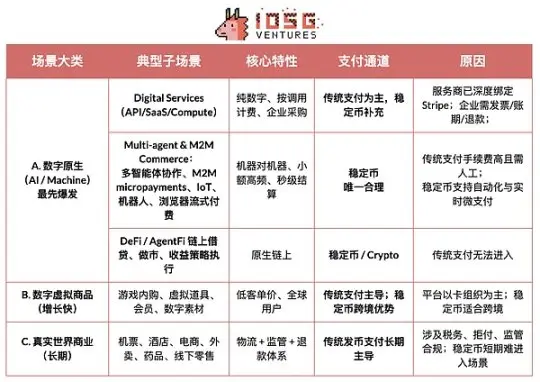
The core of smart commercials is not to replace one payment track with another, but to hand over the executing agents of "lower orders & mdash; authorisations — Payments" to AI Agent, where traditional monetary payment systems (AP2, certificates of authorization, identity compliance) and stable currency systems (x402, CCTP, smart contract settlement) have their advantages. It is neither a zero-sum contest for a French currency vs a stable currency, nor an alternative narrative for a single track, but a structural opportunity to expand both sides’ capabilities simultaneously: French currency payments continue to support human commerce, and stable currency payments accelerate the scenes of machine origin and chain origin, which complement each other and become a twin engine of the intelligent economy。
A business bottom protocol standard panorama for smarts
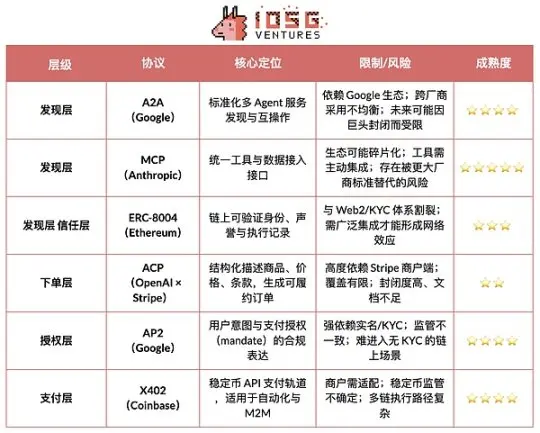
The comptoir of smart commercials (Agentic Commerce) consists of six tiers, forming a complete machine business chain from "capability discovery" to "payment delivery". A2A Catalog and MCP Registry were responsible for finding that ERC-8004 provides a chain of authentication of identity and reputation; ACP and AP2 respectively assume structured orders and authorizations; the payment layer consists of the traditional French track (AP2) in parallel with the stabilization track (x402); and there are no uniform criteria for the delivery layer。
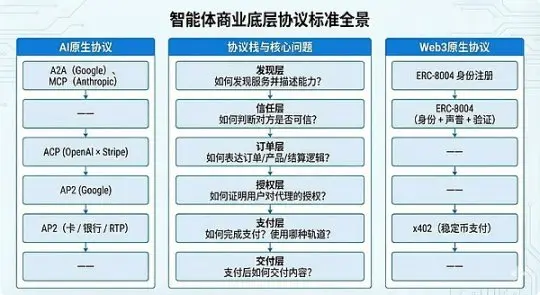
- Discovery Layer: Solve "Agent how to find and understand the service that can be called." The AI side builds a standardized capability directory via A2A Catalog and MCP Registry; Web3 provides a searchable identity guide based on ERC-804. The floor is the entrance to the entire comptoir。
- Trust Layer: Answer "Is the other side credible?" There are no common standards on the side of AI, and Web3 is a key advantage of Web3 by building a unified framework for authentication of identity, reputation and execution records through ERC-804。
- Ordering Layer: "How orders are expressed and verified." ACP (OpenAI & Times; Stripe) provides structured descriptions of goods, prices and settlements to ensure that merchants can perform. Because of the difficulty of expressing the real world business compact on the chain, the layer is largely dominated by Web2。
- Authorisation Layer: Dealing with "Agent's legal authorization." AP2 Attaching intent, confirmation and payment authorization to the real identity system by authenticating documents. Web3 signatures are not yet legally valid and therefore cannot be held responsible for contracts and compliance at that level。
- Payment Layer: Decides on “what track payment is made”. AP2 Covers traditional payment networks such as cards and banks; x 402 provides the original API payment interface in stable currency, allowing assets such as USDC to be embedded in automated calls. The two tracks form functional complementarities here。
- Fulfillment Layer: Answer "How to secure delivery after payment is completed". There is currently no uniform agreement: the real world relies on commercial systems for delivery and Web3's encrypted access controls have not yet resulted in cross-ecological standards. This layer remains the largest gap in the comptoir and is most likely to give birth to the next generation of basic agreements。
Details of key core agreements for smart business
With regard to the five key points of discovery, trust judgement, structured billing, payment authorization and final settlement, institutions such as Google, Anthropic, OpenAI, Stripe, Etheum, Coinbase and others have proposed a bottom-up agreement at the corresponding point, thus building together the next generation of Agentic Commerce core agreements。
Agent‐Agent (A2A) & ndash; Smart Interoperability Protocol (Google)
A2A is an open-source agreement initiated by Google and donated to Linux Foundation to provide a common standard for communication and collaboration for AI Agents, which are built on different suppliers and frameworks. A2A Based on HTTP + JSON-RPC, secure, structured exchange of information and tasks, enabling Agents to engage in multiple rounds of dialogue, collaborative decision-making, task decomposition and state management in original ways. Its core objective is to build an "inter-intelligence Internet" so that any A2A compatible Agent can be automatically detected, called and combined, thus creating a distributed Agent network across platforms and organizations。
Model Context Protocol (MCP) & ndash; Unified Tool Data Access Protocol (Anthropic)
MCP, launched by Anthropic, is an open protocol linking LLM/Agents to external systems, focusing on the harmonization of tools and data access interfaces. It abstracts databases, file systems, remote API and proprietary tools into standardized resources, enabling Agent to access external capabilities in a secure, controlled and auditable manner. MCP design emphasizes low integration costs and high scalability: only one docking by developers allows Agent to use the entire tool ecology. MCP has now been adopted by many head AI manufacturers as the factual criterion for interactivity。
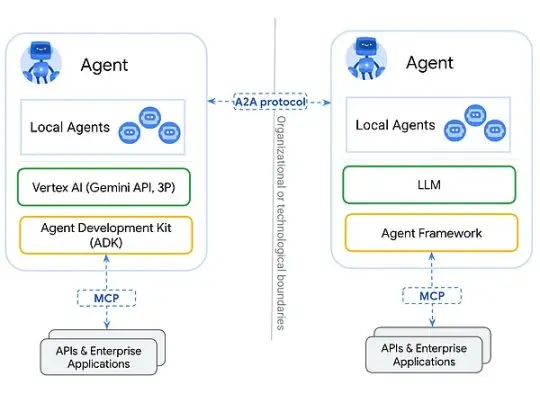
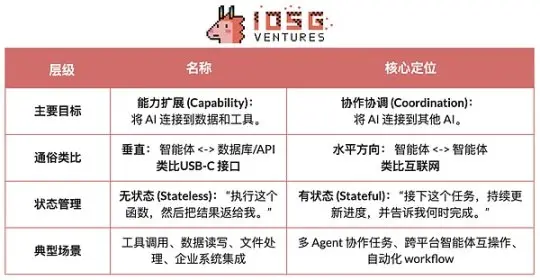
MCP is concerned with "Agent how to use tools" — — providing a unified and secure external resource access capability for models (e.g. database, API, file system, etc.) to standardize the interactive approach of ant-tool/agent-data。
A2A addresses how "Agent works with other Agents" — — establishes primary communication standards for cross-producer, cross-framed intelligents that support multiple rounds of dialogue, task decomposition, state management and long-life implementation, and is the basic interoperability layer between intelligents。
& ndash
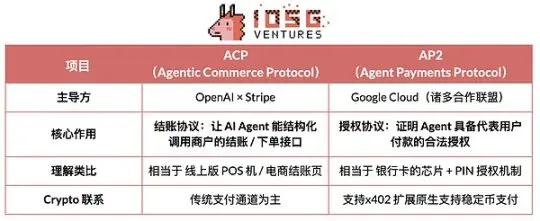
ACP (Agentic Common Production) is the Open List Standard (Apache 2.0) proposed by OpenAI and Stripe for buyers & mdash; AI Agent— and business to create structured sub-lists that can be understood directly by machines. The agreement covers commodity information, price and terms verification, settlement logic and transfer of payment vouchers, enabling AI to initiate purchases safely on behalf of users without becoming a business。
The core design is: AI to use the commercial closing interface in a standardized manner, while the business retains full commercial and legal control. Through structured orders (JSON Schema / OpenAPI), secure payment tokens (Stripe Shared Payment Token), compatible with existing electrician backstages, and support for RET and MCP dissemination capabilities, businesses can access the AI shopping ecology without the need to modify the system. Currently ACP has been used for ChatGPT Instant Checkout as an available payment infrastructure for early deployment。
Agent Payments Protocol (AP2) & ndash; Digital Authorization and Payment Directive Agreement (Google)
AP2 is an open standard developed by the Google Joint Payment Network and the Science and Technology Corporation to establish a uniform, compliance and auditable process for AI Agent-led payments. It binds the user's intention to pay, the scope of the authorization and the status of compliance by means of encrypted digital authorization, providing a verifiable "who is paying for whom" evidence for businesses, payment agencies and regulators。
AP2 is designed as a "Payment-Agnostic" principle, while supporting encrypted payment tracks such as credit cards, bank transfers, real-time payments and extended access to stable currency by x 402. Throughout the Agentic Corporation, AP2 is not responsible for the specific goods and the particulars of the lower orders, but provides a common Agent payment authorization framework for various payment channels。
ERC ‐8004 & ndash; Chain-based Agent Identity / Honor / Validation Standard (Etheum)
The ERC-8004, a joint initiative of the MetaMask, the Etheum Foundation, Google and Coinbase, aims to create a cross-platform, verifiable and untrusted identity and credibility system for AI Agents, consisting of three parts of the chain:
- Identity Registry: A chain identity similar to that of NFT can be found for each Agent, attached to cross-platform information such as MCP / A2A endpoint, ENS/DID, wallet, etc。
- Reputation Registry: Standardized records scoring, feedback and behavioural signals to make Agent ' s historical performance auditable, comprehensible, groupable。
- Validation Registry: Supports certification mechanisms such as status re-execution, zkML, TEE to provide verifiable execution records for high-value missions。
Through the chain of identity, credibility and behaviour of ERC-8004, ERC-8004, Agent is a key infrastructure for building an open, credible AI economy through the formation of a trust base that can be discovered, altered and validated across platforms. The ERC-8004 is at the Review stage, which means that the standards are generally stable and achievable, but are still being widely consulted and have not yet been finalized。
x402 & ndash; Stable Currency API Payment Track (Coinbase)
x402 is the Open Payment Standard (Apache-2.0) proposed by Coinbase, which transforms long-term idle HTTP 402 Payment Required into a programmable chain-paying handshake, allowing API and AI Agent to de-account, friction-free, and pay-as-you-go chains without account numbers, credit cards, or API Key。
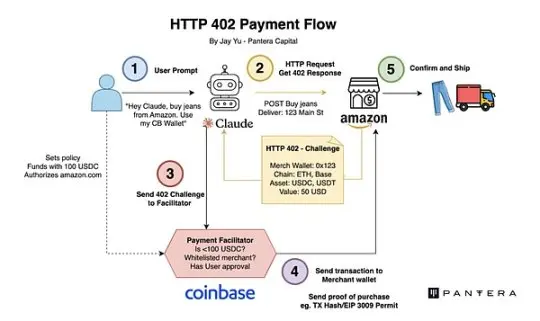
LEGEND: HTTP 402 PAYMENT WORKFLOW
Source: Jay Yu@Pantala Capital
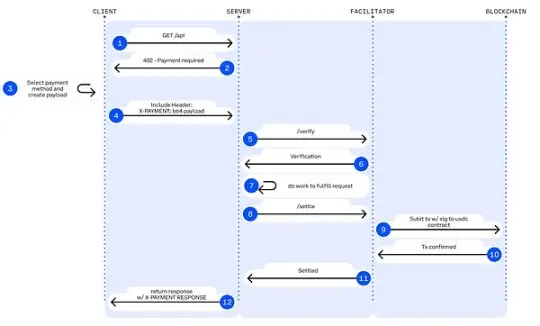
- Core mechanism: x402 agreements revive the early HTTP 402 status code from the Internet. Its work flows to:
- Request and Consultation: Client (Agent) initiated request -> service-end returns 402 status code and payment parameters (e. g. amount, receiving address)。
- Self-payment: Agent signs transactions locally and broadcasts them (usually using stable currency like USDC) without manual intervention。
- Validation and delivery: The immediate release of resources after the transaction on the certification chain of the service provider or third party "Facilitator"。
x402 introduced the Facilitator (Facilitator) role as the intermediate link between Web2 API and Web3 settlement layer. Facilitator handles complex chain validation and settlement logic, allowing traditional developers to monetize API with little code, without the service provider having to run nodes, manage signatures or broadcast transactions and relying on the interface provided by Facilitator to complete the chain payment processing. Currently the most mature Facilitator achieves by Coinbase Development Platform。
the technical advantages of x402 are: to support micropayments on the chain up to 1 cent, to break the limits of the traditional payment gateway that cannot handle HF small calls in the AI scenario; to completely remove accounts, KYC and API Key so that AI can independently complete M2M payments closed loops; and to achieve, through EIP-3009, a Gas-free USDC-authorized payment that is original compatible with Base and Solana, multi-chain scalable。
Based on an introduction to the Core House of Agreements, the table below summarizes the positioning, core competencies, key constraints and maturity assessments at all levels, which provide a clear structured perspective for building a cross-platform, implementable and affordable smart economy。
Web3 Smart Business Eco-Representative Project
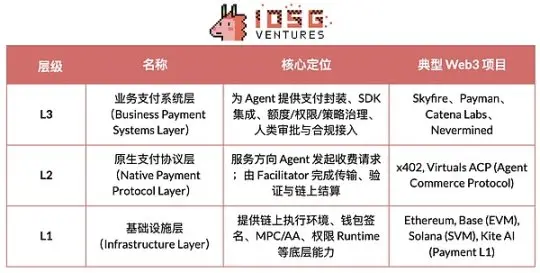
Web3 of Current Smart Commerce can be divided into three layers:
- The Operational Payments System Level (L3) includes projects such as Skyfire, Payman, Catena Labs, Nevermined, which provide payment envelopes, SDK integration, scope and authority governance, human approval and compliance access, and, to varying degrees, interface with traditional financial tracks (banks, card organizations, PSP, KYC/KYB) to build bridges between payment operations and the machine economy。
- The primary payment agreement layer (L2), consisting of agreements such as x402, Virtual ACP and its ecological projects, is the centrepiece of genuine automation and end-to-end liquidation in the current Agent economy and is responsible for claims, payment certification and chain settlement. x402 Provide the original M2M/A2A capacity to pay without reliance on banks, card organizations and payment service providers。
- Infrastructure layers (L1), including Etheleum, Base, Solana and Kite AI, provide a trusted base for the implementation of the environment on the payment and identity chain, key systems, MPC/AA and Runtume。
L3 Business Payments System Level - Skyfire: AI Agent Identity and Payment Certificate
Skyfire, with KYA + Pay at its core, abstracts "Identification + Payment Authorization" as an AI-available JWT voucher to provide a verifiable automated access and deduction capability for websites, API, MCP services. The system automatically generates Buyer/ SellerAgent and hosting wallets for users to support card, bank and USDC fulls。
At the system level, Skyfire generates Buyer/SellerAgent and hosting wallets for each user to support filling balances through cards, banks and USDC. Its greatest advantage is that it is fully compatible with Web2 (JWT/JWKS, WAF, API Gateway, available directly) and provides "identity-based pay access" for content sites, data API, tool class SaaS。
Skyfire is a realistic mid-level Agent Payment, but identity and asset hosting are both central options。
L3 Business Payments System Level - Payman: AI Primary Funding Authority
Payman offers four types of capacity: Wallet, Payee, Polity, Approval, to build a manageable and auditable "fund authority" for AI. AI can enforce real payments, but all financial actions must meet user-set levels, strategies and approval rules. The core interface is through the Payman.ask() natural language interface, which is responsible for the interpretation of intent, validation strategy and execution of payments。
The key value of Payman is that "AI can move money, but never exceed power." "The transfer of enterprise-level funding to the AI environment: automatic payroll, reimbursement, vendor payments, bulk transfers, etc., can be done within clearly defined limits of authority. Payman is suitable for financial automation within the enterprise and team (wages, reimbursements, vendor payments, etc.), positioning as a controlled level of financial governance and does not attempt to construct an open Agent-to-Agent payment agreement。
L3 Operational Payment System Layer - Catena Labs: Age Identity/ Payment Standard
Catena, using AI-Native financial institutions (hosting, clearing, wind control, KYA) as the commercial layer, constructs the Agent Unified Identity Agreement (ACK-ID) and the Agent-native Payment Agreement (ACK-Pay) as the standard layer for Ack (Agent Company Kit). The goal is to fill the missing verifiable identification, authorization chain and automated payment standards in the machine economy。
ACK-ID is based on DD/VC establishing the chain of ownership, delegation of authority for Agent; ACK-Pay defines payment requests decoupling with the bottom clearing network (USDC, Bank, Arc) and verifiable receipt formats. Catena emphasizes long-term cross-ecological interoperability, with a role closer to the "TLS/EMV layer of the Agent economy" and a high degree of standardization and clear vision。
L3 Business Payments System Level - Nevermined: Measurement, Fee and Micropayment Settlement
The Nevermined Focus AI usage-based economic model, which provides Access Control, Metering, Credits System and Usage Logs for automated measurement, sub-counting, sub-counting and auditing. Users can automatically verify usages, deductions and generate auditable logs on every API call via Stripe or USDC charge。
Its core value lies in supporting real-time micro-payments for sub-cent and automated settlement of Agent-to-Agent, so that data purchases, API calls, workflow movements, etc. can be run on a “call-for-pay” basis. Nevermined did not build a new payment track, but rather a measurement/ billing layer over payments: the short-term drive for the commercialization of AI SaaS, the medium-term support of A2A marketplace, and the long-term possibility of micropayments for machine economies。
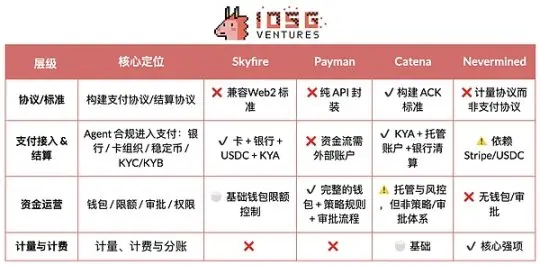
Skyfire, Payman, Catena Labs, Nevermined are in the business pay level, requiring, to varying degrees, interlocking banks, card organizations, PSPs and KYC/KYB, but their true value is not in "access to French currency", but in addressing the original needs of machines that traditional finance cannot cover — — identity mapping, authority governance, procedural controls and subcounting。
- Skyfire (paying gateway): Provide "identity + automatic withholding fee" for website /API (link identity map Web2)
- Payman (financial governance): strategy, scope, authority and approval for the enterprise (AI can spend but not exceed authority)
- Catena Labs (financial infrastructure): The banking system is integrated, constructed through KYA, hosting and liquidation services (AI Compliance Bank)
- Nevermined (Cashboard): only measures and charges are paid above; payments depend on Stripe/ USDC。
By contrast, x402 is at a lower level and is the only original payment agreement that does not depend on banks, card organizations and PSP, and can be made directly through the 402 Workstream for the payment and settlement of the chain. When upper-level systems such as Skyfire, Payman, and Nevermined can call x402 as a clearing track, thus providing the genuine M2M / A2A automated primary payment closed loop for Agent。
L2 Primary payment agreement layer - x 402 Ecology: settlement from client to chain
x402 Native payment ecology can be divided into four levels: client (Clint), service (Server), payment execution (Facilitators) and block chain settlement. Clients are responsible for enabling Agent or applications to initiate payment requests; the service end provides API services such as data, reasoning or storage to Agent in descending order; the payment of payments on the completion chain of the enforcement layer is the core execution engine for the entire process; and the block chain settlement layer assumes the final confirmation of debits and chains to achieve non-alterable payments。
LEGEND: X402 PAYMENT FLOW
source: 402 white paper
Client-Side Industries / The Payers
Allowing Agent or application to initiate a request for payment x402 is the starting point for the entire payment process. Representative items:
- (b) The most commonly used ecox402 client standard, which maintains active, multi-chain support, is a default tool for developers to integrate x402。
- Nuwa AI— — enables AI to access the representative items of the "Agent Paygate" service at no direct cost without coding。
- Axios/Fetch, Mogami Java SDK, Tweazy, etc. are also listed as early clients。
The current client remains in the "SDK Age" and is essentially a tool for developers. A more advanced type of browser/OS client, robot/IOT client, enterprise system that can manage multiple wallets/ many Faciliator has not yet emerged。
Service / API Commodity (Services / Endpoints / The Sellers)
The sale of data, storage or reasoning services to Agent, in part on behalf of projects, includes:
- AIsa & mdash; & mdash; API Call and Clearing Infrastructure, which provides a fee-paying resource for real AI Ages to enable them to access data, content, algorithms and third-party services by call, token or volume, currently x 402。
- Firecrawl & mdash; — AI Agent's most frequently consumed web-based analysis and structured reptile portal。
- Pinata & mdash; & mdash; Mainstream Web3 storage infrastructure, x 402 already covers real bottom storage costs that are not light API。
- Gloria AI & mdash; & mdash; Provides high-frequency real-time news and structured market signals, transactional and analytical sources for Agent。
- AEON— — x402 + USDC extended to sub-business receipts in Southeast Asia/Latin America/Africa。
- Neynar— — Farcaster Social Map Infrastructure, which opens social data to Agent in the form of x402。
The current service end focuses on reptiles / storage / news API, and the implementation of financial transactions by API, advertising by API, the Web2 SaaS gateway and even the more advanced critical layers of API, which can perform real-world tasks, are almost undeveloped and represent the most promising growth curve for the future。
Facilitators/ The Projects
completion of chain deductions, validation and settlement is the core implementation engine x 402, representing the project:
- Coinbase Facilitator (CDP) & mdash; — Enterprise-level Credible Executor, Base Homenet Zero Rate + Internal OFAC/KYT is the strongest option in the production environment。
- PayAI Facilitator & mdash; & mdash; Multi-chained: the widest and fastest-growing project on the executive layer (Solana, Polygon, Base, Avalanche, etc.), which is the most used multi-chain in ecology, Facilitator。
- Daydreams— — a strong scene project that combines the LLM reasoning path, is the fastest-growing "AI reasoning payment implementer" and is becoming the third-polar force of x402 ecology。
According to nearly 30 days of x402scan, there are also a number of medium-sized and long-term tails, including Dexter, Virtuals Protocol, OpenX402, CodeNut, Heurrist, Thirdweb, x402.rs, Mogami, QuestFlow, etc., the total number of transactions, the number of sellers, the number of buyers, etc., are significantly lower than the first three。
Block chain settlement (Blockchain Settlement Layer)
x 402 Final point of loss for the payment of work flows, responsible for completing the actual debit and chain confirmation of the token. Although the X402 protocol itself is Chain-Agnostic, in terms of current ecological data, settlements are concentrated mainly on two networks:
- Base— — by CDP official Facilitator, USDC is home-grown, cost-stabilized and currently the largest clearing network for transactions and sellers。
- Solana— — supported by multiple chains such as PayAI, Facilitator, with high throughput and low delay, grew fastest in high frequency reasoning and real time API scenarios。
The chain itself is not involved in the payment logic, and as more Facilitator expands, the settlement layer of x402 will show a stronger trend towards multi-chaining。
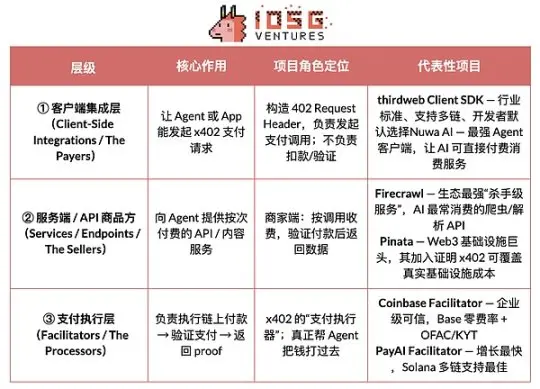
In the x402 payment system, Facilitator is the only real payer on the enforcement chain, the most recent being the "agreement-level revenue": it is responsible for certifying payment authorizations, submitting and tracking transactions on the chain, and producing auditable clearance certificates, while processing re-laying, timeout, multi-chain compatibility and underlying compliance checks. Unlike Client SDK (Payers) and API (Sellers), which only deal with HTTP requests, it is the final clearing export of all M2M/A2A transactions, with access to traffic and settlement fees, and is therefore at the value capture core of the Agent economy, with the greatest market interest。
The reality, however, is that most projects are still in the testing network or small Demo phase, which is essentially a light "pay implementer" with clear low-threshold, high-homogenization features in the absence of critical capacities such as identity, billing, wind control, and multi-chain steady state processing. As the ecology matures, Facilitator will have a winner-take-all pattern: the head agency with the advantage of stability and compliance (e.g. Coinbase) has a strong lead base. In the long term, x402 is still an interface layer, unable to carry core values, and truly competitive on a continuous basis is the ability to build an integrated platform for an identity, billing, wind control and compliance system based on settlement capabilities。
L2 Origin Payment Protocol Layer - Natural Payment Corporation
The Virtual Agent Company Protocol (ACP) provides a common set of standards for business interaction for autonomous AI, which enables independent intelligence bodies to request services, negotiate terms, complete transactions and undergo quality assessment in a secure and verifiable manner through the ReQuest & Rar; Negotiation & Rrr; Transaction & Rrr; Evaluation IV process. ACP uses block chains as a credible enforcement layer to ensure that interactive processes can be audited and not tampered with, and that an incentive-driven system of credibility is created by introducing Evaluator Argentinas, so that an intersecticular and independent profession, Agent, can form an “autonomous business” without central coordination and engage in sustainable economic activity. At present, ACP is still in its early stages, with a limited ecological scale, more like an exploration of the "business interaction criteria for multi-smarts"。
L1 Infrastructure Layer - Kit AI: Emerging / Vertical Agent Payment Chain
Major common public chains such as Etheium, Base (EVM) and Solana provide Agent with the core implementation environment, account systems, status machines, safety and settlement base, with mature account models, stable currency ecology and a broad development base。
Kite AI is a representative "Agent Original L1" infrastructure designed for the lowest level of implementation of payments, identities and privileges for intelligence. Its core is based on the SPACE framework (stable currency origin, programmability constraints, agent priority certification, compliance audit, economically viable micropayments) and is isolated by the three-tier key system of Root&rr; Agent&rr; Session; and the construction of the "Agent Native Payment Railway" in conjunction with optimized status channels, which puts costs at $0.0001, delayed control at 100 ms, making API-grade HF micropayments feasible. As a generic executive level, Kite is upperformed by x 402, Google A2A, Anthropic MCP, downperformed by OAuth 2.1, with the target being the unified Agent payment and identification base connecting Web2 to Web3。
The AisaNet integration x 402 agreement with L402 (Lightning Labs developed 402 payment protocol standards based on a lightning network) as a micro-payment and settlement layer for AI Agents to support high-frequency transactions, cross-agreement call coordination, settlement path selection and trade routes, enabling Agens to complete cross-service, cross-chain automatic payments without understanding the underlying complexities。
Summarizing and looking forward: from payment agreements to restructuring the machine economy
Smart Commerce is the creation of a new machine-led economic order. It is not as simple as "AI Automatic Listing" but rather a whole re-construction across the main chain: how services are discovered, how credibility is built, how orders are expressed, how authority is delegated, how value is liquidated, and who bears the burden of the dispute. The emergence of A2A, MCP, ACP, AP2, ERC-8004 and x402 standardized the "commercial closed loop between machines"。
along this evolutionary path, the future payment infrastructure will be divided into two parallel tracks: an operational governance track based on the traditional monetary logic and a primary settlement track based on the x402 agreement. the value of the two is not the same。
Operational governance track: Web3 Operational payment system layer
Application scenario: Real world transactions with low frequency, non-micropayments (e.g. procurement, SaaS subscriptions, physical electricians)。
Core logic: The traditional French currency will long be dominant, and Agent is a smarter front-end and process coordinator rather than a substitute for Stripe / card/ bank transfer. The hard barrier to large-scale currency stabilization into the real business world is regulation and taxation。
The value of Skyfire, Payman, Catena Labs is not at the bottom of the payment route (usually done by Stripe/Circe), but at the Machine Governance Service (Governance-as-a-Service). This means addressing the original needs of machines not covered by traditional finance — identity mapping, authority governance, procedural control, attribution of responsibility and M2M / A2A micropayment (token/sec). The key is who can be the AI finance housekeeper of business。
Native settlement track: x 402 protocol ecology and Facilitator terminal
APPLICABLE SCENARIO: HF, MICROPAYMENTS, M2M/A2A DIGITAL PRIMARY TRANSACTIONS (API BILLING, RESOURCE FLOW PAYMENTS)。
Core logic: x 402 (L402) as an open standard to bind payments to resource atomization via HTTP 402 status code. In programmable micropayments and M2M / A2A scenarios, x402 is currently the most ecologically complete, pre-depositioned protocol (HTTP original + chain settlement), with a prospective analogy of position in the Agent economy `Stripe for goals'。
Simple access at the Client or Service end x402 does not result in a race price premium; what really has the potential for growth is the ability to settle long-term repurchases and high-frequency (HF) transfers of upper-level assets such as OS class Agent client, robot /Iot wallets and high-value API services (market data, GPU reasoning, real-life task execution, etc.)。
Facilitator assisted Clit and Server to complete the payment handshake, invoice generation and settlement of funds agreement gateway, which is the closest link to the "income" in x402 Stack. Most Facilitator is essentially a "pay implementer" with obvious low-threshold, homogenized characteristics. Largers with the advantage of availability and compliance (e.g. Coinbase) form the dominant pattern. The core value of avoiding marginalization will be moved up to the "Facilitator + X" service level: providing high-māori capacity for arbitration, wind control, treasury management, etc., by building a verifiable service catalogue and reputation。
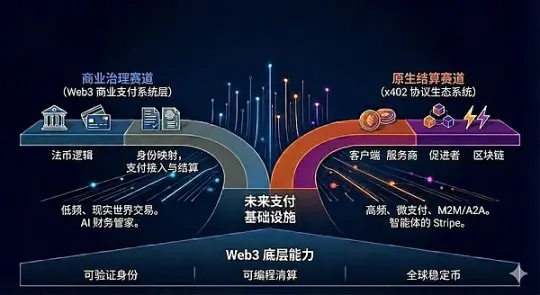
We believe that the future will be a "two-track parallel" to a "stable currency system": the former, which supports mainstream human commerce, and the latter, which carries high-frequency, cross-border and micro-payment scenarios of machine origin and chain origin. The role of Web3 is not to replace traditional payments, but to provide the bottom-up capacity for the Age of Agent to verify identity, programmable liquidation and global stability currency. Ultimately, smart commerce is not limited to payment optimization, but rather is a re-establishment of the machine economic order. When billions of microtrades are automatically completed by Agent backstage, those agreements and companies that spearhead the ability to provide trust, coordination and optimization will become central to the next generation of global business infrastructure。
