
Paradigm bet Brazil: the new battle for stability is not in the United States
When the dollar stabilizes the dividend, Paradigm chooses Brazil as a well-regulated, well-paid market where the currency stabilizes with huge incremental space。

Original title: Paradigm voted for Brazilian Stable Currency, but why Brazil
Photo by Eric Foresight News
In recent days, Crown, Brazil's Stabilisation Currency Corporation, has completed the $13.5 million A round of financing, which was invested by Paradigm, with a $9.0 million valuation. In the press release of The Block, it was clearly emphasized that this was the first time Paradigm had invested in Brazilian companies. This financing was also Crown's second round, completed in two months, and in mid-October Crown just completed the $8.1 million seeder finance, which was sponsored by Framework Ventures, Coinbase Ventures and Paxos。
That's not the front page, but there's two things on the news that deserve attention: why Crown? And why Brazil
Crown, why is it worth investing
An analysis of one matter usually requires consideration of both internal and external factors。
With regard to external factors, it is argued that there are few investment opportunities for local United States stabilizers, and Tether and Circle have taken over most markets, making it necessary for investment agencies to target external markets if they are to find a bigger Alpha. Foreign capital is allowed to invest in companies associated with domestic currency, and stable currencies have the same few domestic market targets。
Brazil is a rare “holy land” in the Americas that meets most of the conditions。
Turning to Crown, according to the data disclosed, the current total of the Rials issued by Crown is just over 100 million, the value of which in dollar terms is less than 20 million, and the amount of transactions over the past 30 days is only 56,000, which means that currently Brazil’s domestic currency is not a large market, let alone Crown, for institutional customers。
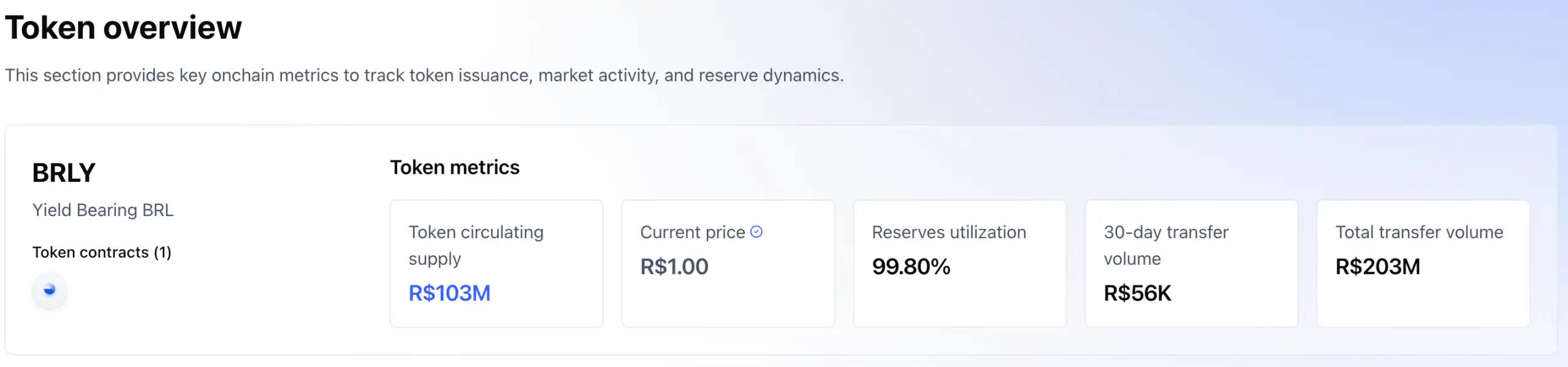
Obviously, the logic of investing in Crown is that the team behind the bet can do something in the future in this market。
Crown's founder and CEO John Delaney was a lawyer in the international financial field and the COO of Xerpa, a well-known local Brazilian firm, received investments from Founders Fund. In 2019, Xerpa launched the "Earned Wage Access" platform, which allows employees to pay their days of work early (rather than waiting for the end of the month) to help avoid high-interest credit. This is particularly popular in the context of high interest rates and financial pressures in Brazil and is considered an instrument of financial well-being for employees. The company charged fixed and small fees without interest。
The co-founder and chief engineer, Vinicius Correa, was an early engineer at the Digital Bank of Brazil, Nubank. Nubank ' s investment institutions are also luxurious, and of a total of $2 billion in multiple rounds of financing, the participating institutions include Redwood capital, Tiger Global, Goldman Sachs, Founders Fund, Tent, Birkhel Khasawe, Nubank in New York City in 2021, with an IPO estimate of $41.5 billion and a current market value of nearly $80 billion。
Alex Gorra, a founding partner and head of ecology, was a managing partner in the $5 billion family office that managed the $5 billion assets of Brainvest, and had previously served in the management of ARX Investments, the Swiss Sing Group, Rosschild Bank and Chase Morgan. COO Bruno "BL" Passos has been leading cross-functional teams in Hashdex。
Crown’s founding team can be described as a full-blown team of stars, and both founders have been involved in the process from 0 to 1 in Brazil’s indigenous enterprises, although the current BRLV data are not good, but it does not prevent them from obtaining financing totalling over $20 million in two months。
In addition, the Brown team, in a blog, said that its launch of BRLV was essentially an observation of the contribution of USDT, USDC, to the purchase of national debt. It is also good that the local issuance of stabilization coins in Brazil can provide purchasing power for the national debt, thereby stabilizing the economy and, in turn, stimulating the use of stable coins. If the dollar stabilizes the United States of America, then the reais stabilizes the country。
Why Brazil
In terms of the legal currency at the bottom of the stable currency, there seems to be much better choice than the Brazilian reais, but why Brazil
You might not believe it, but it's probably 80,90 the last time you hear about football is one of Latin America's leading innovation centres, with more than 1500 financial technology companies and more than 100 million users。
As a capitalist country, Brazil's banking sector has long been dominated by five major banks (Itaú, Banco do Brasil, Bradesco, Caixa, Santander), with assets over 80 per cent, well above those of the United States (about 50 per cent). Traditional banking services are rigid, expensive (credit card annualized interest rates are often over 300 per cent) and highly bureaucratic, leading to the exclusion of tens of millions of low- and middle-income people and those without bank accounts (historicly up to 55 million)。
But it also creates a huge demand gap, with financial technology companies like Nubank cutting in from a free credit card to provide simple, low-cost services that quickly fill market gaps。
The Central Bank of Brazil, although unable to change the monopoly of traditional banking, unexpectedly took the initiative to promote competition and inclusion, and even became a classic case of global digital finance regulation, with the greatest contribution being the introduction of the instant payment system Pix in 2020. Pix supports free and 24/7 real-time transfers, with transactions exceeding R$ trillion in 2025 and users covering more than 90% of the population. Pix quickly replaced cash and credit cards with a 76 per cent preference for Brazilians, significantly boosted financial inclusion and provided Fintech with low-cost infrastructure (e.g. integration of Pix payments, credit innovation)。
I'm sure you've also seen the integration of trading platforms or Cripto payment tools for Pix in Web3 industry news. It is indeed difficult for a capitalist country’s central bank to take the lead in launching a payment system that could destabilize the old banking system, but this “good-for-people” orientation has also given local financial technology companies better prospects for development by reaching more users。
It is for this reason that new forms of finance, such as encrypted currency, are highly acceptable in Brazil. Brazil has over 200 million people, nearly 90 per cent access to smartphones, more than 180 million Internet users and more than five hours per person. Young, digital First Nations, especially Z generation, have a strong demand for mobile finance. Last September, Circe directly started supporting the use of Rayar direct exchange USDC。
The prevalence of the dollar stabilization currency in Brazil has been analysed in many articles as a result of the instability of the Brazilian national currency, but, according to various sources, even the reasons for this are only a small fraction. It now appears that, if that is the case, investment institutions like Paradigm would not be so heavily charged with Brazilian domestic French currency stabilization and financial technology companies。
In fact, Brazil did experience multiple cases of hyperinflation in the 8th and 90th centuries, and even extremes with a monthly inflation rate of 80%. However, in recent years, while reial fluctuations have remained modest, for a country like Brazil they have had a good effect in terms of currency stabilization and inflation reduction. Brazil's inflation rate hovered between 4.5% and 5% in 2025, although still above the central bank's target, it was better than next door in Argentina。
It is true that part of the Brazilian local population holding the dollar-stabilized currency is designed to depreciate against the dollar, especially in the context of the interest rate hikes of the Federal Reserve in previous years, but more for practical purposes such as foreign trade, tax avoidance, ease of capital flows, and trading in encrypted currency。
According to Chainalysis, Brazil has the fifth largest index of encrypted currency after India, the United States, Pakistan and Viet Nam. In July 2024 to July 2025, the inflow of encrypted currency reached US$ 3,18.8 billion, killing Latin American countries。
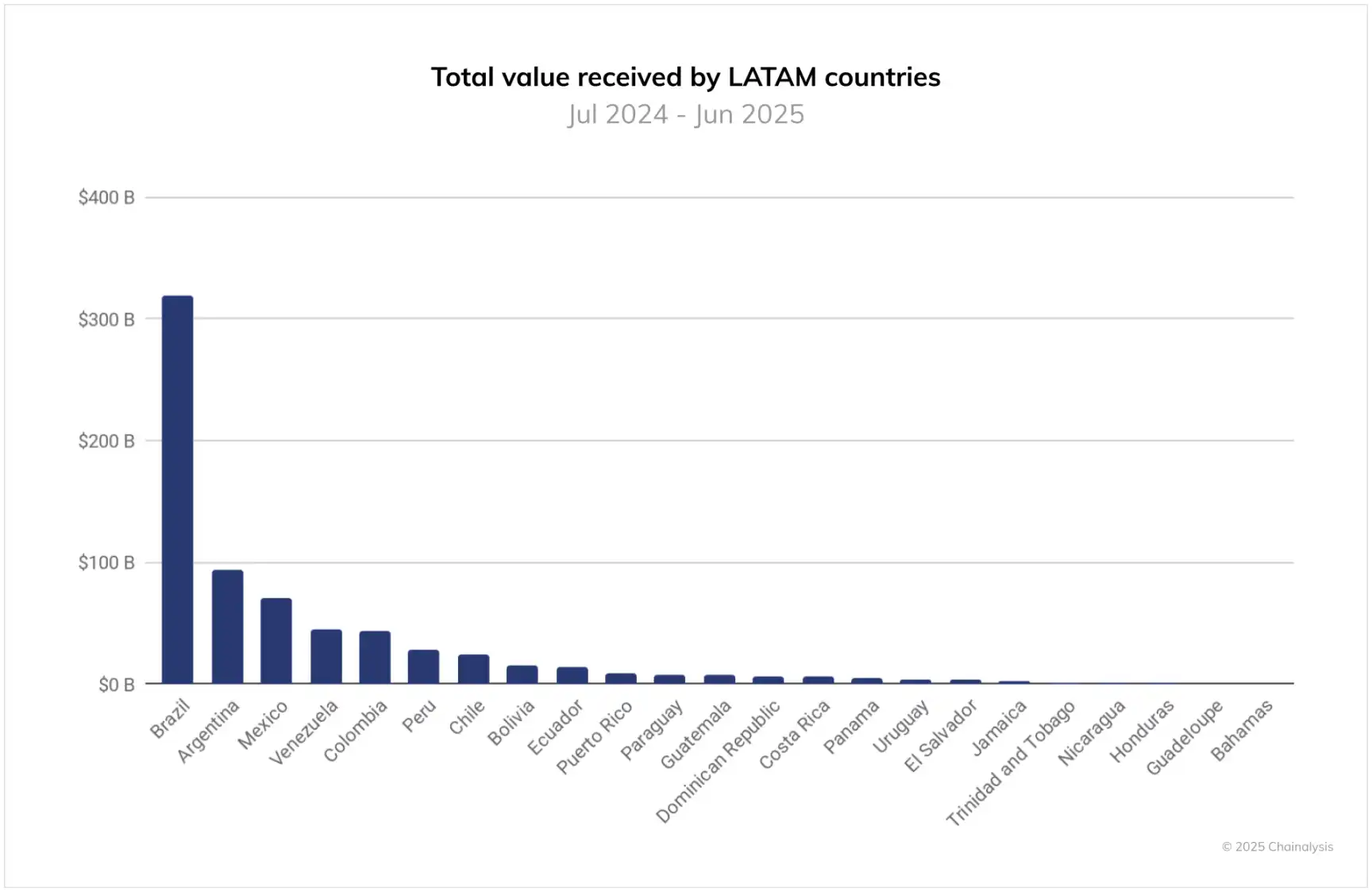
There is also the data provided by the encrypted money marketer Gravity Team, which Brazil has used as a tool for investment and cross-border payments, and which currently accounts for about 70 per cent of the indirect financial flows of Brazilian local trading platforms to international trading platforms。
And then one might ask, what is the point of a stable currency, given that it already has a national payment tool like Pix
Brown launched BRLV, a feature of a network that is not explicit but mentioned in the press release, is that it will share interest earnings on the national debt with the holders of stable currencies, compared to 15 per cent in Brazil. Although it is not possible to allocate all of them to the holders, even half is a very attractive rate of return。
In the future, BRLV can also access the Pix system, and ordinary people, even the poor, may not have the incentive to exchange the stable currency, but for the wealthy, the stable currency not only does not affect payment, but even holds it to "interest" and, in the future, trades seamlessly with the dollar, and even engages in DeFi, all the imaginations that will ensure that the stable currency has enough needs and scenes on the land。
In countries where most countries are weak and are unable to maintain long-term stability in their own currencies, the dollar and dollar stability is a lifesaver for the population, with the exception of Brazil。
