
When a bitcoin mine goes into space
SpaceX was the first to put AI algorithms in orbit, and the same logic is driving bitcoin machines into space。
According to numerous media reports, SpaceX, a space exploration technology company in Mask, will submit an IPO book to the United States Securities and Exchange Commission (SEC) in the near future, with a target estimate of $1.75 trillion, with a projected financing of over $75 billion. If we proceed, this will be the largest IPO in human history, leaving behind the $29.4 billion record of Saudi Arabia and the United States in 2019, which will also be the most important IPO for this year。
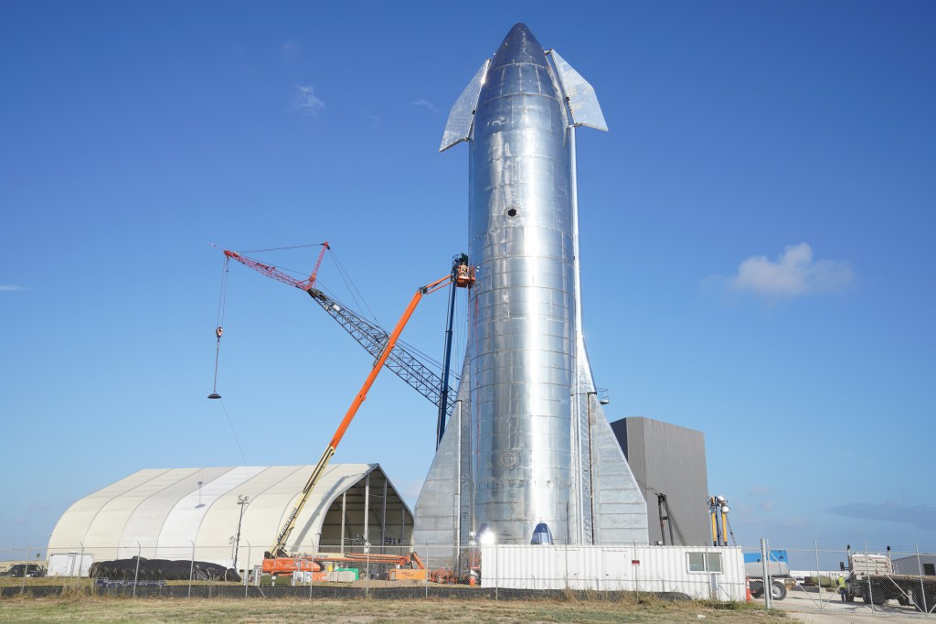
It is interesting to see that SpaceX suddenly acquired another company under the Mask flag XAI in February 2026, and included the Orbital Data Centre in its core strategy: to use the cosmic vacuum environment to heat up and power it with continuous solar power, and to send it to near-Earth orbit. Musk believes that space-based AI is the only way to achieve scale development in the long run。
At the same time, In Welda was also active in this direction. It invested in Starcloud, the orbital data centre start-up company, which successfully put an English-led H100 GPU into orbit in November 2025, completing the first-ever AI-based model training and reasoning in human history。
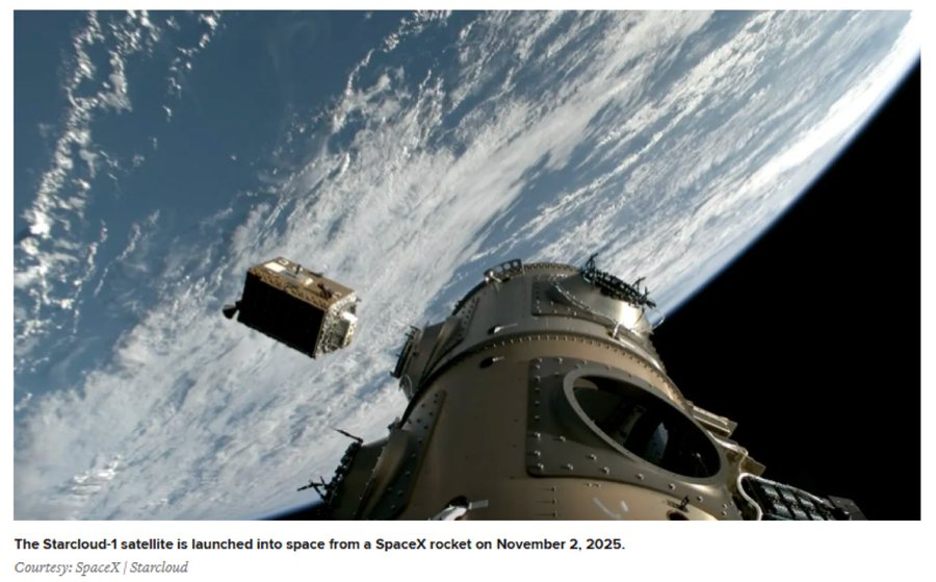
As Space X puts AI in the air, many people start to wonder, whether bitcoin mining can be moved to space with the same reliance on calculator chips and solar energy? But the problem is, in fact, far more complex than you can imagine。
A satellite, a solar panel, a miner
Mining is a competitive mathematical calculation. Millions of miners around the world operate simultaneously, fighting for the fastest out of a given Hash, and successful people receive a bitcoin award for the current block. This process, known as Proof of Work, costs a lot of electricity. The global Bitcoin network continues to consume about 20 gigawatts, equivalent to the total amount of industrial electricity used in a medium-sized country. The profits of miners are largely determined by electricity prices, which, once higher, are reduced。
And the endless sunlight in space corresponds to the core cost variable of bitcoin mining: electricity。
In Earth orbit, solar radiation is about 1380 watts per square metre, six times the average ground level, and is free from cloud, day and night or seasonal interference. In a given sun-synchronous orbit, satellites can be close to receiving sunlight 24 hours a day and generate electricity on a continuous basis. Placing a miner on the back of a solar panel and putting it in orbit so that it can dig forever is the bottom logic of space mining。
Peter Todd, the Bitcoin core developer, published a technical analysis in December 2024, moving the idea from vision to blueprints for work. He introduced the concept of a “plating machine”: the ASIC chip was installed directly on the back of the solar panel, facing the sun, the chip on the back consumed electricity for mining, and the overall structure was radioactively hot in both directions。
Space dispersion is an anti-intuitive problem. On Earth, the heat of the chips can be removed from the air current; but in a vacuum space, there is no air, and the heat can only be released by radiation. Todd ' s calculations show that, without adding additional dispersive devices, thermal equilibrium temperature in orbit of this structure is approximately 59°C, which is fully within the normal working range of the chip. If the temperature is high, the problem can be further improved by tilting the entire panel slightly against the Sun and reducing the light area。
Communication is equally surprisingly simple. In essence, the communication between miners and ponds is the reception of new blocks, the submission of calculations, the amount of data generated on a daily basis of about 10MB, which is less than the flow consumed by a song broadcast by streaming media. Communications in LEO (500 to 1,000 km) are delayed between 4 and 30 ms, resulting in a probability of less than 0.01 per cent of scrap (i.e., submission of outdated calculations), which is of the same magnitude and is not materially different from the vast majority of terrestrial miners. In fact, Blockstream began broadcasting a complete bitcoin block chain to the world using geosynchronous satellites as early as 2017, proving that the combination of satellites and block chains was never a problem。
So, what's the difference between physical and engineering frameworks? This is due to the high price of rocket transport。
I can't figure it out
The Falcon 9 rocket Space X delivered the cargo to low Earth orbit at a current cost of approximately $2,720 per kilogram。
Peter Todd estimates that a complete 20-kW space mining system covers solar panels, heaters, ASIC chips, structural support and communication modules, with a total weight of approximately 1,600 to 2,200 kg. At current prices, the cost of a single launch is between $4.3 and $6 million。
How much money does the system contribute every day? The researcher Nick Moran gave the answer: the daily gain was about $92.7 or $34,000 for the year. The cycle is back over 100 years。
The CEO Philip Johnston of Starcloud calculated that the cost of the launch had to be reduced to less than $200 per kilogram for the basic commercial logic of space mining. This means that costs need to be reduced 13 times。
SpaceX ' s Starship (Starship) is widely regarded as the key to achieving this crossing. A fully reusable starship can theoretically put the launch cost below $100 per kilogram at even lower, which is one of the assumptions that will make it possible to establish a space data centre in SpaceX ' s current IPO vision. But when and whether this cost curve will materialize is still an outstanding variable。
Another challenge is the automatic adjustment of the entire network of bitcoin mining difficulties. The Bitcoin agreement calculates the sum of the total capacity of the entire network every two weeks and automatically adjusts the difficulty of mining to keep the speed of the blocks at about one in 10 minutes. In other words, all miners, including those in orbit, will be simultaneously compressed in profits if large numbers of space miners enter the market and the full-web computing power increases dramatically, with the resulting increase in mining difficulty。
There's always someone in this world who's busy searching for treasures
Nevertheless, there are a number of start-ups that are trying to move this forward。
Starcloud, a former Lumen Orbit, is currently the closest company to actual landing and the most important observation sample of the entire track. Founded in 2024, based in Raymond, Washington, D.C., behind the NFX, Y Combinator, a16z and the Angel Foundation of Redwood Capital, as well as Inweida. Total financing was about $200 million. The company CTO had worked in the airline defence and space sector for 10 years, and the chief engineer had previously been in charge of the Starlink project at SpaceX。
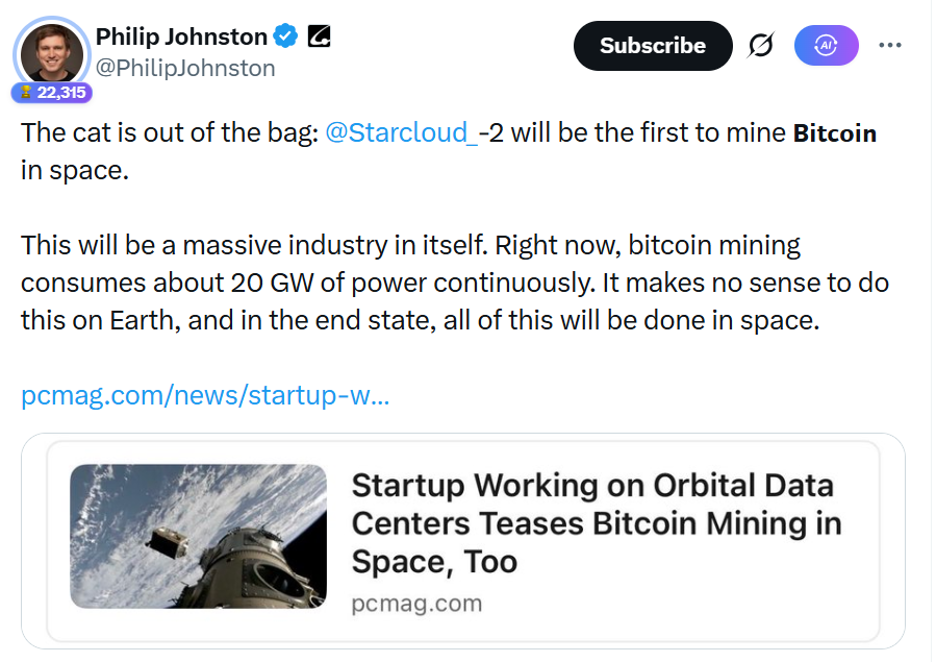
In November 2025, Starcloud successfully put into orbit the first satellite carrying H100 GPU in British Weidar, operated the Google Gemma language model in space and sent to the ground the first message from AI in human history in orbit. In March 2026, Starcloud announced that the second satellite would carry simultaneously the Bitcoin ASIC chip and the newest generation of Blackwell GPU in Inverda, with the goal of becoming the first organization in human history to dig up Bitcoin in space. In addition, the company has applied to the United States Federal Communications Commission (FCC) for a constellation programme of up to 88,000 satellites, with the long-term vision of building in orbit a computing infrastructure totalling 5 GW。
SpaceChain is an OG player on this track, created by Jeff Garzik, a former Bitcoin core developer, together with Zheng Zhong. Since 2017, SpaceChain has launched at least seven block chains to satellites and ISS. In June 2020, Garzik completed the first human transfer of space bitcoin in orbit 400 km from the ground, in the amount of 0.0099 BTC, using the multiple signature wallet nodes installed on the space station by Space Chain. The core direction of SpaceChain is the orbital security node of trade in block chains, rather than active mining: locking private keys in space without physical contact from any hackers or governments on the ground。
Cryptosat, created by two Dr. Stanfords, currently operates three satellites in orbit, mainly providing anti-false orbital cryptography services. In 2023, Cryptosat participated in the largest credible set-up ceremony in the history of the Taifung (KZG Céremony), which generated some random number parameters through the orbital nodes, ensuring at the institutional level that they could not be controlled by any single ground agency. It explores another possibility of a space zone chain: not mining, but making the entire encrypted economy more difficult to attack。
From orbit to market: what does this mean for mining
For the currently operating Bitcoin mining industry, while not creating a real competitive threat in the short term, there are still a large number of start-ups that continue to try, which also means that it represents a significant reduction in the space behind it, and that the attractiveness and imagination of the industry remains high. This also reflects the fact that the entire industry is facing structural cost pressures。
After halving by 2024, global computing power and difficulty continued to grow at an all-time high, with energy costs accounting for 70 to 90 per cent of total operating costs. Against this backdrop, the moat is the deepest of those who have stable access to clean electricity at the lowest cost. Hydropower, wind energy and natural gas resources in the United States, the Middle East and Africa are becoming central drivers of a new round of mining mergers and acquisitions and site selection。
The logic of mining in space is an ultimate extrapolation of the above-mentioned trend: if cheap electricity on the ground eventually shrinks because of competition for demand, then go to the most energy-rich place, the universe。
Of course, in 2026 the Starcloud-2 satellite dug up the first bitcoin, which would have been equivalent to about one piece of sand falling into the sea for the global sum of more than 900 ETH/s per second. But symbolism is per se penetrating. Like the 0.0099 BTC space transfer in 2020, its value is not in money, but in proof that it is achievable。
From SpaceX's IPO narrative to the orbital calculator layout in Weida, to Starcloud's ASIC project, a contours is emerging: the universe is becoming a competitive arena for the next generation of computing infrastructure. AI is the first to go, and bitcoin is right behind it。
On that day, the global digital network that connects all corners of the planet, as described in the Chinese White Paper, could also emerge from the Earth and float out of the universe in search of new opportunities。
