
You bet on the news, head-to-head reading: Polymarket's lost real cognitive shit
In Polymarket, the majority of the people who lost to the car owners did not lose judgement, but did not read the rules seriously. 。

Original by: Changan, Biteye Content Team
Do you know why you can't play in the car in Polymarket? Because they stare at the rules, they bite like lawyers on contracts。
In April 2026, Polymarket's last dispute about Venezuelan leaders blew up in the community。
A market in Polymarket asked, "Who was Venezuela's leader at the end of 2026? Intuitively, many traders were: Maduro was in American jail, Delcy was in Caracas presiding over the cabinet, and the de facto authorities were apparently Delcy, and they put their chips on Delcy。
However, it is clear from the rules and supplementary notes that “official holds” refers to those who are duly appointed and sworn in. The Government of Venezuela, which was accredited by the United Nations, did not formally dismiss or replace Maduro, and the official Government ' s information continues to identify him as President. The rule also adds a specific sentence: “Temporarily authorizing the exercise of presidential authority does not amount to a transfer of presidential office”
According to this rule, Maduro remains the legitimate President of Venezuela even though he remains in United States prisons。
There are many similar examples:
- Polymarket issued a stable coin, and the market was in dispute about the "Polymarket token FDV."
- iran uranium: "approval" standard, conditional vs duly signed agreement
Behind these cases is the same logic: in Polymark, the rules are at the core. But when the rules were disputed, Polymarket had a complete award process to resolve: This paper will describe how the mechanism works and where it is similar and where there are fundamental gaps compared to traditional courts。
I. award mechanisms in Polymarket
The ambiguity of the text of the rules is not merely the result of pricing differences, but it can become a formal dispute at settlement。
Polymarket has a large number of market settlements on a daily basis, involving political statements, diplomatic statements, and markets for military operations that are particularly controversial。
The controversial events are really predicting the market. Discrepancies that create price differences at the trading stage and become controversial at the settlement stage are different manifestations of the same issue at two points in time。
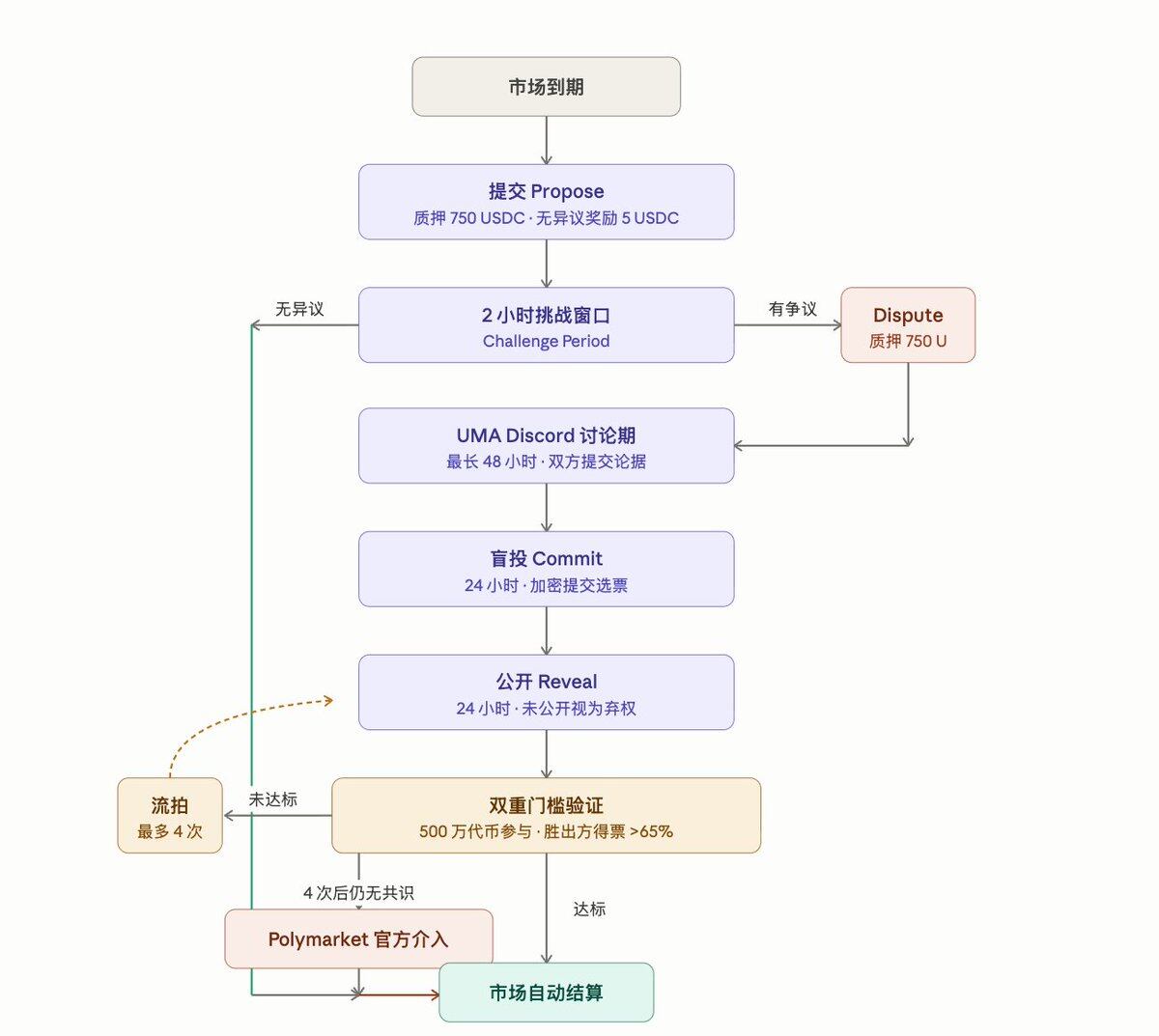
In order to resolve these disputes, Polymarket established a complete award process with two paths, normal settlement and dispute decisions。
Step 1: Submission Propose
When the market meets the settlement conditions, any person may submit an award stating that the market should pass YES or NO. A pledge of 750 USDC is required at the time of submission of the proposal as a bond, which is an endorsement by the submitting party of its own judgement, and a reward of 5 USDC is available to users who submit Propose when there is no objection to the market。
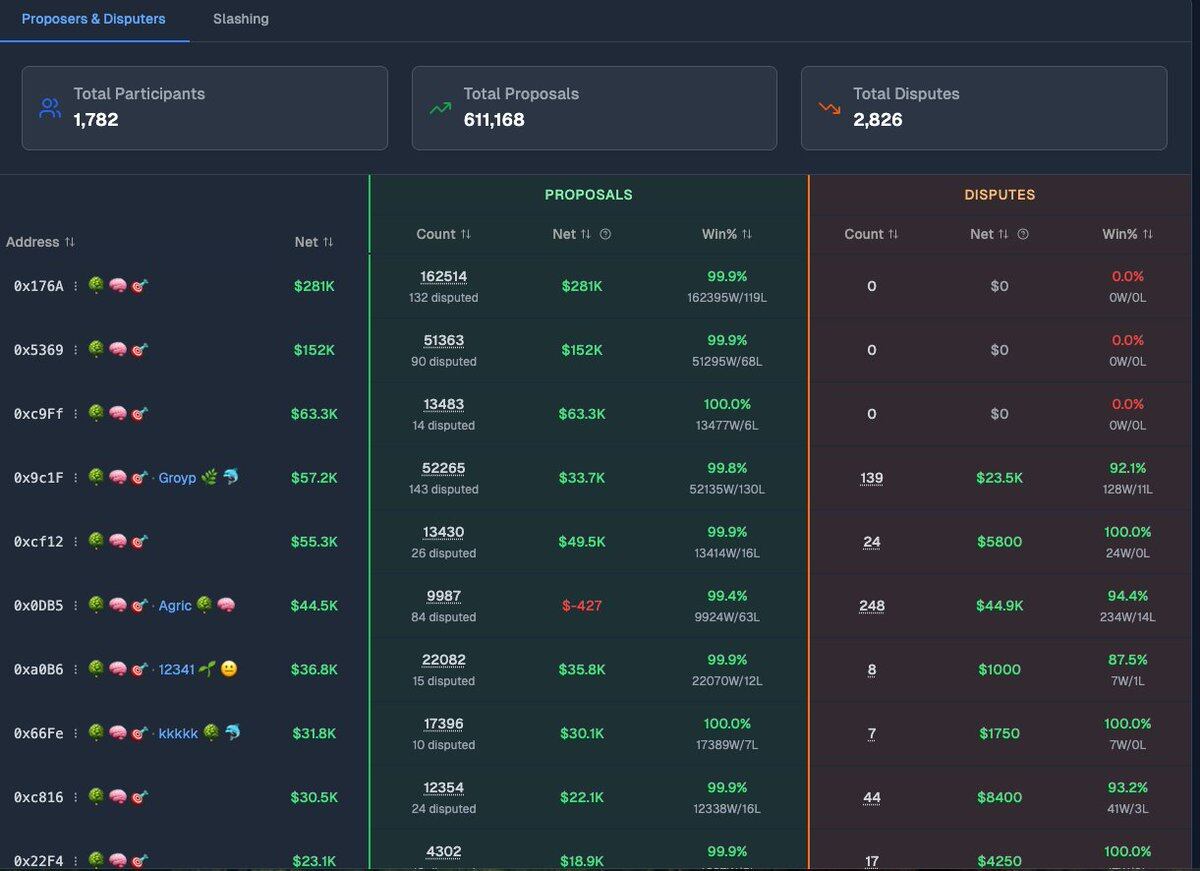
At present, Propose has only 1782 users on the market, and the most profitable users have accrued $281K。
Step 2: 2 Hour Challenge Window
After the proposal is submitted, the challenge period of two hours is reached. This is the first fork in the whole process。
No objections were raised within 2 hours, the system defaulted on the correct proposal, the market was closed and the process was closed. This is the path that most markets follow。
IF THE RESULT OF THE PROPOSAL IS THOUGHT TO BE INCORRECT, THE CHALLENGE CAN BE RAISED WITHIN THIS TWO-HOUR PERIOD AND A PLEDGE OF 750 USDC IS ALSO REQUIRED. THE CHALLENGE IS SUCCESSFUL AND CAN EARN 250 USDC BONUSES。
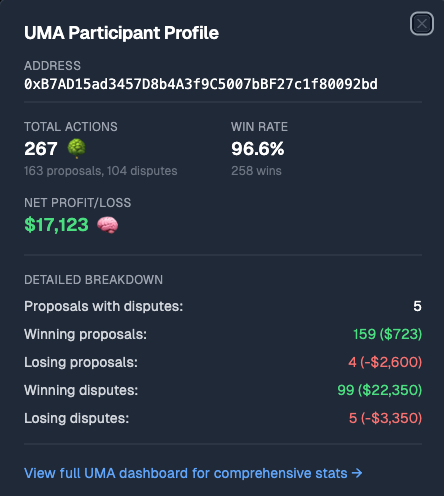
Few people in the market specialize in Dispute, and the most profitable users in Dispute are 0xB7A, with a profit of $17123。
Step 3: Maximum 48 hours discussion Period
After entering the dispute track, the parties entered the UMA Discord discussion phase. The role of this phase is to allow the parties to submit arguments and evidence: the interpretation of the text of the rules, relevant press reports, historical precedents, official statements — any material that can support their position can be presented at this stage。
The maximum duration of the discussion, 48 hours, was the only fully justified link in the process, the quality of which largely determined the course of the subsequent ballot。
Step 4: 48 hours to vote
AT THE END OF THE DISCUSSION, THE UMA CURRENCY HOLDERS VOTED IN TWO STAGES OF 24 HOURS EACH。
- The first stage is blind voting. Each voter must make an independent judgement based on his or her own understanding of the rules, rather than following them。
- The second stage is public. If the ballot is not open at this stage, it is considered a waiver and the ballot is invalid。
AFTER THE VOTE, THE UMA SET TWO CLEARANCE THRESHOLDS, WHICH MUST BE MET SIMULTANEOUSLY TO COMPLETE THE AWARD:
- In terms of the level of participation, at least 5 million tokens would be required to vote to ensure adequate representation of decisions。
- Absolute consensus: the winner must win more than 65%, not just 51% majority。
The two thresholds were not met at the same time, and the vote was streamed and entered the next round of the ballots, with a maximum of four ballots. There was no consensus after the round, and Polymarket had the right to intervene directly in the decision。
Step 5: Automatic settlement
After confirmation of the vote, the market is automatically closed and the funds are distributed according to results. No appeal, no retrial, no opportunity for redress。
The entire dispute process, from challenge submission to final settlement, usually ends within a week。
Polymarket and Traditional Courts: The same logic, different designs
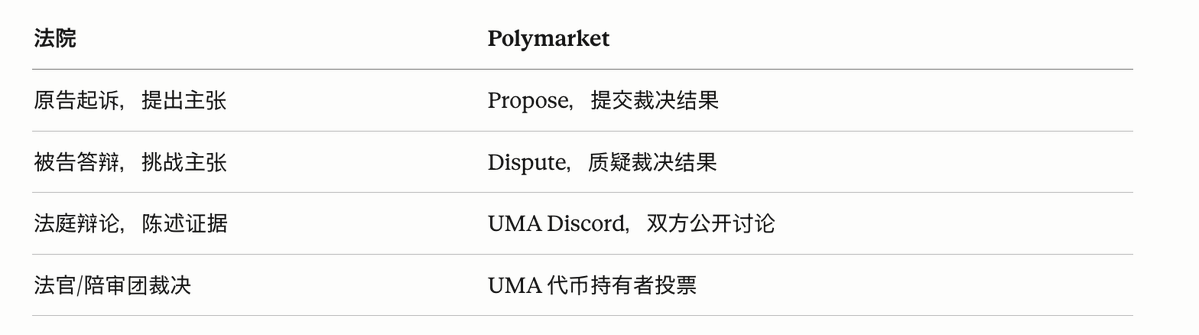
On the face of it, Polymarket ' s decision-making process and traditional courts are highly similar: there is a party with a claim, there is a challenge party, there is a discussion of the presentation, and at the end, there is an adjudicator who gives the result。
But the two systems are fundamentally different: power separation。
The power of the court is isolated
The plaintiffs and defendants of traditional courts have only the right to be heard and have no right to rule. Judges have only the power to rule and have no position of interest. More importantly, there must be independence between judges and cases. Once a judge has any interest in the case, he or she must be forced to recuse himself or herself and have the case heard by another person。
The adjudicator and the party in interest are never the same person。
There's no isolation
The UMA token holders are adjudicators, but at the same time they may well hold slots in the disputed market. The direction in which decisions are made has a direct impact on their own profits and losses. The adjudicator and the interested party are the same person, and this is called a conflict of interest in the traditional courts and is subject to forced recusal and is lawful and normal in Polymarket。
This design flaw is at the root of two problems。
Why is the discussion not working
In court, the position of the plaintiff and the defendant was fixed from the moment of the indictment. The lawyer would not temporarily fail in the middle of the trial, nor would he withdraw his statement because the other party was strong. The whole debate is based on this stability, with a clear position and a clear role。
The UMA Discord discussion faces two problems。
SHEEP EFFECTS: DISCUSSIONS ARE TAKING PLACE IN THE PUBLIC DOMAIN, AND ONCE THE INFLUENTIAL KOL STATES ITSELF, FOLLOW-UP IS EASY TO TURN TO. MANY PARTICIPANTS ONLY SAY "P1" OR "P2" WITHOUT SAYING ANY REASON。
This is why the UMA Discord has often made comments and deleted them。
The root of the two problems is the same: there is no separation between the adjudicator and the interested party. The Court's separation of the two roles by a system of compulsory recusal guaranteed stability of positions during the discussion, without which Polymarket was isolated。
2 ️⃣ Why the findings are not transparent
In court, the judge, having heard the full statements of both parties, rendered a judgement in which it was stated which party ' s arguments were accepted, on what basis and why. The losing party may disagree, but at least know where the losing is, and the next time it can make up for the argument。
These decisions constitute a system of precedent that can be studied and can then be invoked by judges, lawyers and parties, thus rendering the standard of adjudication accessible, academic and predictable。
AFTER THE UMA VOTE, THERE IS ONLY ONE RESULT: YES OR NO. THE TWO PARTIES INVOLVED IN THE DISCUSSION DID NOT KNOW WHAT THE VOTERS SAW, WHAT THE LETTER WAS, AND WHY THEY PREFERRED THE SIDE. WINNING DOESN'T WORK, LOSING DOESN'T WORK. IT IS PRECISELY BECAUSE THE LOGIC OF ADJUDICATION IS NEVER MADE PUBLIC THAT THE OUTCOME OF DISPUTES IS DIFFICULT TO LEARN AND ACCUMULATE。
The Court ' s judgement constituted a precedent system, and Polymucket ' s decision left only one result。
iii. Written at the end
So Polymarket has never been a mere "guess of events" market, much more like a system for translating reality events into legal texts and into settlement results。
Understanding the rules is as important as doing research. The advantages of the front are, in many cases, derived from the depth of understanding of the rules and knowledge of what the system recognizes and what decisions recognize。
Whoever realizes earlier that there is a gap between "realism" and "rules" has a better chance of earning that part of the price deviation created by misinterpretation, controversy and emotion。
