
The DeFi rescue team has raised $163 million to fill a hole. Can it solve Ave's bad debts
At worst, it's $70 million short

DeFi rescue team finally arrived。
On April 24th, Golem announced a total of 1,000 ETH from two vaults to participate in the Aave-led rsETH joint rescue. Earlier, the EtherFi liquidity pledge agreement proposed that 5,000 ETH be injected into a dedicated rescue pool, with the liquid nature of the lead, Lido Finance putting forward a proposal at the Governance Forum to provide up to 2,500 stETHs。
Plus the 5,000 ETHs promised by the founder of Aave, Stani Kulechov, in his personal capacity, a joint rescue operation called "DeFi United", the scale of the funds disclosed was set at 135,000 ETHs plus 2,500 stETHs。
The starting point for this series of funding was the KelpDAO theft a week ago. According to LayerZero, official attribution, the Korean hacker organization Lazarus ' sub-division Trader Tractor invaded the downstream RPC node of LayerZero DVD on 18 April, falsifying cross-chain messages, stealing 116,500 rsETHs from KelpDAO ' s 1/1 DVD Bridge Contract, valued at approximately $292 million, or about 18 per cent of rsETH circulation。
RECOMMENDED READING:Who should pay for the KelpDAO incidentIt's the only thing that's going on
How much have they donated
Putting the four statements together in one picture shows that the amount promised is actually quite different. The Stani and EtherFi Foundations are the two most straightforward, taking 5,000 ETHs directly from their respective national treasury, without preconditions. The 1,000 ETH of Golem was allocated from the Foundation and Factory vaults, which declared that the funds were aligned with the Aave team。
The situation of 2,500 steh in Lido is slightly more complex, as it is a governance proposal with a pre-condition for " overall coverage of assistance programme completion funds " , meaning that the money will come from Lido only if the other participants fill the gap. The four commitments were converted to an average spot price of $2,400 at the time of the incident, totalling approximately $38.4 million。
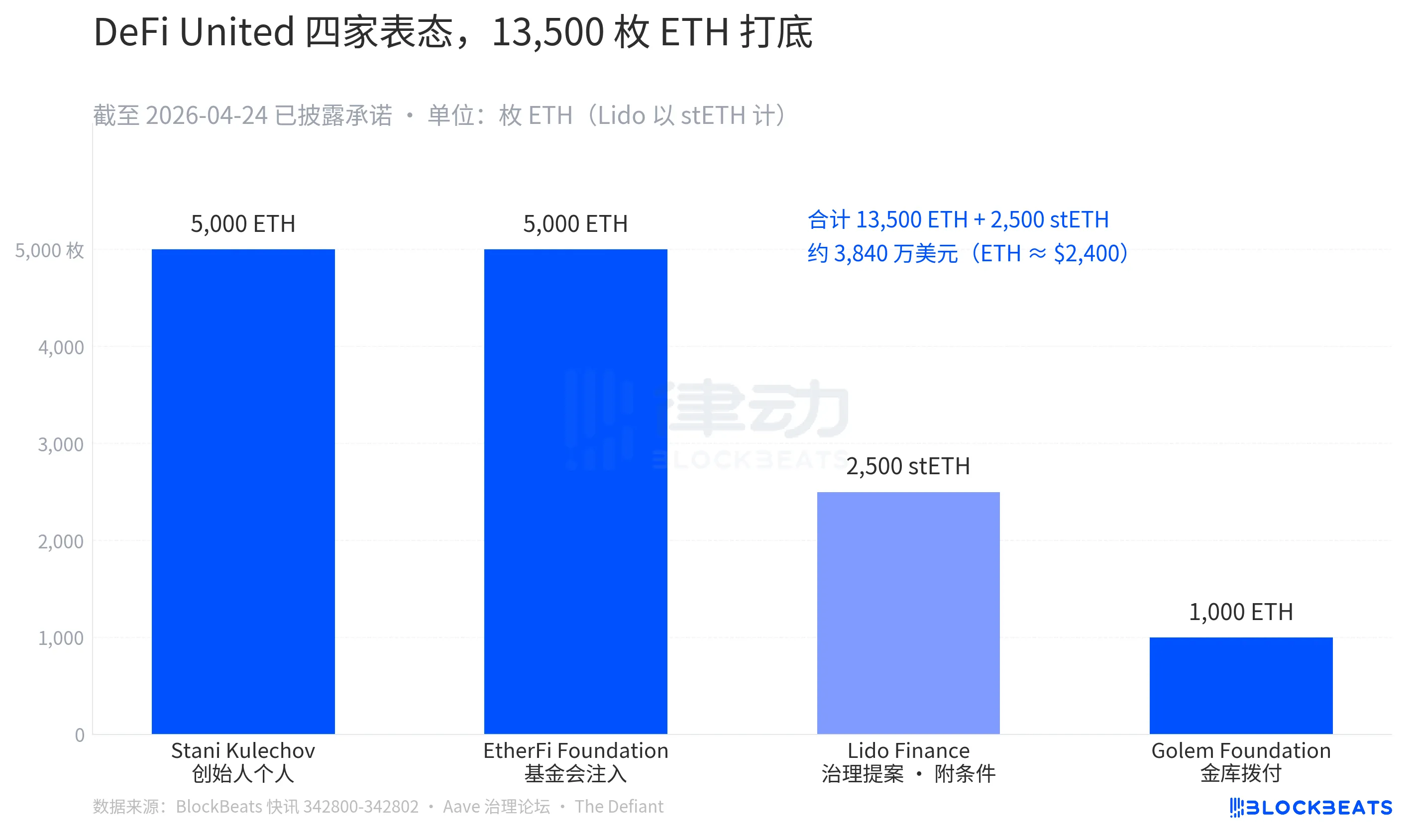
The question is what to compare that number to. According to Aave's official incident report, the estimate of bad debts is below $124 million and above $230 million. Looking down, $38.4 million is just 30 percent of the shortfall。
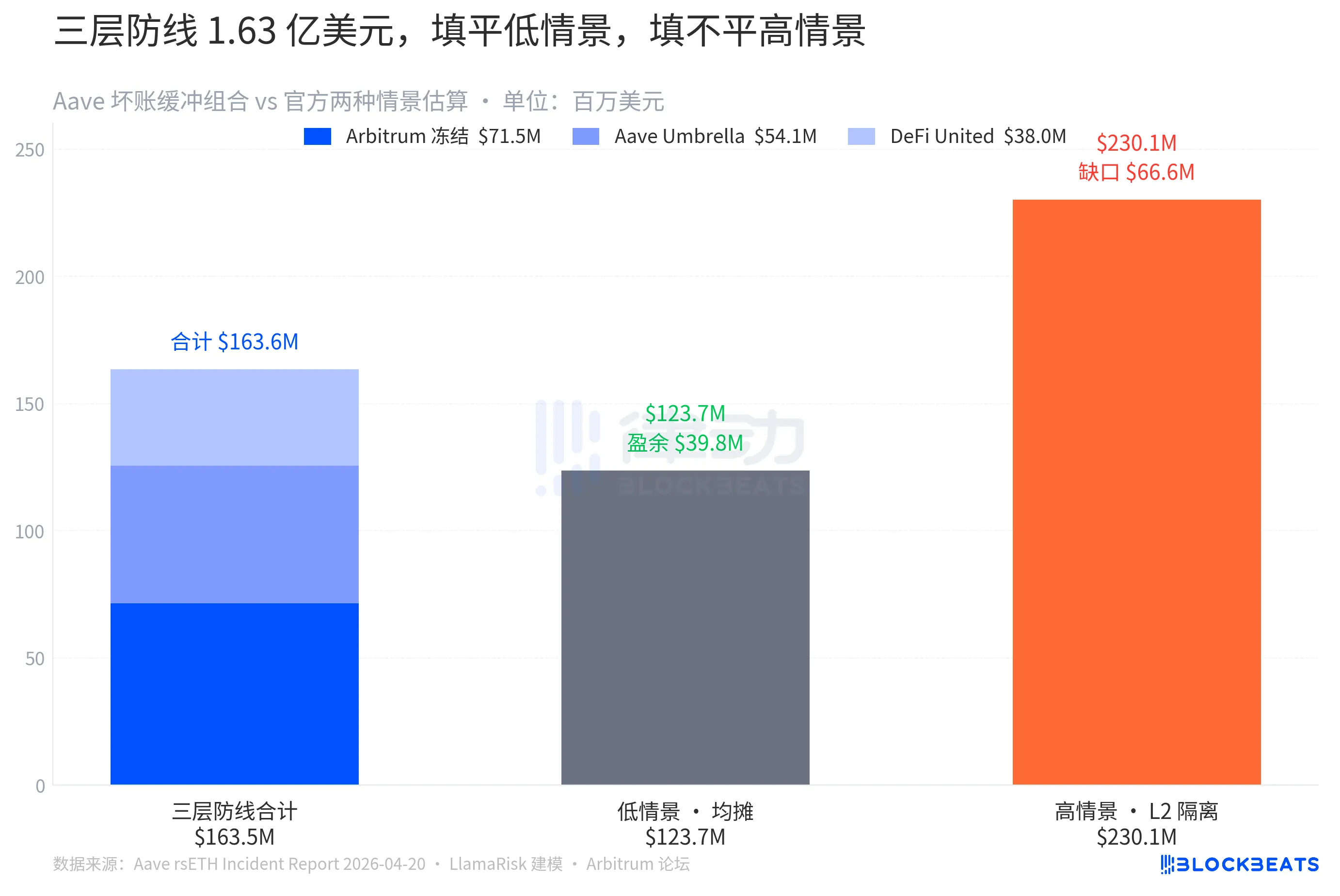
But the $38.4 million of DeFi United is not the only buffer for Aave. On 21 April, the Security Council, in Arbitrum, temporarily upgraded the Inbox Bridge contract without mastering the hacker's private key, issuing cross-chain instructions in the name of hackers and transferring the full number of 30,766 ETHs from hacker addresses to frozen addresses, valued at approximately $71.5 million。
The ETH was the real WETH borrowed by the attackers from the Aave Arbitrum market and, if returned following the Aave governance proposal, will be directly destroyed 36,166.8 corresponding rsETH mortgages, which, according to the Aave Governance Forum, will drop from 112,204 to 76,037 on the whole network, with an anchorage rate of 15.12 per cent to 10.77 per cent。
RECOMMENDED READING:Arbitrum pretended to be a hacker and returned KelpDAO's lost moneyIt's the only thing that's going on
The third floor is Aave's own Umbrella safe. According to the LlamaRisk incident report, the WETH Umbrella module of Etheum Core is currently pledged to a total of 23,507.63 WETHs at the time of the incident, at a price of approximately $54.06 million. This is Aave's new insurance scheme, which was upgraded at the end of 2025, replacing the old Safety Module, which was designed to do automatic slash before bad debts actually fell on depositors。
The three floors add up to $163 million. Compared to the low scenario, 124 million people can add 39.8 million to the amount of wealth that would have been added if the pit had just been filled. Higher scenario 230 million, still short 66.6 million。
In the same attack, why would Aave simulate two scenarios that are close to $100 million
The key is that there is no single answer to the "112,204 rsETH, who bears the loss" problem. Aave Wind Control Service, LlamaRisk, in an incident report released on April 20, divided the options into two paths。
The first one is "the equal sharing route". All rsETH holders share the loss at their current supply, using the formula given by Aave depeg = unbacked/ (original supply + unbacked), resulting in a flat discount rate of 15.12 per cent。
In this case, Aave ' s bad debts are mainly on the Etheleum Core market, which, according to LlamaRistsk, will absorb $91.8 million in bad debts, and Arbitrum, Base, Linea, Mantle and others L2, totalling about 31.9 million, totalling 124 million. The most seriously injured L2 is Mantle, which is responsible for 9.54 per cent of the shortfall in its proportion due to its smallest WETH reserves, but which is in absolute terms small。
The second is the "separation route". Assuming that the main web rsETH collateral is intact, all losses are isolated on the L2 map version of rsETH. After all, the hacker took the original hostnet voucher from the Layer Zero Bridge, and the logical part of the L2 rsETH that has "crossed the chain" no longer has collateral。
Under the isolation route, the discount rate for L2 rsETH went directly to 73.54 per cent and Etheum Core was intact, but Mantle ' s WETH market had a 71.45 per cent reserve gap ($77.7 million), Arbitrum followed 26.67 per cent ($88.4 million) and the other L2 added 64 million, totalling 230 million。
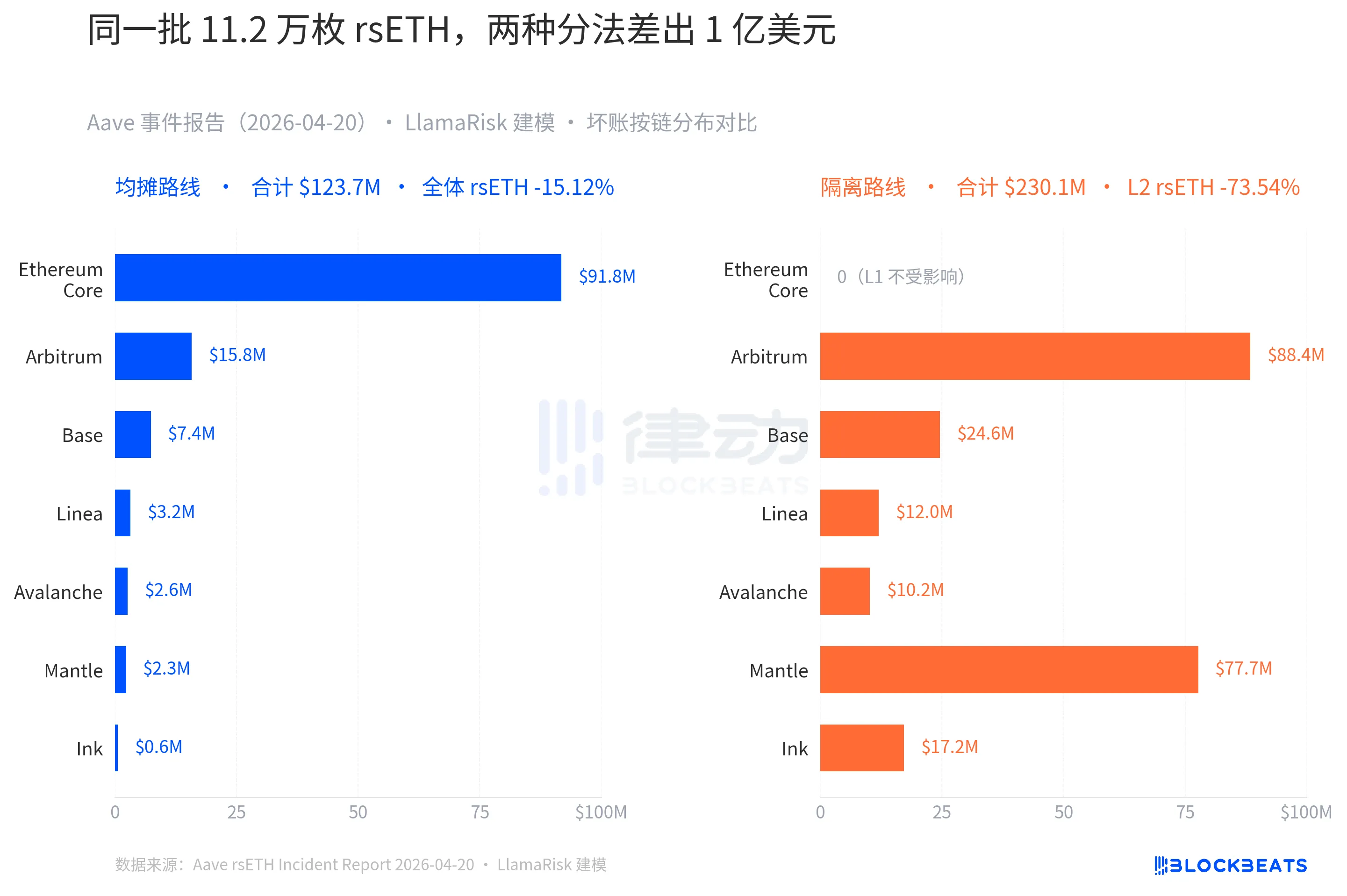
The $106 million difference between Aave's bad debts under the two routes is essentially a transfer of "who pays the price". According to discussions at the Aave Governance Forum, the balance of the election represents a loss of $91.8 million for the depositors of Etheum Core. The main net is completely maintained by the choice of isolation, but the bulk of the WETH depositors on the two L2s, Mantle and Arbitrum。
Aave's current posture is clearly biased towards the latter, and in an updated statement on April 20, official emphasis was placed on "the rsETH online is sufficiently supported", and according to LlamaRisk, which route ultimately depends on KelpDAO's updating of the rsETH' LRT prognosis price and cross-chain calibration "out of Aave's control"。
Can we get the money
Back to the reader's most important concern, I'm in Aave's money. Can you bring it up after the wave? The answer is that DeFi United did not distribute $38.4 million to the Aave depositor's “compensation” and that the help pool would be injected into Kelp's rsETH mortgage to restore the anchor price. As long as rsETH has fair value, Aave will be able to liquidate 89,567 encumbrances against the attackers, repay the 82,650 WeTH loans from liquidation revenues, and the WeTH pool utilization rate will start to fall from 100 per cent to recover the withdrawal。
According to the Aave incident report, the five-chain WETH reserves of Etherum, Arbitrum, Base, Linea, Mantle are currently all 100 per cent utilization, and each chain has an idle WETH balance of less than $20. This is why ordinary depositors now see the "lost withdrawal" not the agreement to run, but the money is all borrowed, the borrower is the hacker, and the repayment waits for the rsETH mortgage to revive。
Another path when there is not enough is Umbrella Falls. According to the Aave Umbrella document, the trigger sequence begins with a WEETH Umbrella pledge that is automatically slashed, then it is the normal WETH depositor who bears the haircut proportionately, then the stkaAVE holder (which needs to be activated by the governance vote) and finally the DAO vault. The result is in two cases。
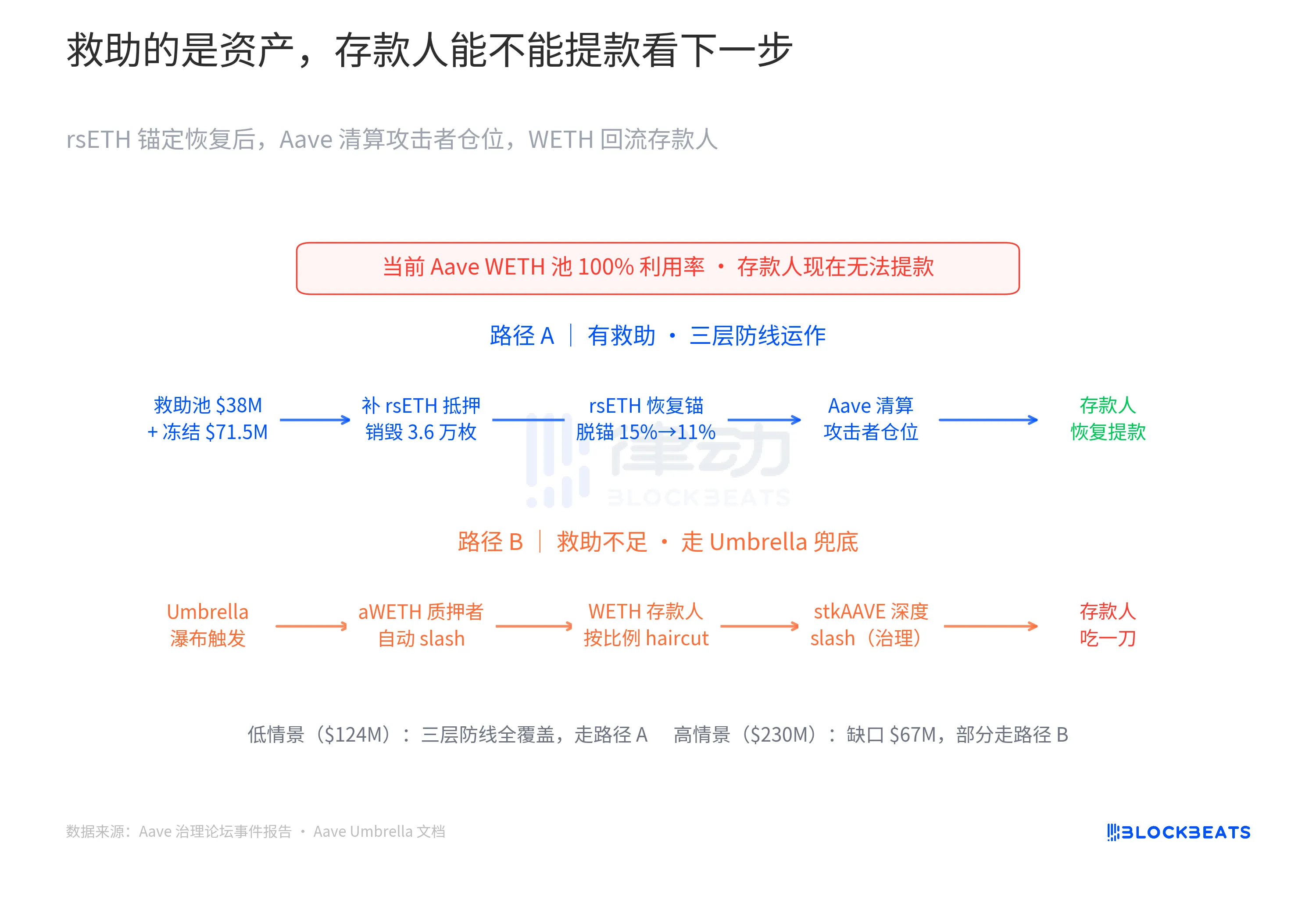
In the end, the 124 million bad debts in the low-case scenario were placed on the Etheum Core at 91.8 million. The 71.5 million ETH frozen by Arbitrum directly offsets a significant portion of L2 arrears, folding up US$ 54.06 million in Umbrella reserves, together with the external infusion of US$ 38.4 million by DeFi United, the line of defense is more than sufficient, and the Etheleum main network and the L2 WETH depositors are likely to recover the entire principal。
If the separation route is eventually followed, the situation will be divided. The Etheum Core was intact and the main network depositor was not affected. Umbrella does not, however, trigger either, as the Aave incident reported that it covered only Etheum Core. Only the US$ 71.5 million freeze of the US$ 230 million of lost WETH depositors on Mantle and Arbitrum, combined with the US$ 38.4 million external funding of DeFi, could be expected to total approximately US$ 109 million。
Compared to the $166 million in bad debts of these two chains (Mantle 77.7 million plus Arbitrum 88.4 million), there is still a shortfall of 57 million. The gap may end up down the path, proportionally to the WETH depositors in Mantle and Arbitrum。
DeFi United's $38.4 million plus Aave's own stock of 54.06 million Umbrella and Arbitrum's recovery of 71.5 million ETH in the name of hackers has created a $163 million fence just enough to cover Aave's own low-profile bad debts. The rest depends on which line KelpDAO will choose, which asset will be saved, which principal will be passive and will not know until a week or two。
