
Former Coinbase CPO: In this market, the greatest advantage is nothing
You don't need more deals. You need less temptation。
Original by Sid, Coinbase ex-PM
Original: Joy ChainCatcher
I still believe in encrypted money, and I see the direction of the industry. And when I write these words, I am not one of those who give birth, swear not to risk, and have just come back with a new sense of understanding from within. I am in possession of encrypted currency, shares, and some alternative assets such as real estate and gold. And hold it happy。
It took me long enough in this circle to crawl and fight, and I knew what I believed and where I had deceived myself. There is no greater lie: better judgment can save me from bad behavior. After 10 years of deep cultivation in this industry (including recent work in Coinbase and earlier venture capital investments), the most tangible thing I can say is:In any market — whether in encrypted currency, stocks or any other field — most people have the greatest advantage of being willing to do nothing。
For most people, the real risk is not ignorance, but haste. It is that once the market begins to wave new things that are brighter and more loud, it will not be possible to hold a well-established position. It's an extreme desire for more dopamine. This is the heart of the whole article。
Same regret
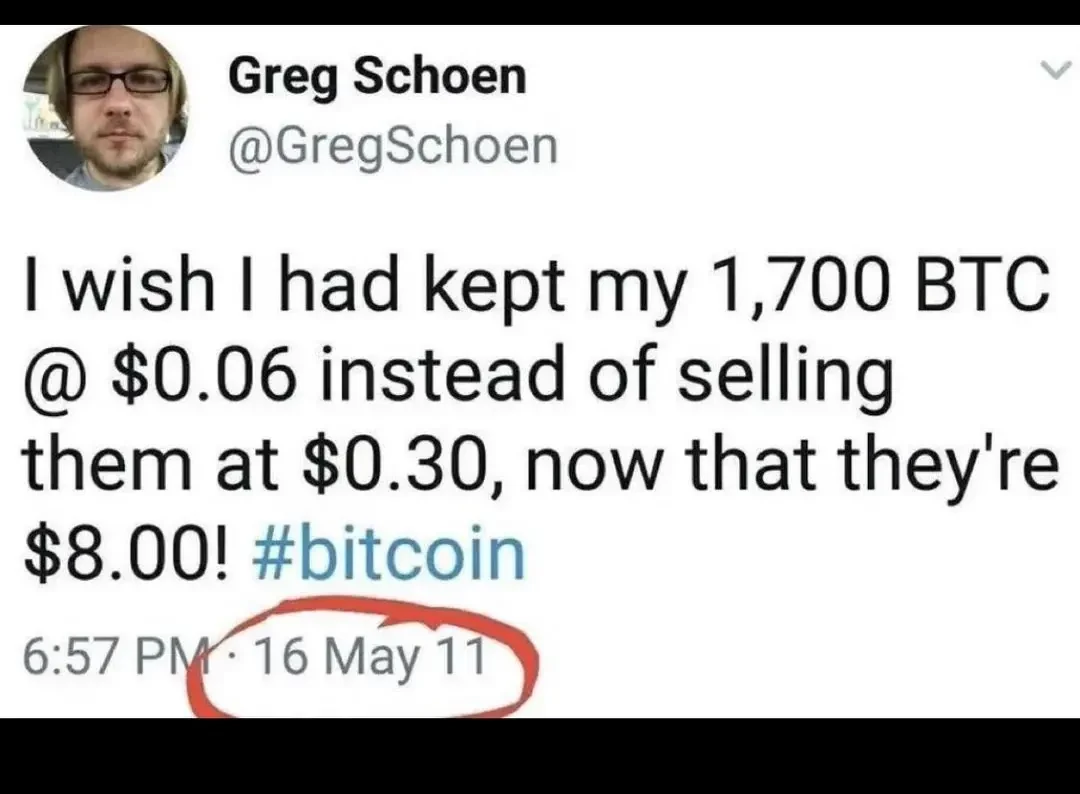
If you stay in the market long enough, you will continue to hear the same sentence in slightly different forms:If only I'd kept it。
Not if I find the next perfect mark. Not if I turn faster. Not if I found that ten times before everyone else. It's just that if I kept the good stuff still. The sad version of the encrypted currency is that it sells bitcoin to chase for her. The stock version is: Selling Ingweida for the end-of-life scenario just because this week you suddenly think you're an expert in volatility. Different markets. The same regrets。
IT'S NOT A STORY THAT I BROKE MYSELF. I'M FINE. BUT I HAVE WITNESSED MANY WISE MEN WHO HAVE SLOWLY DESTROYED CONSIDERABLE WEALTH SIMPLY BECAUSE THEY COULD NOT BEAR THE CALM. AND THE WHOLE SET OF PRODUCTS THEY USE — FROM THE ENCRYPTION EXCHANGE TO THE FORECAST MARKET, TO THE STOCK EXCHANGE APP — IS BUILT AROUND THIS WEAKNESS OF HUMANITY。
If you've been forced to look at the portfolio, panic and sell it when it falls, or make a deal just because you're bored one Tuesday afternoon, the article is for you。
I went through the wrong encryption door
IN 2015, AS A FRESHMAN YEAR, I SET FOOT IN THE ENCRYPTION FIELD AND IMMEDIATELY BECAME OBSESSED WITH WHAT SEEMS TO BE THE MOST EMBARRASSING PART: THE ENTERPRISE BLOCK CHAIN. PRIVATE CHAIN. BUSINESS UNION. “DISTRIBUTED BOOK TECHNOLOGY”. THE ENTIRE PPT INDUSTRIAL COMPLEX PEDDLING “SERIOUS APPLICATIONS”. I THOUGHT THAT WAS THE REAL GUY, AND THE "MAGIC INTERNET CURRENCY" WAS JUST A GAME OF LIBERALS AND SPECULATORS。
I KNOW, I'M EMBARRASSED NOW, TOO. I WAS EVEN DOING BLOCK CHAIN STUDIES AT THE IBM INTERNSHIP, AND IT WAS FELT TO BE A GREAT RECOGNITION. THE WORLD'S LEADING TECHNOLOGY GIANT IS LIKE TOUCHING MY HEAD AND SAYING, "YES, THAT'S ADULT PLAY. YOU'RE SMART。
The longer I spent in this area, the more I realized that most of the projects were not active. Many enterprise-level block chains are just better-packed databases. At the same time, bitcoin (the largest digital asset) continues to infiltrate the mainstream, while the Taicha (a platform that allows developers to build financial applications that are not controlled by companies) continues to attract builders。Open systems are truly attractive. People do not need any permission and there is a constant influx。 is a bit embarrassing, mainly because it means that the “wrong people” are right。
Eventually, I dropped out of college and moved to San Francisco in the early days of DeFi. I had the privilege of working in an excellent YC-backed start-up company, which gained deeper access to the machinery of the industry: founders, foundations, trading companies, DeFi applications, and everything. I eventually led VC investments and joined a self-employed investment company as a member of the founding team during the epidemic。
This experience heals my naive conviction — I thought most market participants were rational. They're not rational. Me too. One cycle after another。
Nobody knows what they're buying
In the early years of encrypted currency, it was called "unusual." Of course, there are smart people around. Liberals. University dropouts. Anonymous developer. I don't know how to earn more than a professor. In the Telegram group, people who have only been in the ring for four months are distributing in-depth advice. At meetings, those who have been here a year earlier than you have become so rich that you feel you can cross the class if you make the next deal。
I BOUGHT BITCOIN. I BOUGHT ETH. I GOT REAL REASONS FOR BOTH。
AND THEN THE ICO BOOMS, AND MANY OF US GET MORE STUPID. FOR THOSE WHO ARE FORTUNATE TO MISS THAT ERA, ICO IS BASICALLY AN IPO WITH LITTLE REGULATION AND MORE NONSENSE. AT THAT TIME, ALMOST EVERYTHING COULD HAVE BECOME A TOKEN. A WEBSITE, A PDF WHITE PAPER, A FEW GREAT DECLARATIONS ABOUT RESHAPING A LARGE INDUSTRY, SUDDENLY YOU CAN SELL IT PUBLICLY。
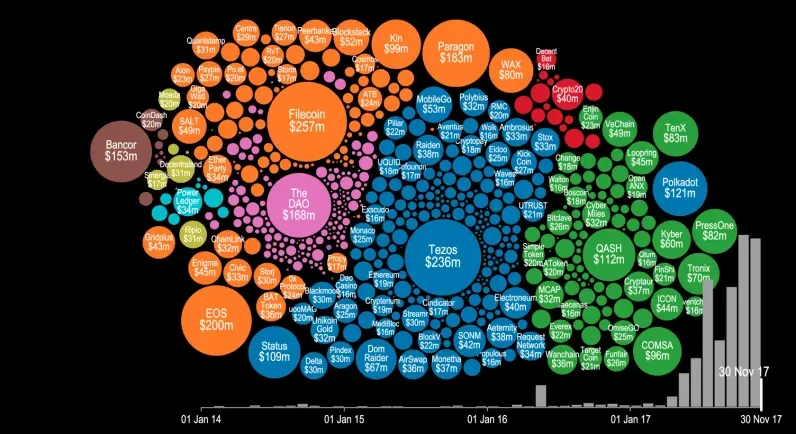
It is easy to confuse water-like ambitions with real values. It's like a 90 per cent mood-based, 10 per cent product-based Kickstarter campaign, with the printing function。
This video gives a more detailed time line for these companies to get investments:YouTube Link
So yes, I bought Cardano because it's called an academic Etherwood. I bought Spank Chain because someone sold me the idea that adult payments are a huge but broken market and that the coin will become its payment layer. Readers, it didn't. I also bought IOTA, and I can't explain it to you today even if you put a gun to my head. In 2017, this was normal behaviour. That's the point. It's not marginal stupidity, it's the mainstream of encryption。
The infrastructure was also very poor: Bitfinex, Bittrex, Poloniex, and EtherDelta. Each platform gives the impression that it could be hacked, frozen, prosecuted by the SEC, disappeared overnight, and sometimes occurred simultaneously. All of this depends on tape and optimism, but as long as the market continues to rise, people feel that they can survive。
And most of us have no idea what we're buying。
The most common mental error is also the stupidest:People mix “low unit prices” with “lower prices”。 a three-cent token makes people feel "cheap" as if the fair share on Robinhood felt cheap. In the face of $10,000 bitcoin, it looks like nothing. Few people are looking at the total supply of currency in circulation. There is little concern about dilution. The role of Facebook bias is half that。
Despite the chaos of the ICO era, the Ether House itself has proved to be one of the best intergenerational investments in its life. If you buy ETH in 2014 at a price of about $0.31 and keep it, at the highest point your return is about 15,000 times. Ironically, most people in the ecosystem at that time, in pursuit of those coins that no longer exist today, traded in such levels of wealth. By early 2018, most of these tokens had fallen by 80 to 95 per cent. It turns out that Spank Chain did not subvert the adult entertainment payment technology。
And what about the bitcoin I sold to finance these adventures? It's still bitcoin. Still scarce. It's still alive. Such mistakes are not only painful but also particularly humiliating. Not because of the complexity and depth of its operations, but because it is stupid and entirely avoidable。
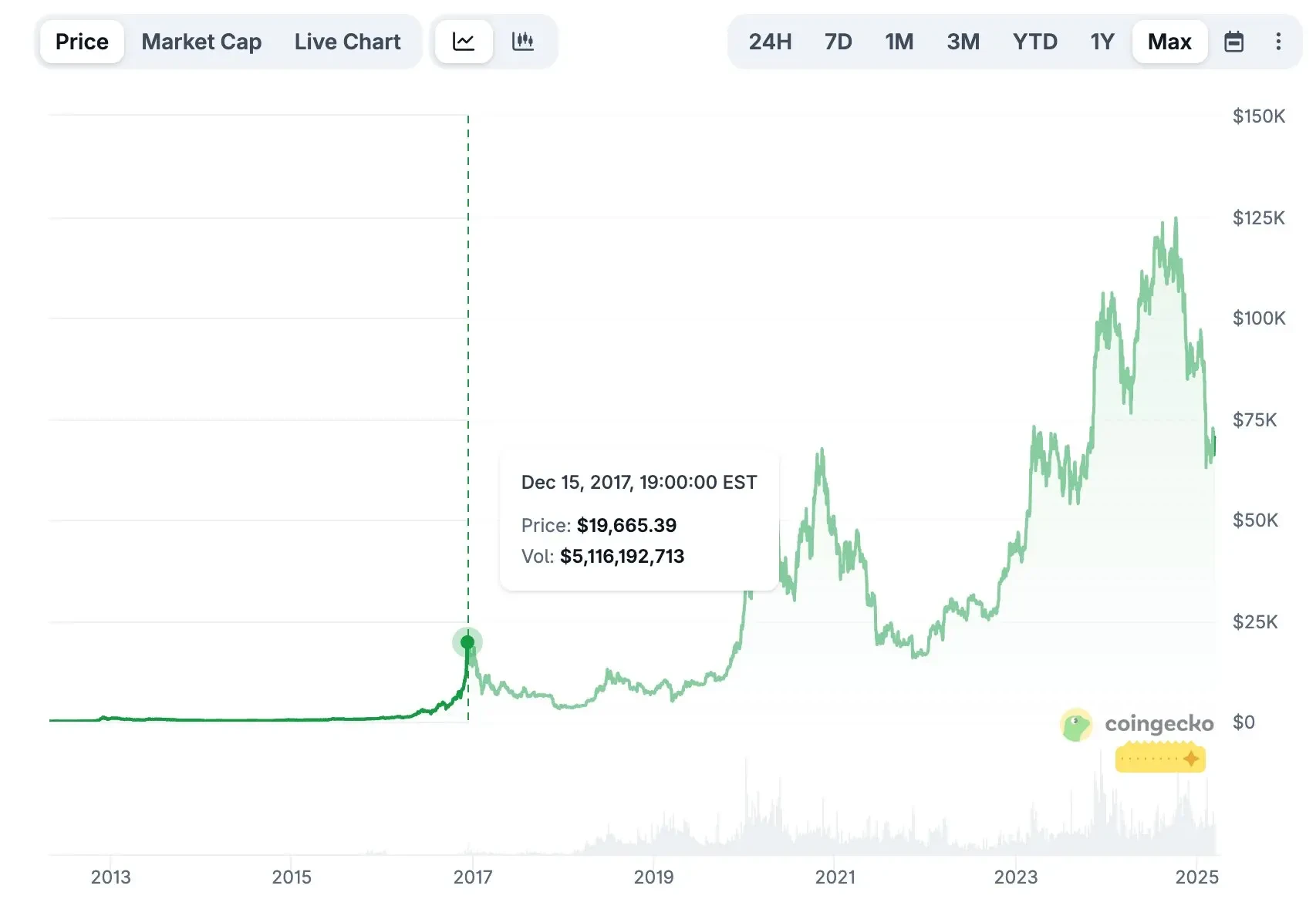
Bitcoin price movements from 2017 to the present are proof of this. Those who survive each collapse and hold it firmly have a return of thousands of percentage points。
Early DeFi, making greed sound intellectual
If 2017 is childish speculation, the summer of DeFi in 2020 is complex speculation. That's why it's dangerous because it makes people feel smart。
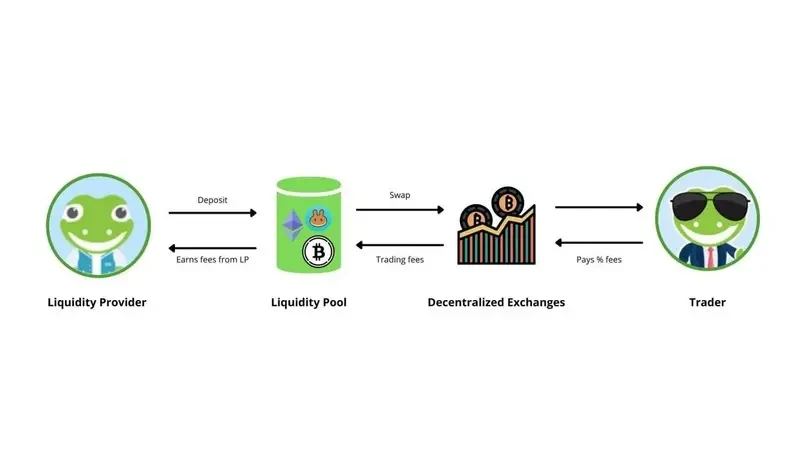
The DeFi application provided an absurdly high interest rate for the funds deposited, sometimes with an annualized rate of return of up to 500 per cent or even 100 per cent, and paid not in United States dollars, but in newly printed tokens. That's where DeFi summer's genius is. After all, ICO was made indiscriminately. And DeFi feels simple and innovative. Its terminology is so rigid that it feels like it's doing financial engineering, and conceals most of its essence:Following unsustainable rates of return, once incentives are exhausted, those gains disappear overnight。
- You're no longer gambling. You're providing mobility。
- You're no longer chasing for coins. You're in "Participating Agreement Growth."。
- You're no longer greedy and ridiculous gain. You're “making idle assets work”。
Here's a good explanatory article:CoinGecko Link
Much of what happened during that period was just the same old greed that was translated into more advanced terms. Then NFT. Then there's the new Layer 1 block chain. Then there's the contract. Then there's the forecast market. Then Memecoin re-emerged and was stripped of the purest form: the noise with the trade code。
In the field of encryption, your counterparty is usually: a team that knows when a token will be unlocked, a fund that buys a quarter of your price, and market participants who know more about warehouse management than you do. The closer you get to professional investors and traders, the worse the experience of ordinary people。
Most people, whether in Robinwood or Coinbase, trade with the least information and the most emotional. Various narratives fill the information vacuum and pass it to the diaspora as a high certainty bet. “This is the next Solana.” “This is the next Britain.” “This currency is still rising.” Normally, you are just someone else's exit from liquidity。
The market keeps changing clothes, but behavioural patterns remain
People's love always seemed to have become more intense in subsequent cycles. That's not true. Packaging is getting higher. However, patterns of behaviour remain familiar。
Pump.fun is a platform on Solana (one of the largest block chains, which can be seen as a faster and cheaper alternative to the inn), where anyone can create a new, tradable encrypted token in seconds. It strips Memecoin of speculation into the most efficient form: fast distribution, fast trading, fast losses, duplication. It will impulsively control barriers to industrialization and exacerbate FOMO。
When Pump went online in January 2024, the transaction price of Solana ' s original token SOL was approximately USD 84. According to Dune Analytics, out of approximately 32.8 million wallet addresses in Pump.fun, only about 139,000 (approximately 0.4 per cent) had earned profits exceeding $10,000. About 55 per cent of the traders are simply losing money, while over 90 per cent either lose or earn less than $1,000. In 2025, the Solidus Labs study marked 98 per cent of the coins on the platform as fraud or demonstrated fraud。
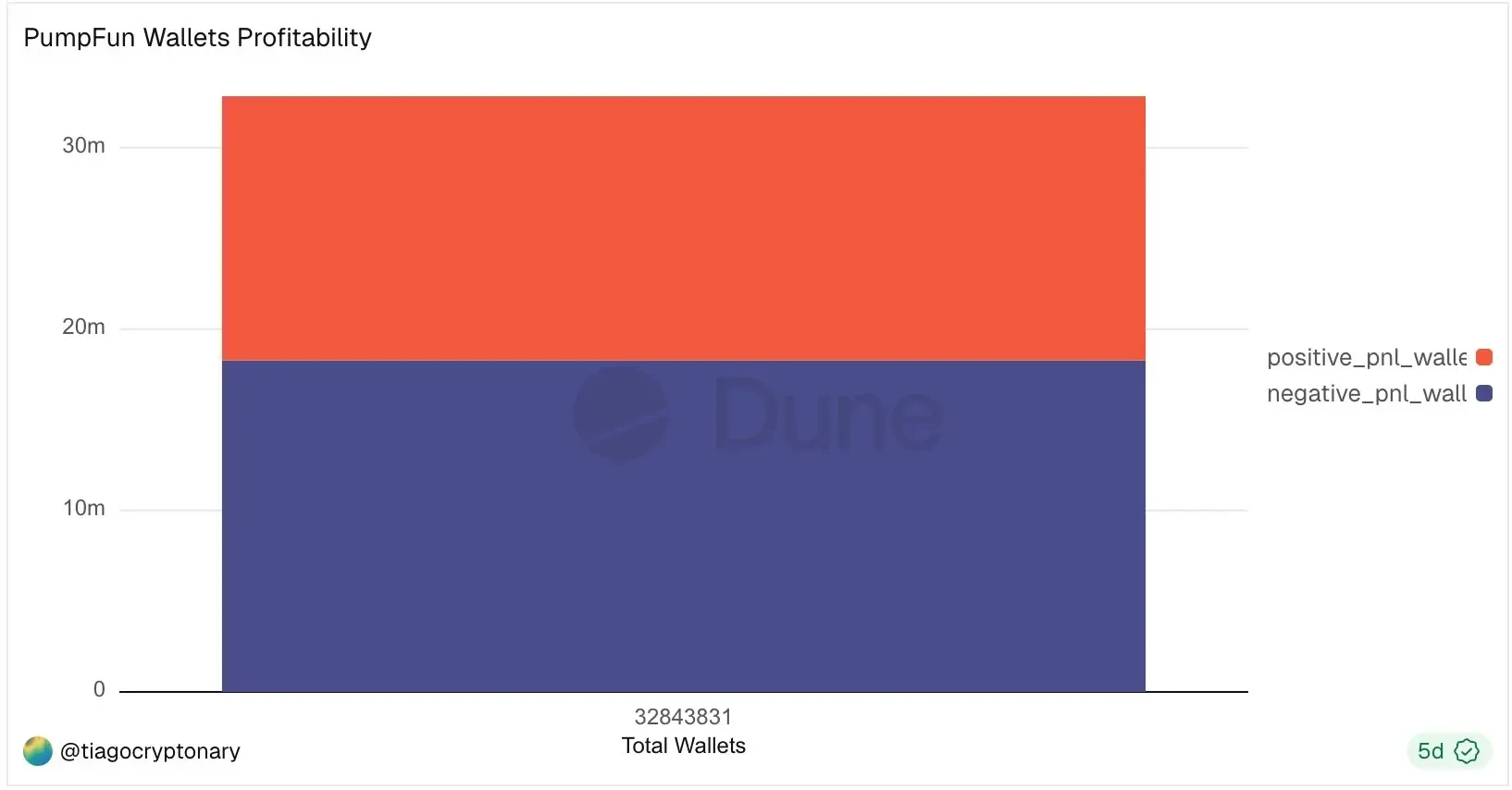
Data source:Dune Analytics Link
The next part might make you want to throw your phone in the sea. If the ordinary participants on Pump.fun took the principals they burned on Memecoin (even if only $500, which is the most common loss zone) and bought SOL honestly in January 2024, they would have been able to get nearly $295 from $84 to January 2025。If you do nothing, you get about 3.5 times the return。 even at today's price of about $84, they can at least keep their books, which is far better than having their blood in the pursuit of a token named after a frog wearing sunglasses。
The ugly truth was not won. Of course someone will win. What is ugly is how much of the profits of these winners are concentrated and how many people have wasted their time and money in pursuing an upward space that does not exist for them. This is a rough calculation rather than an accurate financial audit. However, in the direction of millions of wallets, buying Solana and going out for a walk would have been much better。
In Polymarket, which can be seen as the stock market for predicting events, you buy and sell on the basis of a forecast of whether real world events will occur, about 70 per cent of the more than 1.7 million addresses are in deficit, while less than 0.04 per cent of the addresses capture more than 70 per cent of the profits of the entire platform。
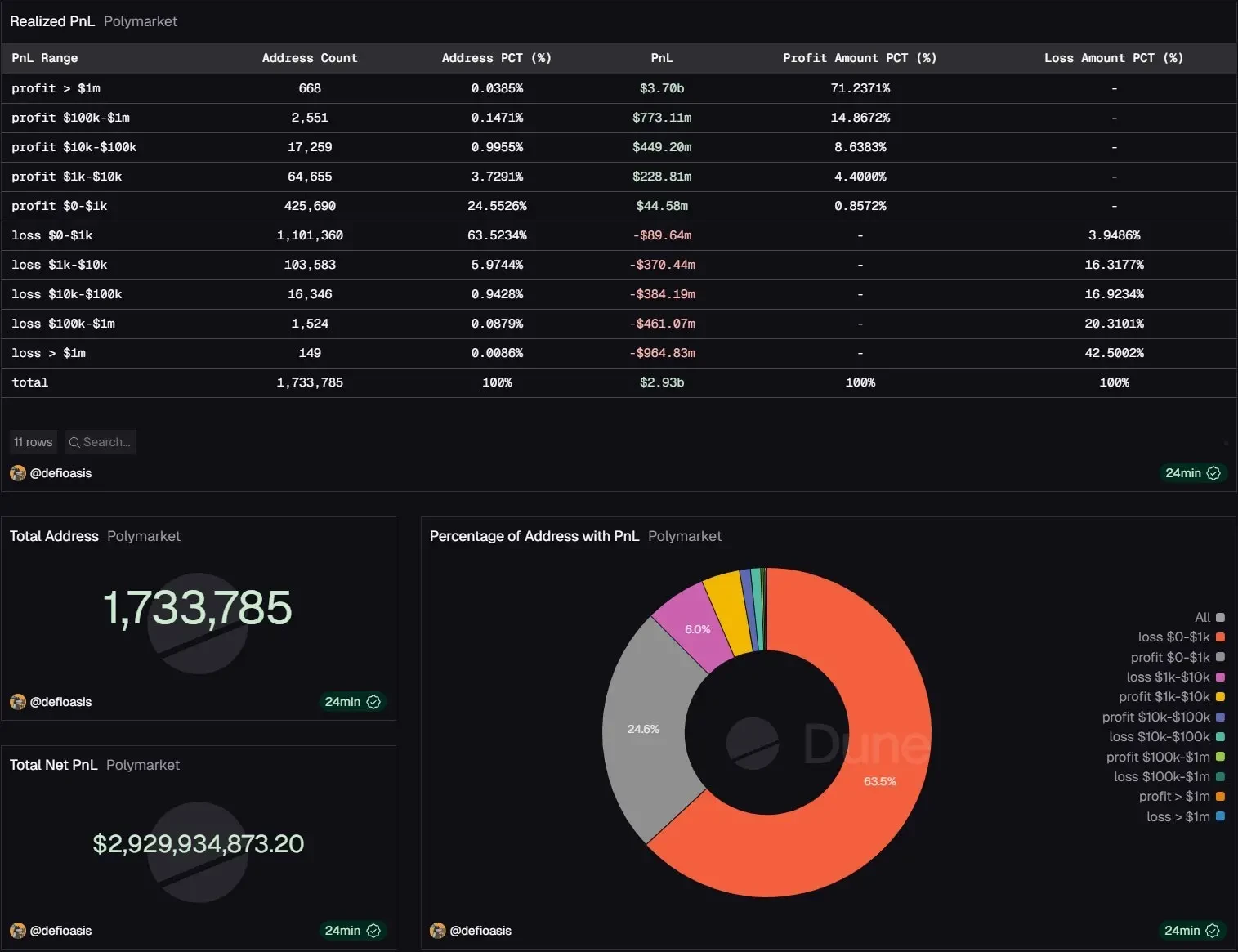 I personally did not trade on Pump.fun or Polymarket. But I watched people burn quite a lot of principal on both. Those smart people who truly believe they have an advantage, find themselves simply out of mobility as faster and better informed players。
This model is not unique in the field of encryption. The classic Barber and Odean studies found that the most active traders had an annualized rate of return of about 11 per cent, while the market rate of return was close to 18 per cent over the same period; but more recent data were equally devastating. In a study in 2024, Dalbar Inc. found that in 2023, the performance of ordinary bulk investors was 5.5 per cent behind the Standard 500 Index, which was the third largest part of the income gap in the last decade, and that the gap tended to widen during the cattle market, as people were sold and missed a rebound when they fell。
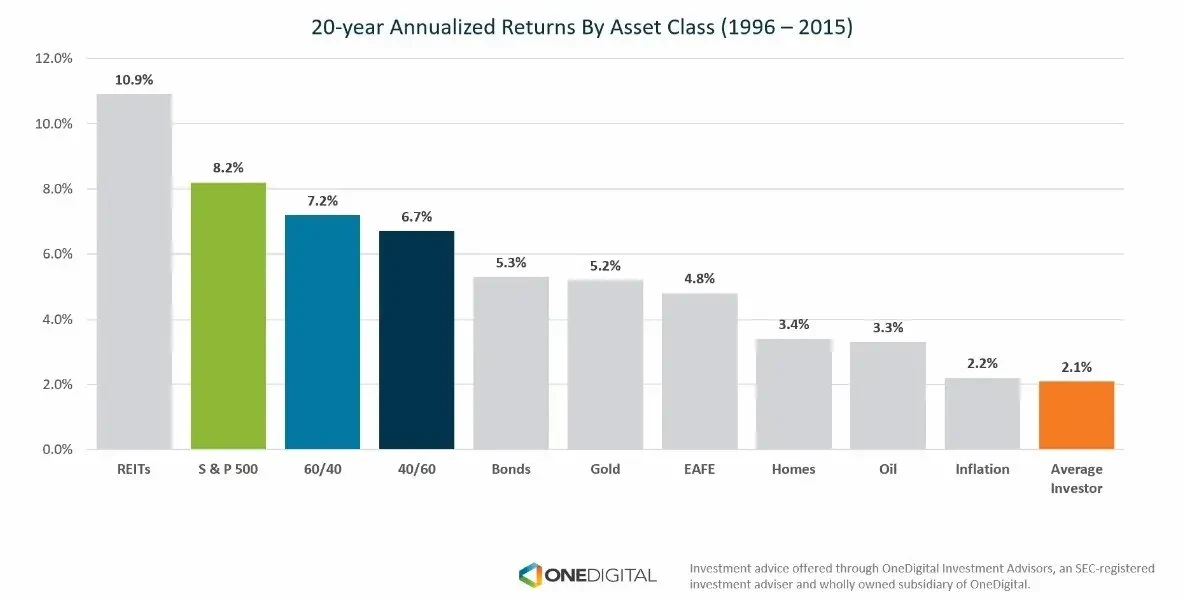
Data source:Crews Bank Link
According to FINRA (United States Financial Services Regulatory Authority) statistics on day-to-day transactions in 2025, 72 per cent of day-to-day traders suffered financial losses at the end of the year, only 13 per cent were able to maintain steady profits for six months, and only 1 per cent were able to sustain success over five years. Bloomberg found that 80 per cent of day traders quit in the first two years. If you've been staring at your Robinhod or Fidelity accounts, wonder why it's better to buy the 500 and forget it。
FOR LEVERAGE PRODUCTS SUCH AS OPTIONS OR FUTURES, THE DATA BECOMES EVEN WORSE. THE INDIAN MARKET REGULATOR, SEBI, REPORTED THAT 70 TO 91 PER CENT OF THE BULKERS WHO TRADED FREQUENTLY IN DERIVATIVES IN RECENT YEARS HAD LOST MONEY. THIS IS THE CASE IN ANY PLACE WHERE ORDINARY PEOPLE ARE GIVEN A BLINKING INTERFACE WITH PROFESSIONAL TERMS THAT ALLOW THEM TO MISPERCEIVE GAMBLING AS AN ADVANTAGE。
I've seen people trade their chips to make them rich
In every cycle, I watched the same thing happen. The old man who survived the last crash slowly traded the positions that enriched them and pursued any new narratives from the market. And then they disappear. Not because of some dramatic explosion, but because of thousands of small-scale plate-wheeled blood. Then the next wave came with eyes open and confidence, and everything started again。
This is not the way to build a lasting economy. This is killing those who should have pushed it forward。
People always fantasize that wealth comes from seizing every new wave. Sometimes it is。But more often, wealth comes from capturing a real wave and is not cut blindly every time there is a splash of water around it。
The deal is not an enemy. But it's probably not your friend either。
I would like to make one point clear: transactions are not bad per se. People who are good at dealing do exist. They tend to have extremely rigorous risk management, disillusionmental objectivity, deep knowledge of market structures, discipline to stop losses immediately, and years of model recognition experience. Most of them see it as a full-time job that requires years of apprenticeship。
That's not what most people can do. The frank truth is that most ordinary investors can buy a small amount of highly certain assets and then do one of the hardest things in the financial world -Don't touch themInstead, they can accumulate more wealth。
Trading products are turning into tiger machines
So why is it so difficult to stay still? Because the product itself is designed to make it difficult。
FROM AN ECONOMIC POINT OF VIEW, THINK ABOUT WHAT A COUPON OR EXCHANGE IS, WHETHER IT'S AN ENCRYPTED EXCHANGE OR A STOCK EXCHANGE. THEY MAKE MONEY WHEN YOU TRADE. INSTEAD OF MAKING MONEY WHEN YOU PROFIT. EACH TRANSACTION GENERATES TRANSACTION COSTS AND DISADVANTAGES (A SMALL DIFFERENCE BETWEEN THE PURCHASE AND SALE PRICES EARNED BY THE PLATFORM). IN THE AREA OF ENCRYPTION, YOU ALSO HAVE TO PAY THE MONEY RATE FOR LEVERAGE POSITIONS; AND WHEN YOUR BETS FAIL, THE PLATFORM WILL FORCE YOU TO CALM DOWN AND TAKE THE REST OF THE MONEY. IT'S CALLED A LOCKDOWN。
The platform doesn't care about your deal. It only cares if you deal。
When you're calm, the coupons don't make money. When you learn to be restrained, the exchange will not celebrate. These businesses depend on your actions. Your click, your view, your reaction to the sense of urgency that they have created. Therefore, their incentive structure is naturally built around "actions" to induce you to trade as often as possible。
Price alert. Bright green. Eyebrow red. Hot trend list. Full-screened ribbons. Small pushers are suggesting that something is happening, and maybe you shouldn't be the last to react. The same behavioral science that keeps you sliding short videos on TikTok is driving you back and forth. Variable incentive mechanisms: Sometimes you win, sometimes you lose, that's what makes you addicted. Sustained stimulus. Unending dopamine。
This is not an accidental design. It's a business model through round corners。IT'S TURNING INTO A TIGER MACHINE WITH A K-LINE。 even the VIP plan for high-frequency traders has made it clear that the more transactions are made, the lower the fees, the higher the status, the greater the identity, and the larger the person. Casinos do the same thing. The dealer rewards not your skill. The dealer rewards your utility value。
Dopamine itself is worthless. The hours spent trying to refresh the screen and see the price before getting up did not produce any lasting value. There's nothing left but anxiety and an agitation that penetrates everything you do. A patient holder generates zero revenue for the platform. A forced sex dealer generates income every day. The whole product experience is designed to ensure that you will never be the patient holder. So, of course, the product will keep feeding you。
This is not to say that these platforms are bad. They are robust, profitable enterprises and have a reasonable presence. It is very good that they enable people to express their market views without resistance. It is just that there is a need for better fencing mechanisms here, which need to be built by yourself and by the platform。
Something I really believe in
I believe that encrypted currency (and, of course, AI) is one of the most important technological and financial changes of our generation. I also believe that the lessons here are far more than in the field of encryption. The psychological mechanism is the same whether you trade options on Robinhod, sell leverage ETF, or check your 401(k) retirement account as if it were forced. The design logic of the product is the same. For most people, the results are the same:The more you trade, the less you keep。
I have a relatively fragmented portfolio covering encrypted currencies, equities and some hard assets. I was able to have these not because I had made such excellent deals, but because I finally learned to stop doing unnecessary ones。
I am now more convinced of the power of calm than in the past. With age, it's getting harder and harder to trade just for the sake of trade. Especially in markets, transactions always have the ability to disguise themselves as “businessful”. You feel so committed. Very sharp. Control everything. Then, over time, you realize that a large proportion of them are just self-inflicted. Every time you sell high-quality assets to buy speculation, you're in custody for your timing and judgment, better than the long-term trajectory of your original holdings. For most people, it's a gamble. You won't lose too much. I'm not gonna lose it all at once. Rather, it is a slow and lasting loss, which only becomes apparent when the timeline is stretched to one year。
IN ANY MARKET, THE MOST DIFFICULT SKILLS ARE NOT LOOKING FOR THE NEXT OPPORTUNITY. IT'S WHEN EVERYTHING AROUND YOU (ALL KINDS OF APPS, WARNING WINDOWS, GROUP CONVERSATIONS, TIME LINES, FINANCIAL MEDIA) SCREAMS TO TELL YOU THAT "SITTING IS LIKE FALLING BEHIND." THAT'S NOT TRUE。
So, if I had to concentrate all this into one sentence, it would have been:You don't need more deals. You need less temptation。
DO WHAT YOU CAN TO HOLD IT
Sid
Thank you, Dan Elitzer, Roy Learner and Jesse Walden for helping with the proofreading. Looking through my tax returns in previous years inspired the article, and in writing, I asked Claude to help edit it。
