
SpaceX IPO approaches: a century harvest hidden in index funds
AN IPO THAT'S DESTINED TO BE SENSATIONAL, AND A BUNCH OF NO-CHOICE CONNECTORS.
Original title: The SpaceX IPO Will Be the After of the City
Original by Lawrence Fossi
Original by Peggy, Block Beats
The author presses: Under the author's writing, SpaceX IPO is not an inspirational story of "commercial space giants heading to the open market" but a carefully designed transfer of wealth. The article first questioned the basis of SpaceX's core valuation: Whether the heavy Starlink satellite, orbital data centres, NASA Artemis missions, or the lunar and Mars colonization narratives, almost all rely on a Starship that is much more mature than the current version; but, in the author ' s view, Starship ' s technological delivery remains uncertain and XAI and data centre stories fail to really support its vast valuation。
The sharper part lies in the financial architecture. According to the authors, the rule-based adjustment of the Nazdak, PS 500 and Fuxeroxor indices may allow SpaceX to quickly enter the main index under low-flow disk conditions, forcing a large number of passive index funds to buy into it for high valuation. As a result, early private investors, insiders and long-term capitalists were given exit windows, while common 401(k), IRA retirement account investors were passive recipients of risk. This is also what is called the Rikishi Moment (the index fund that was once seen as the Gospel of ordinary investors, which was publicly humiliated and downgraded in a mythical scene): The low-cost index fund, originally a market tool reserved for ordinary people by John Bogle, may now be rewritten by rules as a conduit for capital exit and risk transfer。
Finally, it was further noted that even if IPO were successful, SpaceX could still face huge funding gaps, continuous dilution of financing, lack of governance and mandatory arbitration. Its follow-up impact goes beyond SpaceX itself: this IPO could shock stock and encryption market liquidity, become an AI foam pressure test, or undermine long-established trust in index funds. The author's conclusion is not to suggest spaceX, but rather to remind investors that when the Mask narratives, index passivity, and market fanaticism are intertwined, the most dangerous is often not that stories are not told sufficiently, but that ordinary people have no right to opt out。
The following is the original text:
As SpaceX IPO approaches, there are several observations and predictions:
One: From a commercial point of view, SpaceX will suffer a terrible failure
In essence, SpaceX ' s valuation package logic is based on the Starship project. And I'm talking about Starship, which is a much stronger Starship than the version we've seen。
:: Launching of a heavier V3 version of Starlink satellite, which requires Starship。
To make these launch missions — as well as other launch services provided to third parties — more economical, what is needed is reusable Starship。
The promised orbital data centre needs Starship。
• The fulfilment of SpaceX obligations to the NASA Artemis programme requires Starship。
• Any lunar or Mars colony also needs Starship. SpaceX's IPO registration document even predicts that "the moon, Mars and even beyond will emerge a new trillion-dollar market."。
The problem, however, is that the Starlink satellite is operating in orbit about 300 miles from Earth, and that Starship has so far reached its highest altitude — the latest Version 3 launch, both boosters and upper stages have reported losses — only 121 miles. From 121 miles to 300 miles, there is still a long distance between them, and there is a need to consume large amounts of extra fuel. Will Lockett has calculated why Version 3 Starship, in his words, is in fact of no practical value。
This does not address the fact that orbital data centres are almost impossible to achieve at the physical level, nor does it address the very low probability that Starship will complete the cryogenic propellant transfer task in Artemis III。
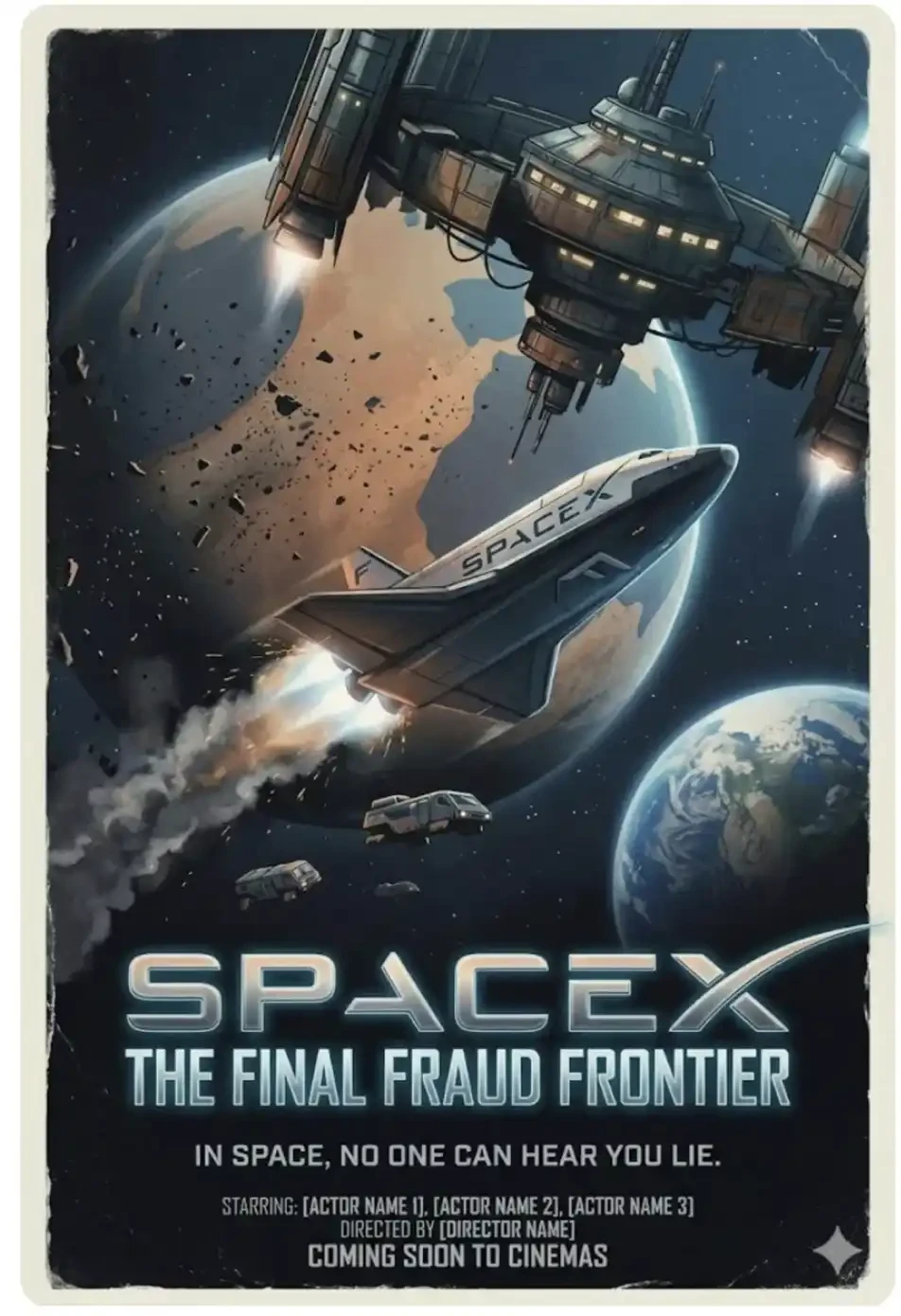
This metaphor I've used before, but I love it so much, I can't help but use it again
And of course, maybe you think that even if you take off the orbital data centre, XAI is the real key to SpaceX's ultimate success. If that's what you think, I suggest you find out about Patrick Boyle in this YouTube video. As Boyle points out, this company ' s AI product, which occupies 93 per cent of what SpaceX claims to have reached the market, is its flagship product, Grok, not even its own engineers. And it's trying to spend $60 billion on the competitor Cursor to make its product really run up。
And as for the well-publicized Anthropic contract of $15 billion a year, Boyle raises the obvious question: XAI is actually renting its calculus and hardware from the Colossus II data centre to the competitor Anthropic. This strongly suggests that XAI is currently unable to make full use of its data centre capacity. (Boyle also proposed a point that was not so obvious: Anthropic could cancel the three-year agreement at any time with 90 days ' notice
However, it will take some time before all these hard facts become fully visible. How long? Two years? A year? Maybe shorter
But, unfortunately, I am quite certain that these facts will not be fully revealed until the various private investors who have invested SpaceX over the past two decades have had ample opportunity to throw their shares at the defenseless public with huge profits。
Two: SpaceX, as a wealth transfer machine, will be an amazing success
A series of rule adjustments in NASDAQ, PS 500, and Fuxado Russell can almost guarantee that SpaceX’s IPO will be rich enough for insiders of SpaceX, while at the same time robbing ordinary retired investors who are unprepared to put their 401(k) and IRA pensions into a broad-based index fund。
A. NAZDACH FIRED THE FIRST SHOT AT THIS SHAMEFUL PARADE
As early as 10 March, when the rumour about SpaceX IPO was in its early stages, the author of the Substack column Keubiko's Musings published a very predictable article entitled “The Shame of NASDAQ”, subtitled “How to manipulate an index to reward a billionaire”
Not only did NASDAQ cut off the so-called "market maturity" requirement so that SpaceX would enter the IPO index only 15 days later; it also changed the weighting of the Nazdak 100 index with respect to the "low circulation stock" stock。
SpaceX will be a very low-share stock, with only 5% of the shares available for sale, but NASDAQ will use it as 15% of total equity to calculate weight. According to Keubiko: This index is giving a restricted, tightly controlled disk with a fictional tens of billions of dollars in weight. Hundreds of billions of dollars of passive capital that is not price-sensitive will be forced to buy the stock in a few days, as required by law and rules. You're actually taking a fire-fighting tap of a huge index capital and forcing it into a narrow real flow of garden pipes. This is the formula that creates a huge, false supply and demand squeeze。
Oh, but things can get worse. Much worse. As Keubiko wrote, mathematics will become "real cruelty" here。
Once the insider's 180-day lock ends regularly, SpaceX's share in circulation exceeds 20 per cent, NASDAQ calculates the weight of this stock according to 100 per cent of total circulation。
Of course, the time when Mask put the locks to a regular end was perfect at the time of the index rebalancing of NASDAQ in mid-December. Keubiko again wrote that the index fund would be forced to buy billions of dollars of this stock at the same time that the insiders could just dump the embargo on the market. Do you feel your liver is being squeezed into foie gras
Since Keubiko first whistled in that article, many financial journalists and market experts have become aware of what is happening. Now, you can find a lot of articles describing how NASDAQ managed to rewrite the rules to ensure that millions of passive investors — ordinary people who invested their pensions in a broad-based index fund — were forced to buy SpaceX stocks with absurd valuations。
B. OTHER MAJOR INDICATORS JOINED THE MARCH
In this race, the Standard 500 has now revised its rules to include index components in a "fast track" and no longer requires companies to prove their continued profitability。
It is foreseeable that the Fulbright Russell Index will not lag behind and follow up soon。
"Rikishi Moment"
Phil Bak has recently received a lot of attention with an excellent Substack article, The Rikishi Moment. The title comes from the deep humiliation that the late great baseball player Pete Rose suffered — a great but also a serious flaw。
It is clear to Bak that John Bogle, the inventor of the low-cost index fund, from the pioneer group, once brought a precious gift to ordinary investors. But once extremely useful market instruments have become evil tools in the hands of cynics and bad men. Bak writes that John Bogle is no longer alive, and I can only imagine how he will look at all this happening today with index funds. I can only imagine his same sad eyes. I can only imagine that he, with the same faintness and fatigue, watched his great invention, which once stood so high, fall into a fraudulent sewer。
WHO WILL BENEFIT FROM THIS THEFT
The question seems too easy to answer, doesn't it? Elon Musk, of course, and his long-standing facilitators, such as Antonio Gracias, Steve Jurvetson and Ira Ehrenpreis。
But the beneficiaries are far more than the Mask. As the brilliant Rupert Mitchell (author of Blind Squirel Macro) said in a recent podcast: In the last 20 years, almost all face-to-face people have had the opportunity to buy SpaceX — and indeed SpaceX. Believe me, everyone holds it. There are no sovereign wealth funds, no institutions, no mutual funds, no private equity companies, no cross-border hedge funds, no large holdings of this stock — and the prices they buy are far below the prices that now IPO sells to the public。
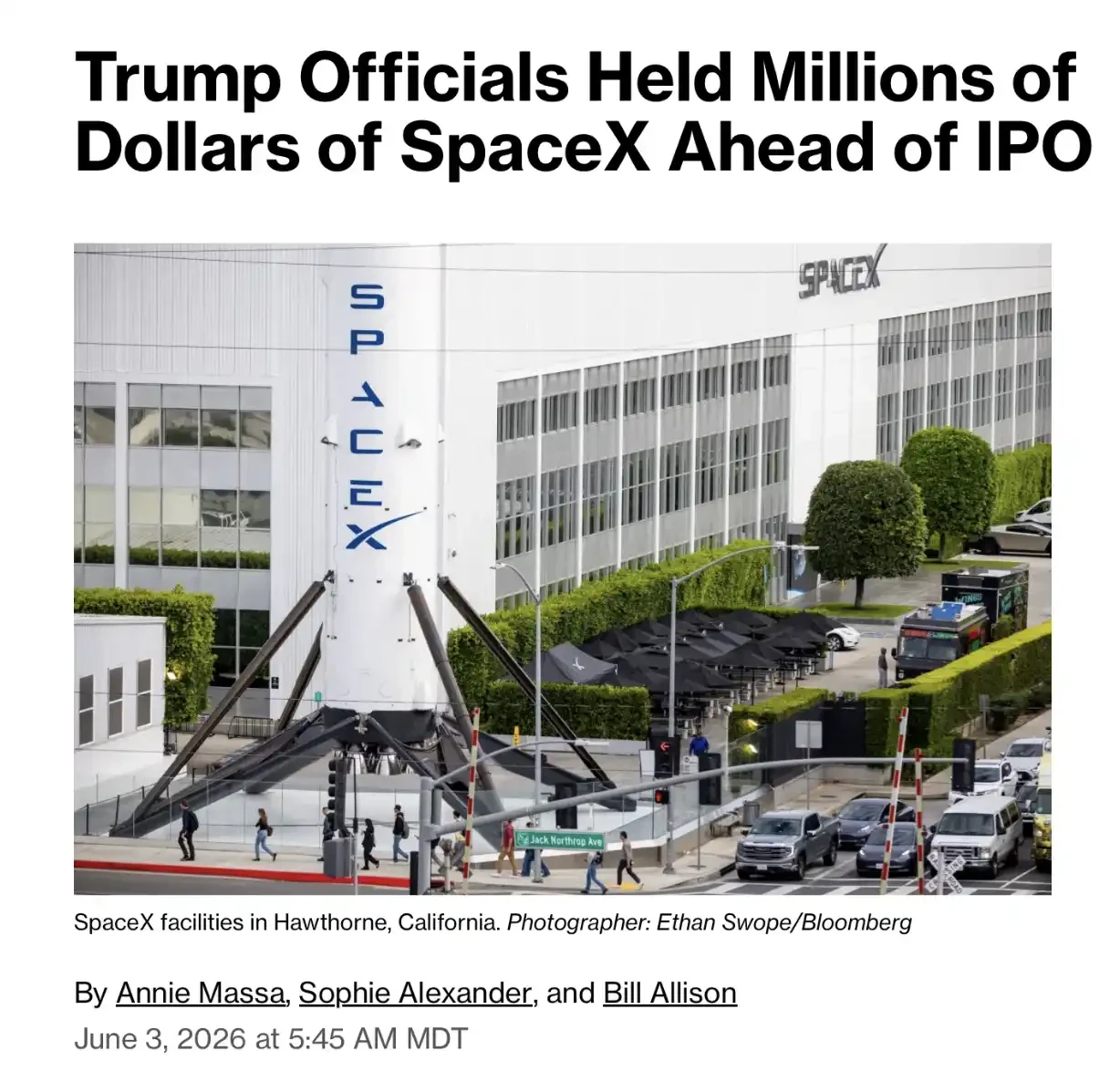
No surprise. Guess who we can add to the Rupert list:
III. What happens when a thief escapes the scene
This question is easily answered: disappointing business performance (see Part I of this paper) and endless dilution of equity。
SpaceX’s IPO, even including the Green Shoes Mechanism, can only finance about $85 billion. But a closer look at its registration documents reveals that — the Greg Collins of Cape Fear Advisors has done so — by 2030, SpaceX's capital needs will reach approximately $235 billion。
If SpaceX were to raise $85 billion through IPO and use $20 billion of it to service its debt, it would still leave a $170 billion shortfall. (Collins anticipates a smaller scale and a larger gap, but in any case this is a huge gap
Of course, an obvious solution is to empty Tesla ' s cash reserves: whether through consolidation or further forcing Tesla to invest in SpaceX. But Tesla's cash is far from enough to fill SpaceX, the money-burning furnace。
The future will be -- and even S-1 documents have already predicted -- endless dilute financing. Deep in the SpaceX revision S-1 document, there is a warning that we may be issuing large shares for related transactions in the future。
Even the sentence itself can be said to be misleading. It's not that there's a problem with the part that says "a lot of equity will be issued in the future"; it's almost certain。
The question is, are these issues really for "a future deal"? Elon, isn't that what you're really saying: those deals that SpaceX has promised in the S-1 file
As to any misleading statements or false information that may exist in the registration documents, as well as possible misconduct by Mask and other executives, directors or future directors, the damaged investors will be almost powerless。
SpaceX shareholders will be forced to accept compulsory arbitration. They have no meaningful right to vote. The governance dispute would be decided by a new Texas Commercial Court, presided over by a Mask friendly judge — and not by a jury。
IV. Final points for reflection
The following ideas are not sequential. At the same time, remember that the only law that Elon Musk can't break is the Law of Unforeseen Consequences。
A. THIS COULD COLLAPSE
SpaceX's IPO may have suffered catastrophic failure in the first place, even delayed or cancelled. The reason is simple: there may be too many stocks that are eager to find buyers and the market does not have enough money to take over。
Rupert Mitchell and Ben Brey discussed these possibilities in a highly informative written report and follow-up podcast。
IT COULD HIT STOCK AND ENCRYPTION MARKETS
SpaceX provides an unprecedented 30 per cent of its distribution to diaspora investors who have to raise money from somewhere。
Therefore, this IPO could trigger large-scale, disturbing sales. The most obvious candidates were stocks and encrypted assets, as those wishing to participate in the subscriptions had to sell other assets to raise money. In fact, the downward pressure on the price of bitcoin in recent weeks may be partly due to such sales. (Michael Saylor's recent move has further added fuel to the fire
C. IT COULD PIERCE AI FOAM
Chris Irons of Quoth The Raven argued that SpaceX IPO would become a market referendum to test whether AI investment bubbles could continue to swell。
If SpaceX is successfully listed and obtains overwhelming demand, it shows that despite the red flag, investors are willing to actively suspend traditional investment discipline and continue to believe in the story. But if the outcome is disappointing, it could be the beginning of the end of the current investment cycle。
(In a recent podcast with Adam Taggart, Chris described the current financial market as a "digital cocaine casino"
D. THE POPULARITY OF ITS POTENTIAL PERMANENT DAMAGE INDEX FUND
For decades, index funds have provided ordinary people — those who do not have complex financial knowledge but need to invest in retirement — with access to a wide range of markets at very low cost。
But SpaceX IPO is a huge trap for these ordinary people. If what I had foreseen actually happened, they would have been forced to buy at a price that had been heavily pushed up and then watch as the assets they had bought inevitably depreciated。
this may leave a sufficiently serious stain on index funds to the extent that the 401 (k) initiative sponsors and managers, as well as financial advisers in the broader sense, are no longer recommended as suitable investment instruments。
Don't try to do spaceX
Elon Musk is a cult calling person. More importantly, he has proved time and again that he can immunize almost any truly effective market, legal or regulatory review。
Mask critics were right about a lot of things: the basics of Tesla's bad, the lies about full self-piloting, the fantasy of Robotaxi, the frightful accounting. But they were wrong when they thought these problems would affect stock prices。
Someday, somewhere, somebody's gonna make big money by doing kotesla or SpaceX. But that guy probably wouldn't be you。
At least now, the best way to understand Tesla is to treat it as a religion rather than as a financial investment. Now SpaceX can also be added to this category。
So my advice is, stay away from it. Take care of your garden. Play with the kids. Read a good book. Listen to a great classical music. Here is a recording that I have heard recently and which I would very much like to recommend。
