
microsoft presses the vibe coding pause, "burn token" is already more expensive than employees
Paying an employee AI co-driver, no inverse token bill, is doomed to lose。

original title: "microsoft press vibe coding pause: burning token is already more expensive than employees"
Original by Zhang Yong-Yi, Holloway Park
On May 14, 2026Microsoft has begun to cancel Claude Code internal clearances for most employeesI don't know. The deadline is June 30th -- the last day of Microsoft's financial year。
Just six months ago, Microsoft was doing the exact opposite -- in December 2025, it opened Claude Code to thousands of employees, including engineers, product managers, designers, and encouraged everyone to reshape the workflow in a vibe-coding way. The staff loved the tool, but maybe, too much。
But six months later, Microsoft withdrew。
And almost the same week, the YC partner, Tom Blomfield, said another sentence on a watch talk:IF YOUR API BILL DOESN'T HURT YOUR HEART, IT MEANS YOU HAVEN'T BURNED ENOUGHI don't know
IN THE SAME SPRING, SILICON VALLEY IS GIVING TWO COMPLETELY OPPOSITE ANSWERS TO THE SAME QUESTION -- AI, IS IT MORE EXPENSIVE THAN HUMANS
failed scene of 01 vibe coding
Microsoft canceled not Claude this model. Anthropic models will continue to be made available to Microsoft employees via Copilot CLI. What it canceled was Claude Code, the product portal itself。
Most affected are the engineering teams behind Windows, Microsoft 365, Outlook, Teams and Surface. In an internal memo, EVP Rajesh Jha packaged this decision as a "toolchain harmonization" but the Microsoft internal news quoted by The Verge was more straightforward: employees generally thought Claude Code was better than Copilot CLI, and Anthropic, a tool that was popular within Microsoft, had even made Microsoft’s own Copilot CLI “cooled”。
In other wordsIt's not because it can't, it's because it's too goodI don't know。
The June 30 deadline is not a coincidence -- it's the last day of Microsoft's financial year. Cutting down a tool of general employee preference, switching back home products, time-stamping on the fiscal year node — how many product judgments there are, how many financial considerations are there, you know。

Source: Visual China
Microsoft is not alone。
A month ago, the CTO Praveen Neppalli Naga of Uber revealed:THE COMPANY'S BUDGET FOR THE AI PROGRAMMING TOOL FOR THE WHOLE OF 2026 WAS BURNED IN THE FIRST FOUR MONTHSI don't know. Uber has also previously done internal rankings to motivate employees to use AI - the result is a budget collapse。
More bluntly, Bryan Catanzaro, Vice-President of the In-depth Applied Studies in Weaverda, said in an interview with Axios:For my team, the cost of computing is far greater than the cost of staffIt's from the head of a hardware company whose core product is sales power。
Fortune put these clues together and gave the article a very Fortune title: "Microsoft's report exposes the real cost of AI -- it's more expensive than raising employees."。
If you read only this level, the conclusion is simple: vibe coding failed, and AI's replacement is ready for the story。
But this conclusion is early。
02 Copilot mode has been hit against the wall
to explain microsoft's retreat, we need to be clear about what the vibe coding is。
Andrej Karpathy put it in early 2025 -- he described a new way of programming: the developers no longer write code in line, but rather describe intent in their own language, allowing LLM to generate code. Developers don't even read codes, read results -- they can run, they can't run, they can't get AI to change again。
This is the most attractive productivity commitment of the AI era. It means: an engineer who can't write Rust can get AI to write Rust; a product manager can get AI to make him prototype; a designer can get AI to write him codes that can run. In December 2025, Microsoft opened Claude Code to -- engineers, PMs, designers -- exactly those three categories. It's not a coincidence, it's the classic landing position。
but vibe coding falls into a big company and becomes a very structural thing。
Assuming Microsoft has an engineer with an annual salary of $300,000. After Microsoft assigned him a Claude Code, his output rose by 20 percent -- this is the ideal state of vibe coding. But at the same time, did he burn the token every month at $200, $500, or $2,000? This number will rise as he becomes more and more dependent on AI。
EVEN MORE TROUBLESOME, HE WON'T BE FIRED FOR USING "AI" -- HIS 300,000-YEAR SALARY, HIS WELFARE, HIS JOB。
In other wordsmicrosoft's total cost structure is "old employee pay plus new token bill"I don't know. There's only one direction to this formula -- the cost surge。

AND IS THE "STAFF OUTPUT + 20%" FINANCIALLY REFLECTED IN "RECEIVING + 20%"? NOPE. IT'S THE "RECEIVING UNCHANGED, BUT THERE'S AN ADDITIONAL AI BILL IN THE COST STRUCTURE" - BECAUSE MOST OF THE EMPLOYEES' OUTPUT DOES NOT DIRECTLY CORRESPOND TO THE INCREASED INCOME, AND HE WRITES FASTER THAN THE COMPANY SELLS MORE。
That's what Catanzaro meant by "calculations are more expensive than employees". It's not that AI's stupid, it's that when you put AI on the original employee, you can't make it work。
This logic is supported by data。
Gartner's latest prediction says that by 2030, the reasoning cost of a large model of a trillion parameters will be nearly 90 per cent lower than in 2025. Sounds like AI's getting cheaper, but the real conclusion of Gartner is that this doesn't make the corporate AI bill cheaper. Gartner, senior chief executive analyst, Will Sommer, said"CPOs should not confuse "commodity-level token deflation" with "the introduction of frontier reasoning."
Goldman Sachs predicts more directly: by 2030, agentic AI will drive token consumption up 24 times to 1.2 billion a month. The single token price dropped by 90%, consumption increased 24 times -- and the total bill is still rising。
Wong In-hoon has a more radical version. He said in public a few months ago that every employee in England will work with 100 AI agents in the future。
Sounds beautiful. But if you're CFO, what do you hear? It's 100 token stoves that burn 24 hours a day。
THE PROBLEM IS NOT AI TOO EXPENSIVE. THE PROBLEM IS THAT THE ASSUMPTION OF "A CO-PILOT OF AN AI FOR EVERY EMPLOYEE" IS ITSELF。
This position has a popular name in the tech world, Copilot Mode. Its core assumption is that people continue to be in the driver's seat and AI advises you on the deputy driver's seat. It doesn't replace you, just makes you faster。
THIS ASSUMPTION IS VERY GENTLE AT THE TEXTUAL LEVEL -- "AI WILL NOT TAKE YOUR JOB, AI WILL JUST HELP YOU." AT THE FINANCIAL LEVEL, HOWEVER, IT IMPLIES THAT:all old wages are unchanged, but one extra token costI don't know。
and token is not a fixed cost, but a consumption fee. the more employees use, the more companies pay... this happens to be the cost structure that businesses most reluctant to see: floating, uncapped, expanding backwards with capacity。
Microsoft may not be fully aware of this when Claude Code opened in December 2025. What it was supposed to be was, let the staff try to see how much AI could make it work. But six months later, the employees were really addicted, Claude Code was too popular within Microsoft... – The result is that the token bill far exceeded expectations and exceeded the output that Microsoft itself could recover from the epidemic。
MICROSOFT RETREATED. BUT IT'S NOT AI-- IT'S THE STRUCTURE OF "STAFF STAY IN THE DRIVER'S SEAT, AI IN THE DEPUTY DRIVER'S SEAT."。
THIS IS A STRUCTURAL FAILURE. IT DOESN'T DISAPPEAR BECAUSE IT'S CHEAPER, OR BECAUSE IT'S MORE SKILLED -- IT'S GOING TO GET MORE AND MORE SKILLED WITH AIMore seriousI don't know。
03 burning token because it doesn't burn. head
Almost the same week as Microsoft's retreat, Tom Blomfield presented a completely different perspective on YC's watch talk. He didn't talk about "AI" -- he talked about "What the companies of the AI era should look like."。
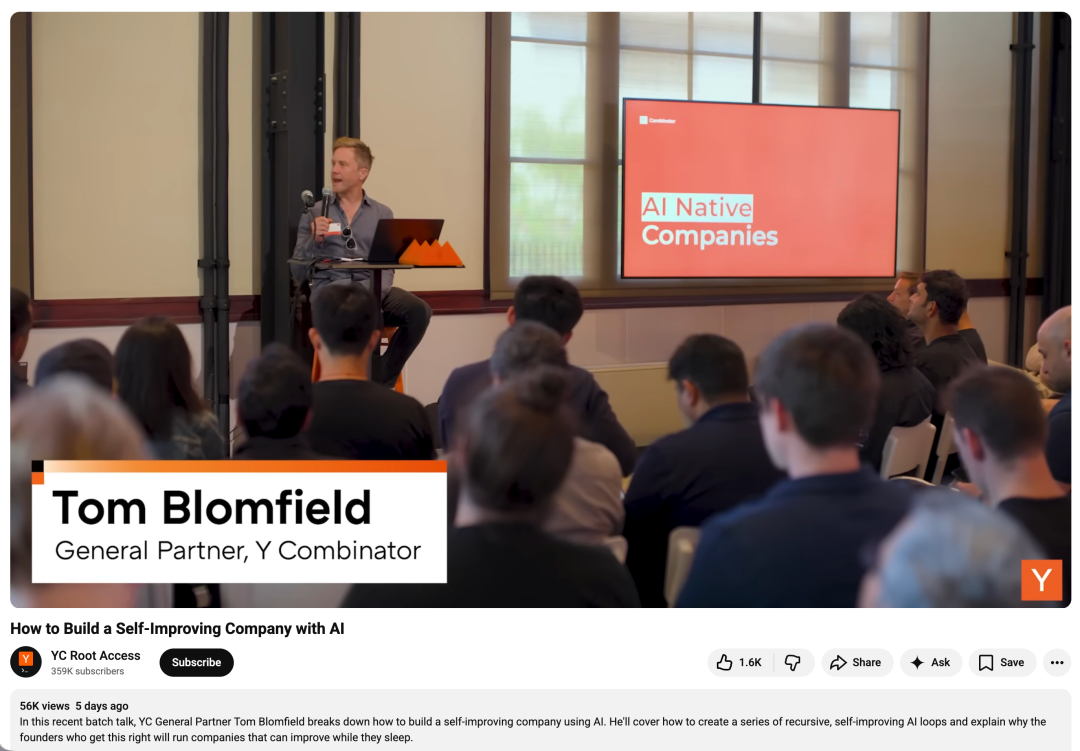
Blomfield's judgement is straightforward: today most companies are still a "Roman Legion"-style structure: information is passed up, orders are distributed down, people are at the heart of coordination。PUT AI ON THIS STRUCTURE, THE EFFECT IS TO SEND THE HEAT WEAPON TO THE ROMAN INFANTRY -- THEY'LL USE IT HARDER, BUT THE TACTICS WON'T CHANGEI don't know。
The real AI-native company should look different。
Blomfield uses a very specific description: each action should produce a recordable, deployable product that allows for a clear readable version of AI; the company should be designed as an "AI loop of self-improvement" with a system that is aware of the environment, makes decisions, calls tools, receives feedback, corrects itself。
There are only two roles in such companies. One is a personal contributor — everyone, regardless of department, meets with prototypes, not just ideas; the other is DRI (directly responsible) — each output has a clear duty to “not hide behind AI”。
Then Blomfield said the golden sentence:"IF YOUR API BILL DOESN'T HURT YOUR HEART, IT MEANS YOU HAVEN'T BURNED ENOUGH."
IF IT APPEARED IN MICROSOFT'S CFO OFFICE, IT WOULD BE CONSIDERED A JOKE; BUT IT WAS IN FRONT OF THE FOUNDERS OF THE YC FAMILY OF STARTERS, NO ONE THOUGHT IT CRAZY。
Why
YC's other partner, Diana Hu, gave the answer in Startup School in early May. She said, "It's not human head, it's token consumption." She also has a more straightforward version: "One person with an AI tool equals a team of great engineers in the past."
The key word here is "equal." It's not the equivalent, it's not the like -- it's the substitute。
The YC's P26 2026 spring watch already uses 5 or 6 people to do 20 or 30 people in the past. Their token bills are, of course, high, but their personnel bills are extremely low — they're taken together, they're earned。
The more radical case is Block. Jack Dorsey has recently laid off 40% of the employees of this financial technology company. This is not the traditional "reduced efficiency" -- Block simultaneously increases the internal input of the AI tool, the new structure described by Diana Hu: IC + DRI + AI anent。
Burning token is not an expense in the YC context, it is a substitute. It's not an AI alternative, it's head salary. The bill was calculated because the company simultaneously removed the positions that would have been burned。
That's why Microsoft and YC see the same thing, but give the opposite answer -- they don't burn the same token。Microsoft's token is to refuel the co-pilot of the original squad, YC's token is to replace the original pilotI don't know。
04 Real assets are being redefined
Tom Blomfield, in his conversation, added another more interesting phrase: "People are short, context documents are important."
This is a judgement at the level of accounting。
What about the balance sheets of traditional companies? On the left are fixed assets, receivables, goodwill, IP and on the right are liabilities and shareholder equity. The employee is not in the asset category - the employee is the cost. But every company knows that employees are real assets: customer relationships in sales, business instincts in product managers, technology know-how in engineers。
This "assets" is a feature that goes away. When the staff left, the assets ran away。
The AI-native company described by Blomfield is doing one thing: extract all of the assets that were originally only in the human brain and turn them into AI readable, accessible, iterative context assets。
What is the specific form? It is a detailed demand file; it is a process document that takes every decision, every e-mail exchange, every Slack discussion of sedimentation; it is an open MCP interface and API; it is an artifact from every internal tool - all of which constitute a new, inheritable asset layer of a company that does not evaporate with its employees。
Instead, people in such companies become "variables" — they can access or leave quickly because the company's core assets are not in the human mind, in the files。
Source: Visual China
If established, this structure means more than a new organizational model — meaning that the company's balance sheet is being rewritten。An AI-native company with six individuals, burning amazing token bills, which seems to be financially unhealthy, may have more real assets than a 60-person traditional company- It's just that the accounting standards have not learned how to calculate。
in other words, vibe coding is not dead. it's just not a traditional company。
The day Microsoft pulled out Claude Code, it wasn't the day that AI failed in economics -- it was the day that it put AI in the position of the old organization and was perjured by itself。
And YC's home-grown company is growing in a different position - they're small, they're burning, they don't have the "Ai usage rate" on KPI's watch, and their CFOs don't panic over token's billings -- because they burn not "the employee's side drive" but "the employee's replacement"。
In the next few years, all medium-sized companies that still have their employees "a little more al" hit the wall that Microsoft hit -- structural token bills。
BUT THE REAL REASON FOR THE CRASH WAS NOT THAT AI WAS TOO EXPENSIVE -- IT'S THAT DIVISION HASN'T CHANGED。
And most companies, I'm afraid, won't change for a while。
Original Link
