
Shao Feng talks with Vitalik Buterin's encirclement: How does the ETA construct the next phase of its application through AI, antiquator calculations
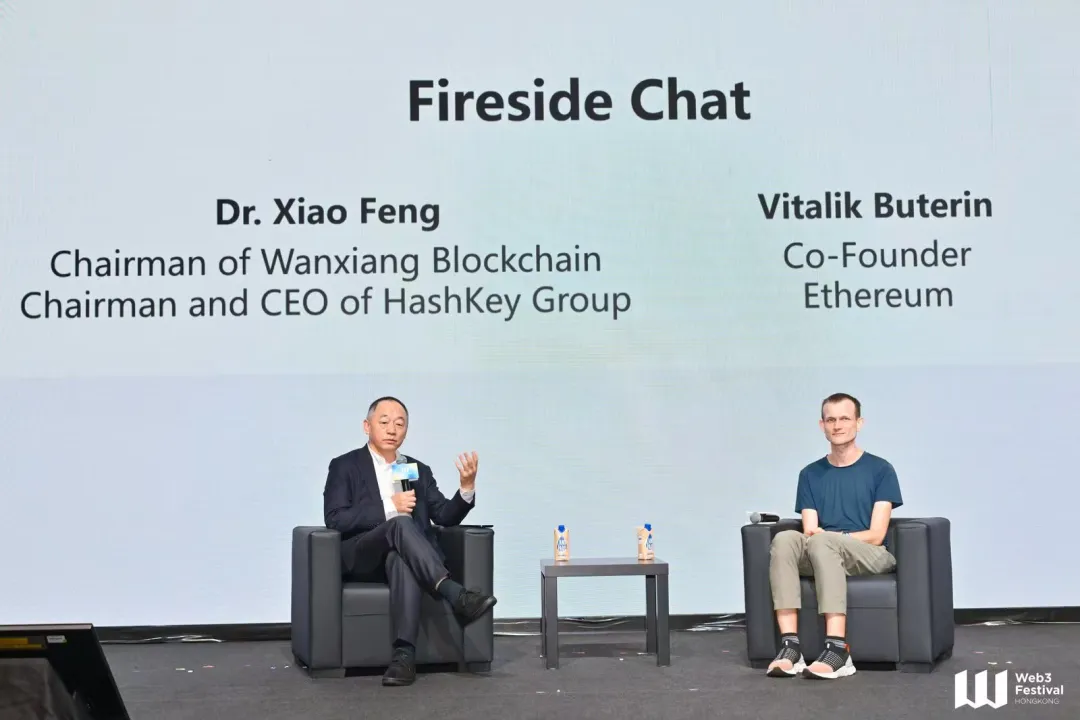
Author: Zone chain
Original link: https://mp.weixin.qq.com/s/deqoLlj avmwj9wnc0EsDQ
Statement: For the purpose of reproduction, readers can obtain more information by linking to the original language. If the author has any objection to the reproduction, please contact us and we will proceed with the modifications requested by the author. Reproduction for information-sharing purposes only does not constitute any investment proposal and does not represent the views and positions of Wu。
On the afternoon of April 22th, Vitalik Buterin, Chairman of the Zone Chain, Chairman of HashKey Group and Co-founder of the CEO Xiaofeng and the Ether Workshop, held an in-depth discussion on the theme " Future Vision - the next phase of the application of Etherwood " at the main site of the 2026 Hong Kong Web3 Carnival. The following is based on the live summary of the encirclement interview, with little effect on the intended deletion。
Shaft: & nbsp; friends, welcome to the second conversation with Vitalik, which we had last year. Vitalik, would you like to say hello
Vitalik Buterin: Hello
all right, everybody
There was actually just a discussion about the combination of smart hardware and block chains before we came up. And I know that in recent weeks Vitalik has seen a lot of companies and entrepreneurs involved in chip, smart hardware manufacturing. And I'm curious to hear about this: Why are you suddenly so interested in smart hardware and chips at this point? What kind of interaction do you have with Ether's? I'd like you to talk about this first。
Vitalik Buterin: & nbsp; we have recently started to think about a lot, except Full Stack open source security. Fullback refers to each layer of application, including the application layer - if it is a website, the browser is a layer, the operating system is a layer, the hardware is a layer, so there are many different layers。
If no layer is safe, then the system is not safe. We have been talking about doing something safe that does not require central trust, but if we really want to do this, we need to look at every level。
I SEE A LOT OF PEOPLE SAY THEY'RE ETH HOLDERS. SO, HOW'S YOUR ETH SAFETY GUARANTEED? THE FIRST IS YOUR WALLET; THE SECOND IS YOUR COMPUTER OPERATING SYSTEM; AND THIRD, IF YOU USE YOUR HARDWARE WALLET, THERE'S A QUESTION: HOW DO YOU BELIEVE YOUR HARDWARE WALLET IS SAFE。
In addition, there has been a topic in the last two years: it is hoped that the application of block-chain-based platforms will do more in the real world, which also depends on hardware. So whatever we do, the hardware layer is important。
Shaft: & nbsp; yes. Not only is there a security problem at the Etherwood and L2 levels, but hardware is also needed to accelerate certain calculations in the Etherwood II agreements. After all, hardware acceleration is one of the current means of addressing performance problems. Perhaps by now, hardware is also needed to guarantee security or provide better efficiency and performance when block chains and the Etherwood as infrastructure are needed to support more applications. This is also the subject of the previous forum。
There's a topic I've noticed you've been talking about, but it's not getting a lot of resonance, and I think it might be very important。
WE KNOW THAT THE BARRIERS TO BLOCK CHAINS AND ETHER ARE STILL HIGH FOR C END USERS. IT INCLUDES NOT JUST WALLETS, BUT ALSO SMART CONTRACTS, BECAUSE NOT EVERYONE HAS THE CAPACITY TO PREPARE A FULLY OPERATIONAL SMART CONTRACT. YOU HAVE ALSO BEEN REFERRING TO THE SIMPLIFICATION OF THE ETHER WORKSHOP, WHICH I UNDERSTAND IS TO LOWER THE THRESHOLD FOR ITS APPLICATION AND TO MAKE IT MORE EASILY ACCESSIBLE。
It reminds me of the history of computer development. The computer's initial operating system is the command line. Bill Gates did the DOS operating system, which is based on orders. If the computer operating system is still command, I'm sure 90 percent of the world's computer users can't use it because it's extremely difficult to learn. Then there was a browser, then there was a graphic operating system like Windows。
AS THE THRESHOLD IS LOWERED, COMPUTER PROCESSES ARE BECOMING SIMPLER AND MORE USERS. THE BIGGEST SIMPLIFICATION IS THE ARRIVAL OF THE MOBILE INTERNET AND THE EMERGENCE OF THE APP. WE KNOW THAT TWITTER IS AN EXTREMELY COMPLEX SYSTEM, BUT IT'S WRAPPED INTO AN APP THAT YOU CAN OPERATE WITH ONLY ONE FINGER. THAT IS, YOU CAN OPERATE A COMPUTER FUNCTION OR PROGRAM WITH ONE FINGER。
We certainly look forward to the gradual simplification, automation and intellectualization of the ETA so that more people can use it more easily with one finger. Would you like to begin with what you have mentioned, the envisaged simplification of the path and the ultimate goal of the Ethera
Vitalik Buterin: & nbsp; I think the word “simplified” has two meanings。
The first meaning could be an iPhone simplification. You have a cell phone, which looks very simple, and you press a button to know what it does, but there's a very, very complicated system behind the screen。
The second is to make the latter very complex system simpler。
actually, both are important. why is the second important? for if a system is too complex, it means that very few people can participate in the core development process. you can say that the system is theoretically trustless, but if the core of the system is very complex and only 50 individuals know how it works, then people around the world still need to believe that 50 people. so an overly complex system cannot be a trustless system。
The other thing is the user experience. I think the command line and the GUI are quite different. One difference is that GUI is more friendly to ordinary users, but command lines have their own advantages. An important advantage is that 50 years ago, the order age had a Unix philosophy. One of the many elements of Unix philosophy is that we should do very simple procedures. A user operation may call many different programs at the same time. For example, the user's input is entered into the first program, the output of the first program becomes the input of the second program, and the output of the second program becomes the third input, which is the concept of “pipeline”。
The concept has one advantage. In the Gui era, there was a lot of criticism or dissatisfaction, some called digital monopolies, digital feudalism. In the GUI, the natural result is that you have an UI, that UI is controlled by a company, that you live in a company's little universe, that your digital life is controlled by a company. On the contrary, the Unix philosophy has many different procedures, each of which is done by different companies and can be interoperable by order。
Now it's step three, that's AI. It's actually starting to get more focused on AI. Last year we formed a Kohaku team, a wallet team. Last month, the first test edition was released at EthCC, Kohaku, and they said it would be ready soon. But we all thought that the idea of a wallet might disappear in two years, and the future is AI. So we need to start thinking about the AI wallet and how to make it safer. We're also thinking more about the AI user interface. AI is essentially an order, but you just talk to the computer。
shaft: in natural languages。
Vitalik Buterin: & nbsp; yes, by order in a natural language. In the third era, it can be said that the advantages of the first two are shared: the virtues of command-making, the ability of many people and different companies to interact with each other in different small programs, and the good user experience. If we do well, we can combine the merits of the command line with the merits of the GUI. If we do well, the results will be very good, but we need to work。
Shawwind: & nbsp; command-line operations are numerous computer programs that can be developed for many developers, and APP is a company that integrates everything and all applications into this APP. From the point of view of consumer welfare, it is certainly the process developed by many developers that can be easily used by consumers, which is the practice of maximizing consumer welfare. If you can't do that, you have to simplify it so that you can use it, and it turns into an APP. There are many other developers behind the APP, but they're integrated on a platform。
Now Vitalik looks forward to AI coming, and there's a possibility of a return phenomenon, going back to command-driven computers. Of course, the command line at that time was not what we had learned, but in the natural language, that is, if you say one word, the computer would mobilize the many programs that were behind you to help you accomplish your goal. I look forward to doing this through the natural language with the help of AI。
I think that when we were talking about simplifying the Taifeng, the topic had already begun to be discussed in 2016 at the Shanghai Conference of the Global Developmentists of the Taifang, such as tools or technical tools to simplify smart contracting. I remember when two different technology development teams discussed formalization at Devcon in 2016 -- formalization to validate all applications in the Taipei, including a variety of smart contracts, finding bugs and making it a perfect smart contract. Now, AI, AI, plus formalization, can it be possible for any individual who is not a programmer, who is not a computer engineer, to build a smart contract for one of his purposes or needs, and this smart contract does not appear, bugs do not exist, hackers find loopholes, and can run well? In another perspective, the formalization process was discussed 10 years ago, and so far, with AI added, will it be possible for people in this room, whether or not they have computer programming skills, to write their own smart contracts and run on the Ether House
Vitalik Buterin: yes, formalization is now very important. Writing smart contracts is an important part. We talked a lot in 2016, when there was the DAO attack, and you realized the importance of smart contract security。
But this year Claude Mythos came out, surprised a lot of people, even scared. As I now understand it, Claude Mythos is really stronger than before AI, but it's a little exaggerated. And we can't just look at Claude Mythos now -- Claude Mythos is much better than AI a year ago, next year's AI is much better than Claude Mythos, and 2029's AI's ability to find all kinds of holes can be terrible. Now I think the only way to get a really safe code with AI plus formalisation and more is to get a code that really doesn't have a serious loophole. Now it's almost possible because of AI, and it's also necessary because of AI's ability to find loopholes。
Now, we're developing the next version of the Ether Workshop, and we're setting a lot of goals for the next version of the Ether Workshop PoS Consensus。
first, faster. the time for financial certainty is reduced from 16 minutes to 16 seconds, 8 seconds or less。
Second, antiquantium. Since last year, everything that is being thought and developed has seen resistance as necessary。
Thirdly, it is more central and safer. They have a lot of needs, and one of the things they do now is to prove that much of the next version of the consensus is safe by formalizing it, including a lot of complicated things like antiquant signature, antiquanto zero knowledge, and recursive STARK。
TWO YEARS AGO, IT WAS AGREED THAT FORMALIZING SUCH COMPLEX THINGS WAS COMPLETELY IMPOSSIBLE AND NEVER POSSIBLE, BUT NOW IT'S POSSIBLE BECAUSE AI IS SO FAST. SO AI IS BECOMING AN INCREASINGLY IMPORTANT PART OF THE L1 CORE DEVELOPMENT。
It was also important to write smart contracts, and recent hacking had become increasingly serious. In fact, the contracts on the chain have been fine in the last two years, and more problems have arisen in the UI floors and lower chains. AI can also help if you use AI, think of last year's Safety tool, the Safety tool is UI tool. If everyone uses Local AI and Safety, that can't happen. If it's done well and correctly, AI can replace third parties UI, and it can help security, but AI has a lot of its own security concerns, which we're thinking about. On the smart contract level, the last UI's Vyper is the second program language for writing smart contracts (Solidity is the first). Vyper now supports formalisation, and Solidity's ability is getting better. This tool is not perfect, it can't solve all the problems right now, but its ability, plus that of AI, is really very powerful。
Shaft: & nbsp; we have just discussed how formalization can empower everyone to write their own credible smart contracts. At the same time, you mentioned two topics that I wanted to talk to you about: quantum and resistance. We saw Google publish a paper of its own, and there are comments that Google's paper points more to the risk than bitcoin, but rather to signing algorithms in Taifung. What do you think of this
And I myself have asked some cipherists, who think that quantum calculations that can decipher encryption algorithms like bitcoin networks are very, very difficult in themselves, and very difficult in algorithms. But it's a foot taller, and it's a magic taller, and it's a very fast way to calculate the quantum. Seven or eight years ago, I visited some of China's most famous cipher scientists, who had a lot of money to study encryption algorithms for antiquator computation. Since the decryption of quantum computations is not limited to Crystal or Blockchain, the threat of encryption algorithms worldwide is such that countries are investing heavily in the development of anti-quantitative encryption algorithms. For example, eight years ago I was exposed to the concept of a “gap code”, which gave me the impression that there was a balance between the two sides and that there was no one-sided phenomenon。
What do you know about quantum computation encryption? There is much discussion about quantum calculations, and there is much discussion about the threat to different algorithms, such as Taifung, Bitcoin, but I think there is less discussion about the progress of antiquantic encryption algorithms themselves。
By the way, I asked a very creative cipher. What if there were a lot of accounts on the Bitcoin network that could not move? What if someone does not respond in time and does not update their wallets? This would cause huge losses and shocks to the system as a whole and even make it untrustworthy. He said it's really nice to have an antiquated encryption algorithm superstitious to existing encryption algorithms. Of course, some performance and experience will be sacrificed, but those who cannot move can do so slowly, even after three years. Of course, this is the most “slugger” solution。
I'd like you to talk about quantum encryption from an antiquantic encryption algorithm。
Vitalik Buterin: actually antiquity algorithms are more mature topics. About 20 years ago, people knew that there were two types of coded techniques that were resistant to quantum. The first is based on Hashi, including many Hashi-based signature algorithms, and zkSNARK — the antiquantium zero knowledge that you now know is also based on Hashi. The second is based on a mathematical method that quantum computers can't crack. Now, Lattice-based cryptoprophy is what everyone would use, probably both。
HASHI-BASED SIGNATURES ARE POSSIBLE AND ZERO PROOF OF KNOWLEDGE IS POSSIBLE, BUT ENCRYPTION WITH A PUBLIC KEY PRIVATE KEY IS NOT POSSIBLE — PERHAPS 40 YEARS AGO MATHEMATICIANS PROVED THAT HASHI-BASED INABILITY TO DO SO. THEREFORE, ANY ENCRYPTION OF PUBLIC AND PRIVATE KEYS, INCLUDING FHE, AND OTHER MORE COMPLEX OPERATIONS REQUIRE ALTERNATIVE APPROACHES。
The idea now in the ETA is more likely to promote pure algorithms based on Hashi, because we want to make more than an antiquator chain, but also an anti-AI chain. There are several hypotheses, like AI, that make decryption algorithms stronger, including RSA and latice-based algorithms. If there's only one kind of password against AI, it must be Hash. Because Hashi has no mathematical structure at all, Hashi algorithms can be said to be based on some random assumption. Cryptologists would say that it is impossible to distinguish between Hashi ' s output from the Hashi function or real random numbers. If there's only one thing safe, it's Hash。
It is hoped that on L1 all Hashi-based algorithms will be used if possible, but these algorithms have one disadvantage: efficiency. The current ETA signature is based on an elliptical curve, with 65 bytes based on an elliptical curve, 2,000 bytes based on Hashi, and between 0.6 and 3KB based on Lattice. ZK-SNARK may now be 500 bytes, Stark is proof of resistance to quantum, at least 300 KB or more. Efficiency issues need to be addressed。
We know there's a way to call it "aggregation." If a block requires a large number of signatures and certificates, the node of the manufacturing block can itself produce a 300 KB certificate (i.e. Stark) to prove the validity of all signatures and certificates. No matter how many transactions, no matter how complicated, need not contain all signatures in the block, just a 300 KB Stark. Many of our projects are studying this approach, and there are more complex thinking in their application。
Shaft: & nbsp; encryption algorithms that are resistant to quantum computing have developed over a long period of time, except that they may not be available on a large scale. It is not that these algorithms are not or are not working at all, they are already available, but we need to upgrade performance. That's why Vitalik, you've been worried about smart hardware lately. Many algorithms can be accelerated by chips or other hardware to improve performance and efficiency and to bring it closer to meeting performance requirements in actual application scenarios。
The hot spot in the last few days is DeFi's safety. DeFi grew up in the Ether House, where DeFi's main market share has so far remained. DeFi has had some security incidents every year in the past. Once, we thought that the loophole had been filled, and the following year there would be new ones. What do you think of DeFi, safe? Is there any ultimate solution? It may take time, but is there some ultimate solution to DeFi's security problem? Because DeFi is a central link for the Ether, block chains and encrypted finance。
Despite the fact that DeFi had a huge risk event, hundreds of millions of dollars had been stolen. I have also asked cipherists, who say that using zero-knowledge proof (ZK) to build cross-chain bridges, such methods can now better address the interoperability of assets between different chains. There are already solutions, and zero knowledge has proved to be an important part. With regard to the ultimate solution to DeFi's security, what is its prospect at this stage? Please talk about this。
Vitalik Buterin: DeFi has many parts of security. Technically, we know how to be safer, and there is one more thing about which agreements are willing to be safer. In the AI era, if you want to make a security code, the security code will be much more capable, so the security code may be safer, but the normal code will become less secure. Why? Because AI makes it easy for people to write 10,000 lines of code, and you think you write a lot of things in an hour, and it looks great, but it's not safe, and you can't see the unsafe places. Security is not just a technical capability; it is also an option。
I also have a point: a lot of new chains have come out recently, including Solana, and Tempo. In this case, what is the role of the Ether House? I think the Ether House needs to do what only Ether House can do. What can the Ether House do? It's safe. First, the ETA network has thousands or even tens of thousands of nodes around the globe. Second, there are five completely independent different clients. So even if a client had problems, the entire network could still operate. Maybe you'll remember a lot of DOS attacks 10 years ago in Devcon, Shanghai. The attack was made possible by the fact that the attackers exploited the leaks in the memory of the Geth client in the processing of specific codes, mainly related to the Gas billing mechanism. And that's when people change to Parity clients, and Parity is fine; next time, if Parity gets attacked, Geth can top it. So there are a lot of safety-related advantages to the network and the technology。
I think Ether's L1 DeFi should also make a choice. Our transition goal is Low-risk DeFi, which is decentralised and safe. No matter what happens, no matter what company collapses, no matter who is hacked, your assets or your security. I think it's possible. That is the choice, and we need to choose to do so。
Xiaofeng: & nbsp; Vitalik just spoke about security not only as a technical issue, but also as a matter of will — would you like to write a very safe program, the first level. Second floor, AI can bring a lot of security, but right now the programmers have a saying, "Code of the Shit Mountain," and AI has created so much code that you don't know who's right or who's wrong." Of course, there are many bugs that can be checked with AI to prevent loopholes on DeFi。
MOREOVER, ETA HAS BEEN EMPHASIZING THAT IF IT IS ACCEPTED THAT THE SO-CALLED BLOCK CHAIN CANNOT BE TRIANGULATED (DECENTERIZATION, SECURITY, PERFORMANCE), WHILE DEVELOPING TWO-TIER AGREEMENTS SUCH AS L1, L2, ETA L1 EMPHASIZES ONLY DECENTRIZATION AND SAFETY AND DOES NOT ATTEMPT TO IMPROVE PERFORMANCE IN OTHER WAYS. IT WAS NOT INTENDED TO INCREASE THE NUMBER OF TRANSACTIONS PER SECOND, BECAUSE THE TRIANGLE HAD NOT SO FAR FOUND A PERFECT SOLUTION. THE PROBLEM OF PERFORMANCE IS THEREFORE LEFT TO THE SECOND TIER, WHERE THE APPLICATION SCENE IS TO BE RESOLVED, AND THE ETHER WORKSHOP ITSELF IS SOLELY RESPONSIBLE FOR CENTRALIZATION AND SAFETY。
I have asked cipherists to prove with zero knowledge that they have built the bridge. At least so far, the cross-chain asset interoperability problem encountered by DeFi has proven to be a good solution with zero knowledge。
Quantum and resistance calculations are discussed earlier, which is a matter of safety. So the zero-knowledge proof, and the full-style encryption that was discussed by developers at Devcon in Shanghai in 2016 -- the zero-knowledge proof and the same-style encryption are privacy protection techniques. Of course, the two focus slightly: zero-knowledge proves that something is true and the numbers are accurate after encryption, and identical encryption allows others to calculate 100 per cent of the results after encryption. One focuses on proof, one focuses on calculation, but it is done in secret。
And when we were doing the Ether Shaft application, HashKey also had a HashKey Chain, the second floor of the Taifung. There is a strong need for privacy when we recommend ETA block-chain solutions to institutions that have a strong demand for compliance and privacy protection. Of course, data on the public chain is 100 per cent unlicensed, which is precisely one of the characteristics of the block chain. However, there is a strong need for privacy protection for those who use the ETA, which requires the use of zero-knowledge certification, generic encryption, privacy protection and privacy computing techniques. Zero-knowledge proves that we have spoken for 10 years, and for 10 years, we have also spoken of universal encryption. Are these technological developments able to adapt to the application-oriented needs of the Etherak? Is it possible to adapt to commercial applications on a large scale? What stage have we reached? Waiting for some time to come
Vitalik Buterin: & nbsp; I think zero now proves to be more mature, with many applications. We've spent 10 years working on a lot of tools, and now with AI, it's easy. FHE may be a little behind ZK, but it's still growing fast, and more and more applications have recently started using FHE。
ZK and FHE have different advantages and disadvantages. The advantage of ZK is that there's no need for trust. You don't need to trust anyone. Validation is proof. FHE's downside in terms of trust is that there is always a need for a private key to be decrypted, that there is always a need for a person and a company to have a private key, and that it is only through him that you can get the FHE calculations. You can't limit them to saying, "You can only get the results of this, you can't do the other ones," which is FHE's fault. However, the FHE has the advantage of calculating or combining data from different users. ZK is a user that can calculate the calculation using its own private information, validates the calculation results and then sends the certificate to another person or to the chain. FHE has other features。
The third technique, called obfuscation, could theoretically combine the characteristics of ZK and FHE, but is very slow and largely impossible. Theoretically, it is known how to do it, but it actually turns out that it takes one year to run, so it is still a research field. If I can do that, I think it'll be great. But now the combination of ZK and FHE can be done well。
Shape: & nbsp; this is very important for the integration of block chains and AI because any application of AI involves calculation. But if only AI calculations, there's a problem: if AI calculations are not encrypted, I'm sure they will be relatively slow to expand. AI, or separate block chains, is open and transparent to users。
YESTERDAY I CITED A CASE IN POINT: HOSPITAL MEDICAL DATA ARE EXTREMELY VALUABLE, BUT THE REQUIREMENTS FOR PRIVACY PROTECTION ARE ALSO HIGHEST. AI THE RESEARCH APPROACH, IF USED WITH HOSPITAL DATA, CLEARLY REPRESENTS A SIGNIFICANT IMPROVEMENT IN HUMAN WELL-BEING. IF PRIVACY PROTECTION IS NOT ADDRESSED AND CAN'T BE COUNTED IN ENCRYPTION, I'M SURE ALL HOSPITALS ARE AFRAID TO OPEN THESE DATA TO R & D PEOPLE. - DRUG RESEARCH AND DEVELOPMENT AND MEDICAL PROGRAMME DEVELOPMENT。
At the same time, encryption is certainly possible, e.g. simultaneous encryption, ZK, zero proof of knowledge. But if it's a combination of AI+ private computing techniques, you're actually a Web2 business model: you need to talk to this hospital, you need to negotiate, sign agreements, get permission, and pay. I'm sure it's very difficult for hospitals to expand from the perspective of the Token factory. But if we add the block chain, the AI+Pilot +Link chain, and transform it into a platform like Bitcoin, the Ethernet, without permission and trust, all the hospital data becomes AI Token. Since it's AI Token, using a block chain, without permission, without trust, anyone can call it. You consume the hospital, Token, you pay the hospital, the hospital doesn't need to know who it is. In this way, the commercial boundary will be significantly expanded from the perspective of the “Token factory”. These three technologies, in my view, need to be combined to create great commercial value。
I'D LIKE TO ASK YOU ABOUT THE L2 OF THE ETHER. THE SOLUTION TO THE IMPOSSIBLE TRIANGLE IS L1, L2. I THINK IT'S NOT POSSIBLE FOR A TRIANGLE TO BE A MATHEMATICAL PROBLEM, AND CHALLENGING A MATHEMATICALLY VALIDATED TRIANGLE IS EXTREMELY TECHNICAL. HOWEVER, THE PROBLEM WAS NOT INEXPLICABLE, SINCE IT LEFT THE ISSUE OF PERFORMANCE TO ANOTHER LEVEL. WHAT DO YOU THINK OF THE FUTURE OF L2 AND THE RELATIONSHIP BETWEEN L1 AND L2? WHAT DO YOU THINK IS THE BEST RELATIONSHIP IN THE FUTURE
Vitalik Buterin: thank you, Mr. Shaw, for mentioning a lot of important topics. Medical and FHE topics are particularly interesting。
WE HAVE RECENTLY HAD A PROJECT THAT COMBINES ALMOST EVERYTHING THAT HAS JUST BEEN SAID. THE PROJECT IS A DEVICE TO SEE AIR QUALITY INDICATORS. IN FACT, AIR QUALITY DATA IS VERY PROBLEMATIC: THESE DATA ALLOW US TO KNOW WHEN SOMEONE IS IN A ROOM, WHEN THEY ARE NOT, WHO IS THERE, WHAT HE IS DOING, AND A LOT, INCLUDING THROUGH AI. SO WHAT WE DO IS WE TAKE THE DATA DIRECTLY ON THE EQUIPMENT, THE HARDWARE, AND WE ENCRYPT THE INFORMATION THROUGH THE FHE, PLUS ZK. YOU NEED TO KNOW WHEN THE INFORMATION CAME FROM GOOD HARDWARE. THROUGH FHE, THE CONTENT OF INFORMATION CAN BE PROTECTED, INFORMATION SENT TO THE SERVER, WHERE A LOT OF SCIENTIFIC RESEARCH CAN BE DONE TO GUIDE THE IMPROVEMENT OF AIR QUALITY AND HUMAN HEALTH INFORMATION. THIS REQUIRES BOTH ZK, FHE AND SAFETY HARDWARE, AS WELL AS SMALL AND HIGH PERFORMANCE HARDWARE. SO IT'S A MATTER OF ENCRYPTION, IT'S A MATTER OF HARDWARE, IT'S A MATTER OF MEDICINE, IT'S A MATTER OF APPLICATION — EVERY LEVEL. THE PROJECT WE'RE DOING IS MORE INTERESTING。
AI and FHE are also interesting. If we can keep the LLM reasoning in FHE or zero knowledge, we can expand the application we can do. If the L1 reasoning is in FHE, it means that your mobile phone, IOT equipment, computers, all equipment can use the most powerful models safely. If you can prove LLM, you can use it, for example, to write a smart contract, which can theoretically be written in a natural language. You can prove the content of some articles, and according to the LLM's ruling, something happens, and then you can send some currency to an account. We all know that several companies are working very hard to optimize AI's FHE and AI's ZK, and I particularly hope that they will succeed。
With regard to L1 and L2, there has been a larger change in the last two years: the Taipei L1 is now willing to expand more than before. Why? Now that ZK technology is in place, it is possible to separate "manufacturing block calculations" and "certification block calculations." So, for the first time, we're rethinking the impossible triangle, which does not include the ability to separate and validate through ZK, which is now available, so there are plans to raise the gas ceiling more this year than next year. But there's still a lot I can't do。
The ideal L2 isn't "L1+ more scaling" to do a bigger EVM, which I find boring. What's more interesting is to start thinking about what is needed for applications -- what is needed for applications, L1, what is not possible? What other applications need but L1 does not provide? You can do those services, that's L2. I think there's gonna be a lot of new L2, and they're gonna be completely different from the old L2, and they're not gonna make a bigger copy of the EVM. L2 is actually moving in this direction, and Arbitrum has been saying, "We're not just EVM," for a long time. If they succeed in this path, it's the best way for Ether and them。
Shaft: & nbsp; on the one hand, the impossible triangle of the block chain can be greatly enhanced in modern technology by the presence of these new technologies ZK, and the Ether Mill itself, which is the foundation of L1, can also be significantly enhanced, and it is not possible that the water levels of the triangle may be rising. Of course, the same can be said for decentrization and safety if performance increases, except that new technologies can solve problems that are better than they used to be, the first level. The second level, the relationship between L1 and L2: L2 should be more applied-oriented than doing what L1 has done, and there is no need to repeat wheels and not necessarily cost-effective commercially. Applications-oriented, with different applications with different individual needs, may not be considered by L1 because they are too personal. Individualized needs require L2 to consider and meet, including performance needs. Some applications have higher performance requirements than L1, so L2 can do that. I totally agree。
I have learned that the Etherdorf Foundation updated its mission, vision, values about two months ago. All of you are fans of the Ethera, and the new mission, vision and values of the Ithera Foundation may not be too well known to the outside world. Why should the Etherwood Foundation update its mission, vision, values in the near future? Following this update, what kind of future Etherleaf Foundation does Ethera Foundation want to be
Vitalik Buterin: in the last two years there have been many very significant changes both inside and outside the block chain ecology. First, AI brought us a lot of change. In block chain ecology, many new chains have emerged, many new applications have emerged and many applications have begun to move in a more central direction。
We see a lot of mainstream adoptions. But in the ETA ecology, one thing needs to be emphasized: we should do what only ETA can do. If going to the hub community is just doing something that companies can do more, then we can't pretend to be HFT companies, pretend to be banks, pretend to be central exchanges。
There are two things to distinguish between efficiency and decentrization, security, privacy and lack of trust. The first point can be said to be the virtue of helping everyone in the ordinary world. Second, in many cases it may be considered useless -- why think about it? But it is still necessary at the most critical moment, and only bitcoin and Ethera can do it. It is difficult for other chains to allow a technology development team to develop five truly independent teams, which is totally impossible. So, we should put more emphasis on our strengths — only the chain of blocks that the Ether House can do。
L2 can be efficient, application can be efficient, L1 should provide only what the Ether House L1 can provide. And one thing is, from the point of view of what the application and the chain of blocks brings to the world, it's actually bitcoin and the L1 of the Ether Workshop that don't talk to you about efficiency. If you're going to be efficient, AI is going to be very efficient, and central finance is going to be great. What can a block chain do for us? I can give a more philosophical example. In the EF document, we mention many philosophys, anticensorship, open source, privacy, safety (CROPS principles), and more soft sovereignty。
You can think about the car 100 years ago. You buy a car, it's yours. You don't text the server every second. A 100-year-old car doesn't have to pay the company $100 a month if you don't pay for it. You buy a car, it's yours, you can fix it, you can change it, you can figure out how it works, you can wrap everything up. In this high-tech age, it's very easy to lose these things. For each application, the power of the user is limited. Many times, if a company collapses, your account may not exist, much of your information is deleted and the company doesn't know where it went。
So that's the concept: how can we make a high-tech future, but we can still maintain the advantages of a hundred years ago -- technology that users can control, they can understand, they can trust. We would like to emphasize again the characteristics of the Taifeng, including at the protocol level, at the application level, and beyond its ecology. In fact, when we talk to open-source hardware people, we find that they think exactly the same way many times. There's a lot of people who want to do a completely local AI, and they're like, "You can do what you want with or without the Internet, whatever happens."。
We hope that, starting at these points, these advantages will not be lost by improving the Ether Workshop agreement and its applied ecology. We cannot afford to lose these in the process of evolution and optimization. If it is lost, the whole Ether Workshop will be meaningless — we have a centralized, less efficient version. We want every layer of ecology built. The advantages of doing so are likely to be totally invisible on the first day, possibly in the first year and possibly not in 10 years. But there's always a crisis, and there's always three things that you think won't happen at the same time. Hope your accounts and assets are secure on the Etherport chain and in DeFi。
Shaft: updated two months ago with the Taifeng Foundation ' s vision, mission, values. The first is, of course, a repositioning strategy that focuses on what it should do and what it does best. At the same time, and in response to the progress made towards AI and digitalization, the Foundation's original intent was to be more equitable between efficiency and equity, to allow each individual to manage his or her own assets independently, to have greater autonomy over his or her own assets and to manage his or her assets more effectively than to become an “efficiency machine”. Efficiency is done by others, but decentrization, safety and autonomy are the ones to be upheld by the Taifeng. Repositioning, on the one hand, and holding back to its own beginnings and places of departure, on the other. Although the Etherak Foundation has so far been ten years, it must be kept up to date, it must be updated, and the focus must be more focused — this is the most important aspect of updating its own values this time。
THE LAST QUESTION: THE EAG WAS AN INITIATIVE THAT WAS PROPOSED BY BOTH OF US IN SINGAPORE LAST YEAR AND WHICH YOU VERY MUCH SUPPORT. DO YOU HAVE ANY PLANS OR SUGGESTIONS FOR THE EAG ETA ALLIANCE
Vitalik Buterin: & nbsp; the Etherwood Foundation has one more thing to say: the role of the Etherwood Foundation is limited, some things we can do, some things we can't do — not our profession. Maybe it's not the same idea as the foundation it was 10 years ago. Ten years ago, the Foundation had to be at the heart of the Ether Workshop, which had nothing else to offer. There's a lot of other things in the Ether House, applications, client teams, companies. The best time is now for the Foundation to do application-level research on L1 development, core autonomy, security and privacy, but this also means that success with the Taicha ecology requires others to do things that we cannot。
I'VE BEEN VERY HAPPY WITH THE ZONE CHAIN'S SUPPORT FOR THE ETHERAN ECOLOGY FOR OVER A DECADE. IT IS HOPED THAT EAG WILL DO MORE OF WHAT THE FOUNDATION ITSELF DOES NOT WANT TO DO, BUT WHAT THE ECOLOGY NEEDS TO DO, INCLUDING MANY APPLICATIONS THAT ARE RELEVANT, THAT CONNECT THE TRADITIONAL WORLD TO THE CHAIN OF BLOCKS, AND THAT ARE APPLIED BY A WIDE RANGE OF BUSINESSES, TO DO ECOLOGICAL RESEARCH AND DEVELOPMENT GLOBALLY. THESE ARE IMPORTANT. I'M GLAD YOU PUT FORWARD YOUR IDEAS AND STARTED DOING SO YOURSELF. EAG IS EXPECTED TO BE SUCCESSFUL, AND IT IS HOPED THAT THERE WILL BE MORE OTHER TEAMS AND COMPANIES IN THE ETA ECOLOGY WHO CAN LEARN FROM YOU, BUILD MORE INDEPENDENT ETA COMMUNITY ORGANIZATIONS, CHOOSE WHAT THEY ARE GOOD AT, WANT TO DO, AND MAKE THEIR OWN DIFFERENT ETA ECOLOGY. IN THIS WAY, WE CAN ALL WORK TOGETHER AND SUCCEED TOGETHER。
Shaft: & nbsp; thank you Vitalik, and thank you all for staying here until now. This year ' s dialogue is over, and we look forward to another opportunity for dialogue with Vitalik next year. Thank you
