
Tremper's 3642 trade disclosures: "Perfect closed circle" between policy and warehouse position
What the disclosure documents didn't tell you was that policy has a hold on impact, which in turn affects policy.
While dealing with the Iranian war, three,642 entries were placed in United States stock accounts。
THAT'S TRUMP'S Q1。
At the same time, he is dealing with customs duties, negotiating trade agreements and signing executive orders. Last Thursday, the United States Government Ethics Office Network published a 113-page document. A handwritten note was kept on the cover and the declarant paid the late payment. One of the world ' s most interesting trade disclosures was finally published。
In the same week, the United States Congress was moving ahead with the bill to ban official layoffs. According to Axios, the proposal has been co-sponsored by more than 120 members of parliament, both houses of parliament have copies, with a public opinion support rate of over 70 per cent。
But the biggest gap in the bill is that it does not control the President。
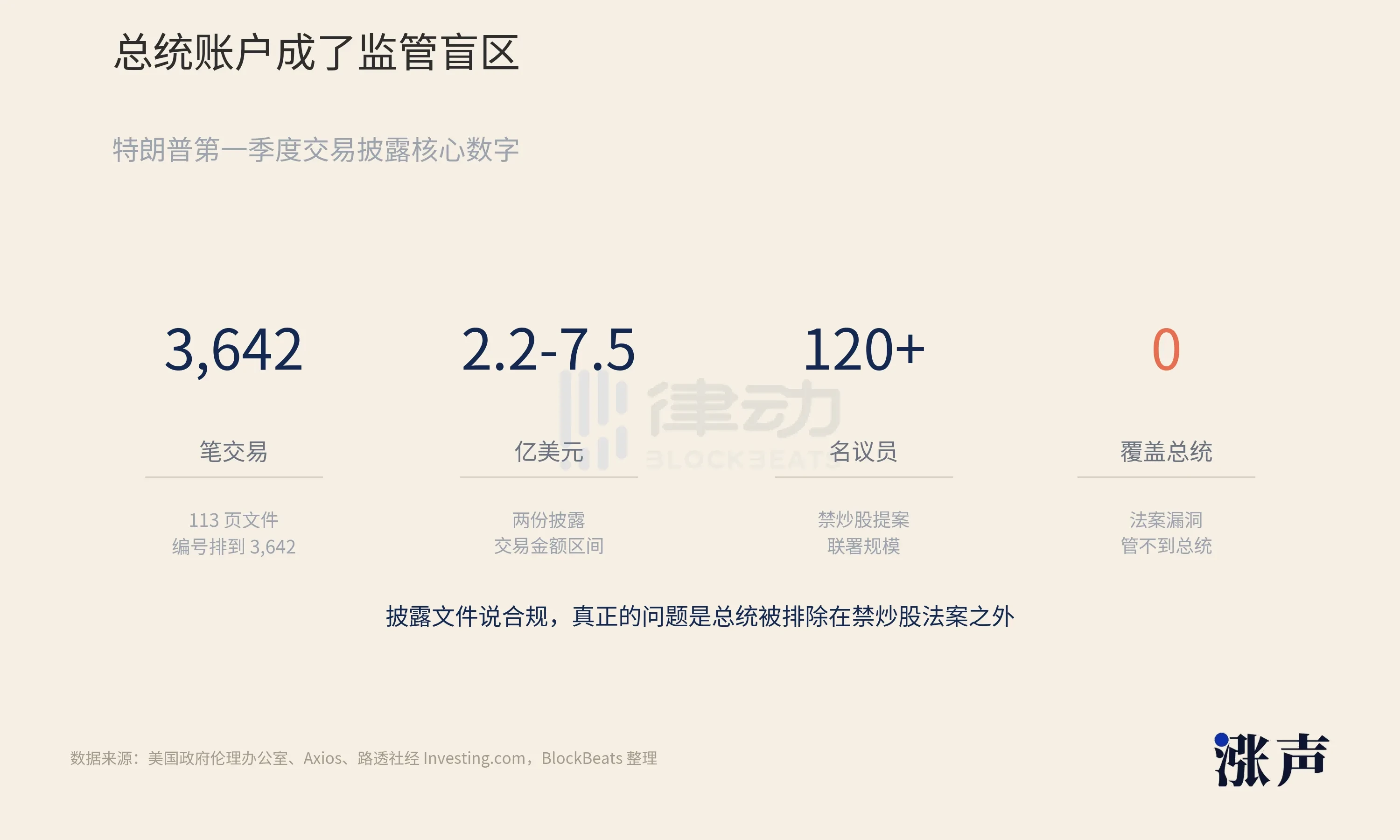
The White House's response is familiar. The President ' s assets are managed by children, the transactions are executed by the account manager and meet all the requirements of the United States official stock transaction disclosure act, and there is no conflict of interest. This sentence has been read many times over the past year. Whenever new details come out, read them. The number of readings has become a message in itself。
A person who can influence tariffs, trade, industrial subsidies, encryption regulation and market sentiment while keeping a large United States share account。
The disclosure document stated that the transaction was in compliance. What the market really wants to see is what he buys, how much he earns, and whether these stocks and his policies go the same way。
Money comes out of big technology and goes closer to policy
Federal disclosure rules require only ranges of amounts and do not require precise prices and actual gains and losses。
Benzina verified the pages of Trump's scans and estimated that Young Wida bought about $2.4 to $6.6 million, Microsoft about $2.4 to $8.1 million, Amazon about $2.5 to $8.3 million and Oracle about $2.2 to $10.6 million。
Big tech over there is another set of moves。
Microsoft, Amazon and Meta have the largest sales orders, up to $25 million each. The same companies, held in front of the first quarter, delivered goods in the latter and purchased and sold alternately in the bill. Money comes out of big technology and goes to semiconductors and artificial intelligence hardware chains。
In Weida, AMD, Broadcom, Dell, Intel are the most frequent names on this line. And Coinbase, Robinwood, Sofi. The construction time fell in the window where the Federal Bitcoin Reserve was discussed and the "Trump Account" retirement plan was launched。
Euronews calculates that if the holdup continues until the date of disclosure, the billings above 100 per cent include AMD, Intel, Marvell, Sandisk, Seagate, etc。
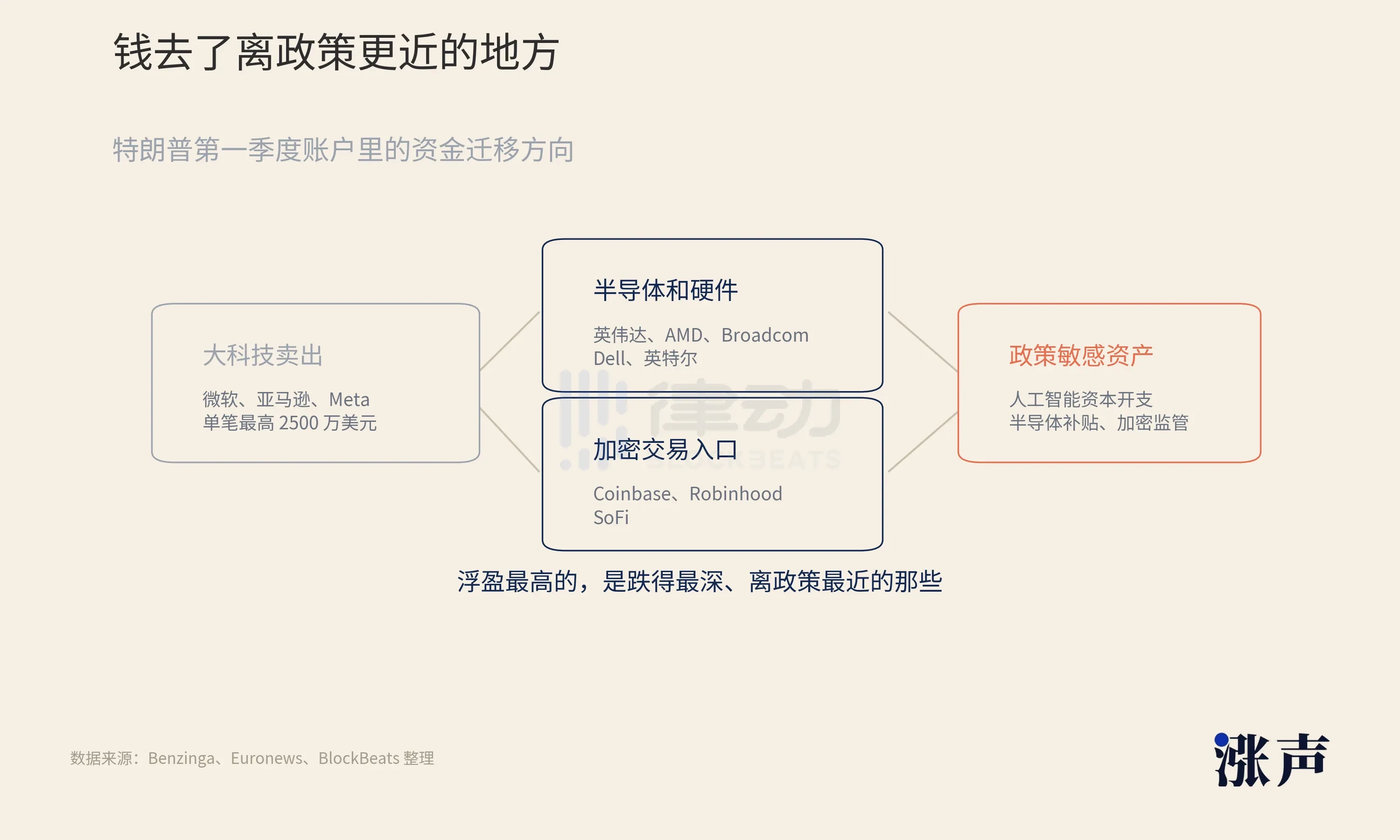
The highest was the ones that fell deepest and closest to policy。
In this business, big technology is still the base. Microsoft has enterprise software and cloud services, Amazon has cloud computing and advertising, Meta has advertising cash flow and artificial intelligence referral efficiency, and Oracle has databases and cloud infrastructure. They are the most successful names for US equity funds when they return to risk assets。
Incremental in the hardware chain。
Weedda is the graphic processor supply center, AMD is the second option, Broadcom does custom chips and data centre networks, Dale does artificial smart server delivery. Every time a cloud manufacturer buys another graphic processor, the company in this chain has an additional order. The money for big technology is the valuation logic of the platform company, and the money for the hardware chain is the first group to receive an account for the expense of artificial intelligence capital。
By contrast, Dale is the cleanest case of time。
On 10 February 2026, the Tramp account was set up in Dell, an amount ranging from $1 million to $5 million. On 8 May, Trump publicly praised Dale's hardware products at a White House event, which was about 12 per cent higher that day. Six days later, the deal was disclosed。
There is a background on the same line. The Dell family had previously committed $6.25 billion to the Tramp Pension Scheme. Each link is legitimate on its own and confirmed by the United States official stock exchange disclosure act。
And no one was investigated。
This is also the difference between the Trump account and ordinary politicians. The stock of ordinary officials disclosed that the reader looked at whether he had stepped on one policy direction. There is an additional layer to Trump's disclosure. Not only is he standing next to the market, but his public activities, policy projects and industrial relations will themselves become part of market pricing。
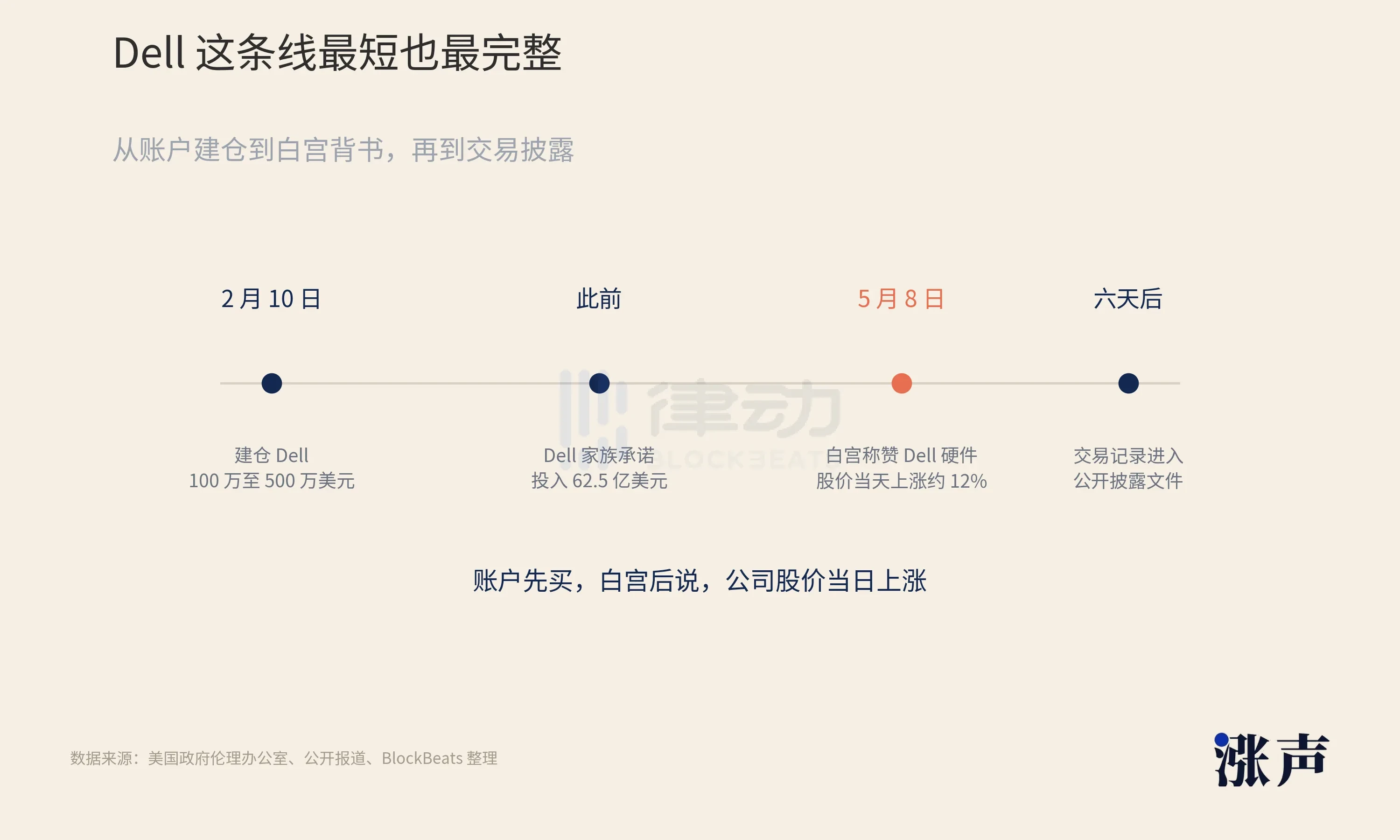
Dale's line is short and complete。
The account was bought first, and the White House later stated that the company ' s stock price had risen the same day and that family funds had entered the Tromp Policy Project. It does not have to prove any violation of the law, enough to allow the market to treat it as a model for politicians to trade。
Intel was bought as an American state enterprise
There's a deal in the U.S. stock account, not in Trump's personal account。
In August 2025, the Chips and Science Act did not allocate $5.7 billion in subsidies to Intel and $3.2 billion to the Safe enclave project, totalling $8.9 billion。
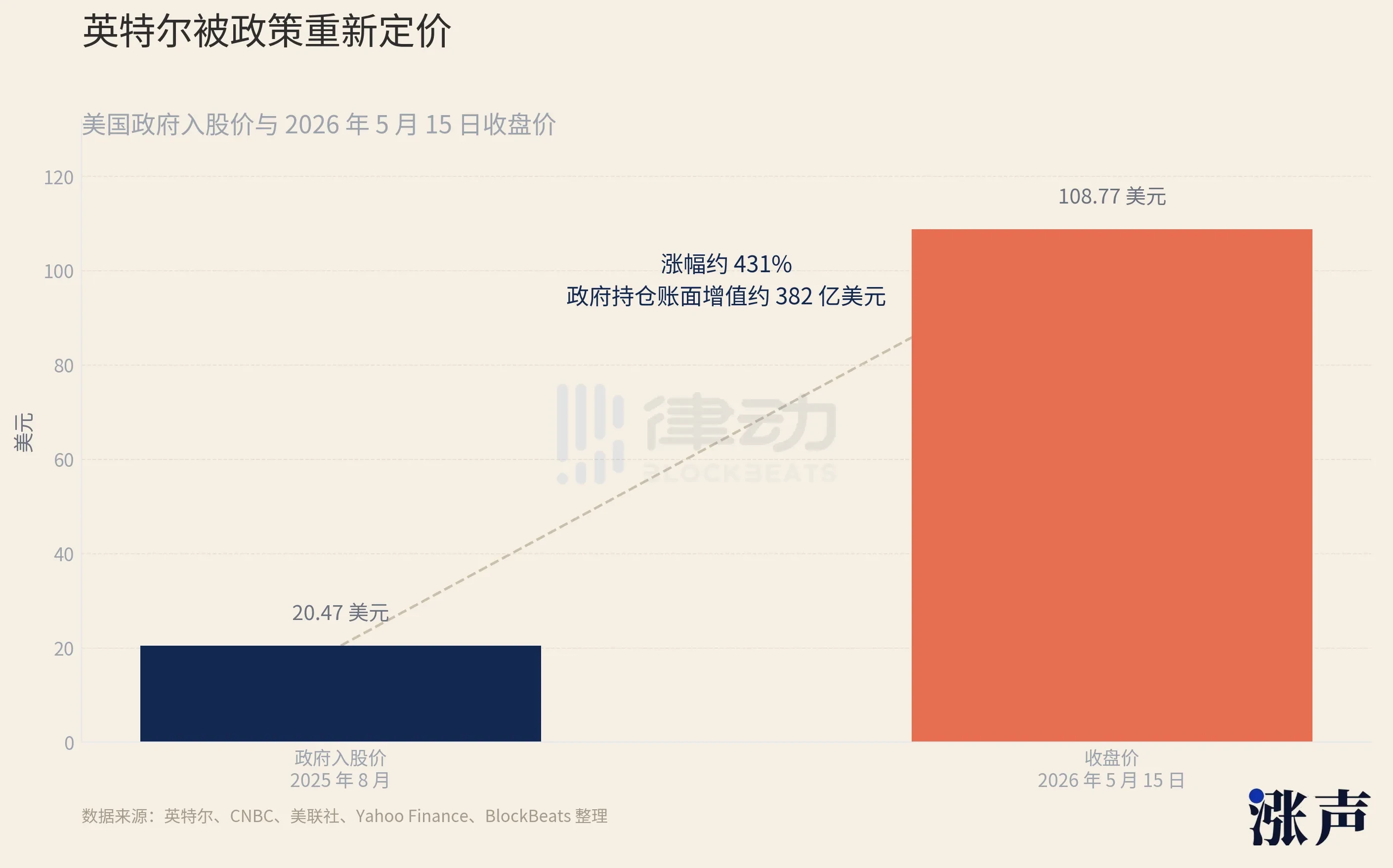
The Trump Government changed the subsidy to equity. 433.3 million shares of Intel General, $20.47 per unit, with approximately 9.9 per cent equity. The United States Government became the largest shareholder in Intel, officially defined as a “passive investor”, and did not require a seat on the board。
This is not part of the design of the Chips and Science Act. Subsidies were deliberately designed as non-equity forms with a clear purpose. The Government gives the money out but does not engage in corporate governance. Take the money, hold the shares. It is difficult to keep up with the financial interest of the Government in the company ' s future after holding shares。
Trump changed the rules。
Prior to the deal, the Intel stock price had been on the ground for almost a year under $20, with the harvest falling and the process falling behind, and the market judgement was that a company was uncompetitive. When the Government came in, a new variable was added to Intel ' s valuation, and the United States Government would not let the company die。
This judgement does not fit into the cash flow discount model, but the market will price it。
Chip manufacturing is a national strategy, and the largest shareholders will not stand idly by, and the tail risk in Intel has been cut off by policy from that moment on. The Intel warehouse in Trump's personal account appeared in early March 2026, six months after the Government had completed the handover。
At this time, Intel has exceeded profit expectations for six consecutive quarters, artificial intelligence reasoning demands have led to the repair of central processor orders, apple-based worker hearsays continue to ferment, and the story of basic face-repair can begin to be explained. By May 15, 2026, Intel had collected $1 108.77. From the Government's share price of $20.47, the increase was approximately 431 per cent, with an increase of approximately $38.2 billion in government holdings。
First the taxpayers' money, then the taxpayers' money. That sounds harsh, but the sensitivity of the Intel case is here。
Public information already exists and the purchase of Intel by Trump ' s personal account does not necessarily involve non-public information. The problem is that when the Government has pushed a company to the National Strategy Centre and the President ' s personal accounts appear next to the same company, it is difficult for the market to see it as a single investment。
The community called Intel the "American State Enterprise" with a realistic judgment behind the joke。
It is different from the traditional state, but when governments buy $8.9 billion as large shareholders, Intel is placed in the policy framework of US manufacturing, supply chain security, artificial intelligence sovereigns, and semiconductor subsidies. Investors bought it, with the exception of Intel's next season profits, and the expectation that the United States Government would not let it out。
That's why Intel is more important than Dale。
Dale is a clear time line。
Intel is a system time line. It begins with the conversion of subsidies into equity, linking industrial policy, government financial interests, individual holdouts and market pricing。
In the past few years, the market has followed the Perosi family transaction, with only one logic. Policymakers knew what in advance and bought it in advance. That was a one-way cause and effect, policy generated information, information brought trading opportunities, and officials ran。
Intel's different. The key here goes beyond knowing a policy in advance, and the Government itself becomes a direct part of the deal. Subsidy, equity, return to manufacturing, artificial intelligence, personal accounts, all of which are on the same company。
This case explains the importance of artificial intelligence hardware and semiconductor assets in the Tramp account。
Inveda and AMD are algorithm chips, Broadcom are network and custom chips, Dale is server complete, Intel is homemade by the U.S. government。
They look scattered and point in the same direction. The United States market is buying AI capital, the United States Government is buying indigenous semiconductor capabilities, and the Trump account is being seen alongside these assets。
Closed ring: space and policy push each other
The market's been doing it for years。
The Peroci family deal has been followed for years and logic has been simple. Policymakers knew what and bought it earlier. Policies generate information, which brings trading opportunities and officials profit from time lags。
This logic has a legal framework that can be addressed, and this is the result of the United States Official Stock Exchange Disclosure Act。
Trump's equity account has another layer and is more difficult to process。
He owns Intel and has a financial incentive to maintain semiconductor subsidies. The possession of Coinbase and Robinhood has the motive to legalize encryption. There is a motivation to continue the expansion of the capital expenditure of the data centre through the smart hardware chain of the holders. The holding of a broad-based index fund and major technology has the incentive to keep the United States stock as a whole in a risk preference。
Accounts and policies go in the same direction, and both things reinforce each other. It's been a long time. It's hard to tell who's pushing。
Policy hastiness, which in turn affects policy orientation, and then the policy pushes up its value. It is difficult for external parties to determine whether or not financial interests have worked in any particular decision-making。
Successive presidents insist on the use of blind trusts, and that is where the central meaning lies. The money is put in, they do not know what they hold and there is no financial bias in the formulation of policies. Cutting off this circuit is the basic premise of the design of the system。
Trump doesn't have that。
The Chips and Science Act originally designed subsidies as non-equity in case the Government became shareholders. Trump changed it to an equity interest, with the Government taking 9.9 per cent. Six months later, his own account went into Intel. The direction of the semiconductor subsidy policy and the market value of the two accounts now refer to the same direction。
The United States Official Stock Exchange Disclosure Act regulates the use of confidential internal information transactions by officials。
Most of the information here is public. The problem was that decision-making power and financial interests were tied to the same individual, and the current rules did not contain such a tie, but merely required him to report the results。
On April 9, 2025, he posted that it was a good time to buy in. Less than four hours later, Trump announced a moratorium on customs duties, raising the standard 500 by 9.5 per cent. Kathleen Clark, law professor at Washington University, later said, "He's sending a signal that he can manipulate the market with impunity."
A year later, the account came out。
The Dell family invested $6.25 billion in the "Trump Account", Tramp built a warehouse in the first quarter, publicly endorsed Dale in the second quarter of the White House for Dale, which rose by about 12 per cent that day and entered the public documents six days later。
Everyone in this chain gets what they want。
The market got a story that explains stock prices. The company got exposed from the White House. The Tramp account got floating. The policy project received family funding from the enterprise。
The disclosure document on page 113 can tell you what he bought, and what it does not tell you is that policy has an impact that in turn affects policy。
