
How exactly do you value encrypted money
Written by Four Pilars
Photo by AididaoJP, Foresight News
Core elements
- currency ≠ equity. the value of the enterprise/holder's income should be used instead of the value of the enterprise/agreement income。
- Accrual ratios (the share of agreed income ultimately available to the holder) are key diagnostic indicators. In the projects we compare, the ratio varies from 25% to 100%。
- There is also a difference between dilution. Team motivation is the real operating cost (which should be factored into the valuation multiplier), while the investor unlocks and sells is a market event (which should not be factored into the multiplier)。
- The value of the treasury depends on "extractability". The problem is not "how much is in the treasury," but "can the holder get it out?"
I often see a common error in the valuation of encrypted currency: someone pulls out a $500 billion agreement that divides the market value by this number, gets a number of digits, and then concludes that it is "cheap." This algorithm denominator is wrong and the molecule is wrong. Investors think they buy themselves five times the value, which may be 20 times, considering what they actually get。
The ratio is a good starting point, but it ignores the balance sheet and capital structure — — this is why the multiplication of business values (EV/EBITA) is used in traditional finance. However, when applying the EV/EBITA concept to tokens, three fundamental problems arise:
- Treasury assets: Holders have no legal claim。
- Agreement revenue: Most may not reach the holders at all。
- Maximum cost: Not on profit statements, but in the form of new currency increases。
The purpose of this paper is to construct a valuation framework adapted to the currency characteristics. The core indicator is the value of the enterprise / the holder's income — — that is, the price you pay for the income of each dollar that ultimately enters your pocket (as a token holder), taking into account the impact of the balance sheet and actual operating costs. I will use five protocols (HYPE, PUMP, MAPLE, JUP, SKY) as an example, which is not an investment proposal, but a methodological demonstration。
1. What is the "business value" of the token
the first error in many token valuations is the starting point — — the direct market value is not equal to the value of the enterprise。
In traditional finance, the logic is clear:
Enterprise value = market value + debt - cash
Because if you buy the whole company, you'll have to take the debt and you'll take the cash. Cutting cash is reasonable, because it's legally yours。
BUT IN THE ENCRYPTED WORLD, THINGS ARE COMPLICATED. FROM AUTOMATIC DESTRUCTION (USDC INFLOWS, CURRENCY PERMANENTLY DESTROYED, NO ONE CAN GET THE USDC) TO THE WALLET OF THE FOUNDATION (A FEW HUNDRED MILLION DOLLARS LYING WITHOUT GOVERNANCE OR DISTRIBUTION MECHANISMS). THE KEY QUESTION IS NOT "WHAT'S IN THE TREASURY," BUT "CAN THE HOLDER TAKE IT OUT?" IF SOMEONE BUYS THE WHOLE DEAL, OF COURSE, THE DISCOUNT DISAPPEARS, AS DOES TRADITIONAL FINANCE. THE TERM “REQUIREMENT DISCOUNT” HERE IS MAINLY DIRECTED AT US, THE MINORITY SHAREHOLDERS
I'm using the term "business value" because it's logical: you're calculating the amount of money to be paid for core business while removing the portion of the balance sheet that does not belong to you. The formula is as follows:
Business value of currency = market value + currency debt - recoverable treasury assets
Most of the agreements do not yet have a “currency debt”, so the focus is usually on the treasury assets。
What's in the treasury first? The treasury of an agreement normally holds three types of assets:
- Stable currency: Real silver and silver, which in principle can be withdrawn completely。
- Original token: own token. The deduction is equivalent to a "self-deprivation" and usually requires a discount of at least 50 per cent。
- LIQUIDITY (POL) AND OTHER ASSETS OWNED BY THE AGREEMENT。
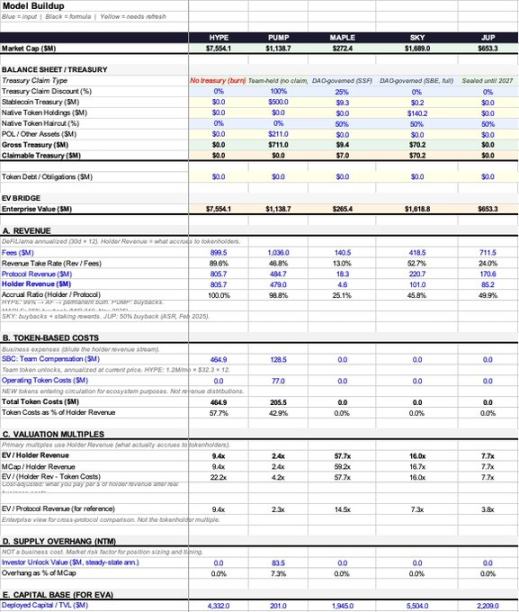
Treasury Assets = Stabilized Currency + Original Currency & Times; (1 - Discount Rate You Think Fit) + POL
but total assets ≠ can be extracted, which is the core issue to be addressed in this framework。
SOME AGREEMENTS DO NOT EVEN HAVE A PUBLIC TREASURY AT DISCOUNT. FOR EXAMPLE, PURE DESTRUCTION MECHANISMS (USDC INFLOWS FOR BUY-BACK AND DESTRUCTION OF COINS) DO NOT CREATE BALANCE SHEET ASSETS THAT CAN BE ACQUIRED BY ANYONE. IN THIS CASE, THE PUBLIC TREASURY ASSETS MAY BE WITHDRAWN = 0, THE ENTERPRISE VALUE = THE MARKET VALUE. THIS IS THE CLEAREST CASE, WITHOUT ANY SUBJECTIVE JUDGEMENT。
For the treasury that does hold the real assets, I have introduced the "claim right discount" framework, which takes value between 0% and 100%, depending on the actual disposition of the holder:
- 0% discount: Automatic buyback is destroyed without the need to vote; or the use of funds is left to the sole discretion of the token holder。
- 25% DISCOUNT: ACTIVE DAO AND ACTUAL DISTRIBUTION HISTORY。
- 50% discount: There is power to govern, but only on paper and never really exercised。
- 75% discount: the treasury is under team control and governance is weak。
- 100% discount: The funds are controlled by the Foundation and the holder has no claim。
These percentages are the most subjective and vulnerable parts of the overall framework, and I recognize them. But the two analysts argued that 25 per cent or 50 per cent was much more meaningful than they all ignored the treasury and talked about the ratio。
See the actual cases:
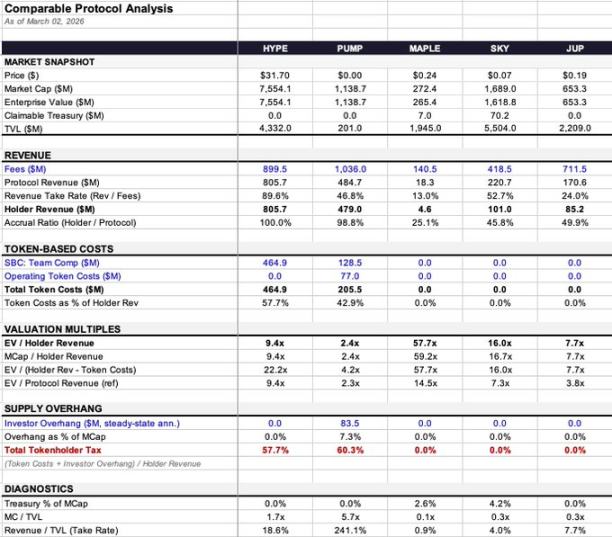
- Maple: The Treasury has $9.36 million (99.7 per cent stable currency), which is modest. The value of the enterprise slightly increased from $272 million to $265 million, with minimal impact。
- SKY: THE TREASURY HAS $140.3 MILLION, BUT 99.9 PER CENT IS ITS OWN CURRENCY. AFTER CUTTING OFF 50 PER CENT OF THE DISCOUNT, I THINK IT'S WORTH $7.02 MILLION, AND THE VALUE OF THE ENTERPRISE DROPPED FROM $1.69 BILLION TO $1.62 BILLION。
- PUMP: SOME $700 MILLION IN STABLE CURRENCY IS REPORTED TO BE IN POSSESSION, BUT THERE ARE NO GOVERNANCE MECHANISMS AND NO DISTRIBUTION CHANNELS AVAILABLE TO THE HOLDERS. AS A RESULT, THE ASSETS CAN BE WITHDRAWN = 0, THE ENTERPRISE VALUE = THE MARKET VALUE。
- HYPE AND JUP: ALSO PURE DESTRUCTION OR CLOSURE OF THE TREASURY, WITHOUT JUDGEMENT, BUSINESS VALUE = MARKET VALUE。
Income and currency costs: How many can get in my pocket
The gap between the money earned by the agreement and the money that the holder has acquired is where most valuation frameworks fail and is key to the real impact of the multiplier。
You can imagine income as a three-layer waterfall:
- Cost: Total amount paid by the user。
- REVENUE FROM THE AGREEMENT: THE PART OF THE AGREEMENT LEFT BEHIND AFTER IT WAS PAID TO THE "SUPPLIERS" SUCH AS THE LP, THE CERTIFIER, ETC。
- Holder ' s income: the portion ultimately reached by repurchase, destruction or direct distribution to the token holder。
There are two key conversion rates in the middle:
- retention rate = agreed income & diviide; costs (how much can the agreement leave out of total costs)
- accrual ratio = holder ' s income & diviide; protocol revenue (how much of the remaining portion ultimately reaches the holder)
These two ratios are superimposed and their effects may differ from one another:
- HYPE: RETENTION RATE 89.6%, ACCRUAL RATE 100%. OF THE NEARLY $900 MILLION, $805.7 MILLION EVENTUALLY WENT TO THE HOLDERS。
- Maple: Retention rate 13% (costs & Rarr; 18.3 million agreement income), accrual rate 25.1% (18.3 million agreement income & Rar; 4.6 million holder income). The cumulative pass rate is only 3%, and HYPE is 90%。
WITHIN THE SAME FRAMEWORK, ONE 3%, ONE 90%. IF YOU COMPARE THE TWO AGREEMENTS DIRECTLY WITH EV/COST OR EVEN EV/ REVENUE, IT'S A BIG DIFFERENCE。
Why does the denominator use "holder income" instead of "agreement income"
In traditional finance, EV/income is viable because the holders of shares have residual claims — — all legally belong to them. But token holders do not have that right, and they only get the part that the token economic model designs for them. If the revenue lies in a team-controlled treasury, and there is no mechanism for distribution to the holders, then the revenue alone is not "yours"。
Using the term "arranged income" as the denominator, those agreements with a low accrual rate would be glorified, making them look more "lower" than they actually are. I call this gap an "accrual discount"。
Take Maple, for example:
- EV/ PROTOCOL INCOME = 14.5 TIMES
- EV/ HOLDER INCOME = 57.7 TIMES
Four times the difference. The same data, based on different denominators, you're going to judge the price of the market differently。
3. Cost: Dilution is also 369th
The word "dilution" is used too broadly in the encryption circle, and the valuation is miscalculated。
category i: team incentive (equity incentive) — — this is operating cost
buffet said decades ago: what is an incentive if it is not a cost? a present? in traditional finance, it will be reflected in profit statements, reducing profits. in the encrypted world, it is manifested in new tokens coming into the market, but the economy is exactly the same as — — this is the real cost of operating。
- HYPE: TEAM MOTIVATION IS ANNUALIZED AT $464.9 MILLION, CONSUMING 57.7 PER CENT OF THE HOLDER ' S INCOME。
- PUMP: TEAM MOTIVATION IS ANNUALIZED AT $128.5 MILLION。
These should be factored into the valuation multiplier。
category ii: operating token costs (ecosystem incentives, user access, etc.) — — this is also operating costs
THEIR ROLE IS EQUIVALENT TO THE USER'S ACQUISITION COST, WHICH IS EQUALLY REAL AND SHOULD BE FACTORED INTO THE MULTIPLIER. IN ADDITION TO TEAM INCENTIVES, PUMP HAS $770 MILLION IN OPERATING CURRENCY COSTS, WHICH TOTAL $205.5 MILLION。
The test is simple: are new token supplies being created
If the agreement merely allocates existing income to the pledge and no new currency is issued, the cost is already reflected in the previous financial flows (i.e. the difference between the agreement income and that of the holder)。
If the agreement was forged or unlocked a token that had not previously been in circulation, it would be a real dilution and an operational cost。
category iii: investor lockouts due & mdash; & mdash; this is a market event, not a operating cost
YOU DON'T DEDUCT VC SALES FROM APPLE'S PROFITS TO GET A "ADJUSTED PROFIT". SIMILARLY, THIS SHOULD NOT BE COUNTED AS A BUSINESS MULTIPLIER。
THE ANNUALIZED PUMP INVESTOR POTENTIAL WAS $83.5 MILLION, OR 7.3 PER CENT OF THE MARKET VALUE. THIS HAS A SIGNIFICANT IMPACT ON PRICE AND MARKET DYNAMICS, BUT IS NOT A COST OF DOING BUSINESS. I HAVE PLACED IT IN A SEPARATE DIAGNOSTIC INDICATOR CALLED "THE TOTAL CURRENCY HOLDER TAX" (I.E., THE COST OF THE CURRENCY PLUS THE POTENTIAL FOR INVESTORS TO PUSH OUT AS A PERCENTAGE OF THE HOLDER'S INCOME), BUT NOT IN THE CORE VALUATION MULTIPLE。
4. Four core multiples with one diagnostic indicator
Based on the above logic, we are provided with the following indicators (common definition here, directly quoted below):
- EV/ HOLDER INCOME (CORE INDICATOR): HOW MUCH DO YOU PAY FOR EVERY DOLLAR THAT EVENTUALLY ENTERS YOUR POCKET。
- Market value / Holder ' s income: Idem, but without treasury adjustment. The difference reflects the impact of the balance sheet。
- EV/(HOLDER ' S INCOME - TOKEN COST) (COST-ADJUSTED MULTIPLE): REAL OPERATING COST (TEAM INCENTIVE, OPERATING COST) IS DEDUCTED BUT DOES NOT INCLUDE INVESTOR PUSH。
- EV/ AGREED INCOME (FOR REFERENCE ONLY): THE DIFFERENCE WITH EV/HOLDER INCOME IS THE SIZE OF THE `ACCRUAL DISCOUNT'。
- Central currency holders tax (diagnostic indicator): = (currency cost + investor push) & diviide; Holder income. It combines the impact of operating costs and supply pressures. For example, the PUMP is 60.3 per cent, which means that for every dollar of income that reaches the holder, an additional $0.603 hits the market in the form of new supplies. This figure does not in itself directly indicate the high and low valuation, but rather suggests a dynamic relationship between cash flows and supply。
5. Data overview and case highlights
- HYPE: ACCRUAL RATIO 100%, 9.4 TIMES THE HOLDER ' S INCOME. HOWEVER, TEAM MOTIVATION COSTS ARE HIGH AND THE MULTIPLIERS AFTER COST ADJUSTMENT RISE TO 22.2 TIMES. THE INCOME STRUCTURE IS CLEAR AND COMPLEX。
- PUMP: APPEARS TO BE THE CHEAPEST (2.4 TIMES), ACCRUAL RATE 98.8%. BUT THE TREASURY WAS UNABLE TO EXTRACT IT, AND IN AUGUST 2026 THERE WAS A MASSIVE UNLOCKING. THE NUMBER OF MULTIPLIERS AFTER COST ADJUSTMENT INCREASED TO 4.2 TIMES AND THE TOTAL CURRENCY HOLDER TAX WAS AS HIGH AS 60.3 PER CENT (THE HIGHEST SAMPLE)。
- MAPLE: Maximum accrual discount (4 times). The agreement revenue is 14.5 times vs. Holders ' income 57.7 times, and the gap is huge. There are no currency costs, so the cost-adjusted multiplier remains unchanged。
- JUP: THE CLEANEST BALANCE SHEET. THROUGH "NET ZERO EMISSIONS" GOVERNANCE, NO CURRENCY COSTS, NO INVESTORS TOSS, NO PUBLIC TREASURY. ALL MULTIPLES ARE APPROACHING 7.7 TIMES。
- SKY: ACCRUAL RATE OF 45.8 PER CENT IS THE BEST EXAMPLE OF HOW "THE DENOMINATOR SELECTION AFFECTS VALUATION". THE PROTOCOL'S REVENUE IS 7.3 TIMES (WHICH APPEARS TO BE CHEAP), WHILE THE HOLDER'S INCOME IS 16.0 TIMES (WHICH IS LESS CHEAP). THE TREASURY IS PRIMARILY (99.9 PER CENT) ITS OWN CURRENCY, WITH A DISCOUNT。
Concluding remarks
This framework must be flawed:
- The treasury discount is subjective: I hit 25%, you might hit 50%, no one can convince anybody。
- The assessment of whether to increase the number may be complicated by the fact that some protocol casting functions are open but distribution channels are dead and tokens are accumulated in undistributed ponds, and the situation is blurred。
- The data source is noise: DeFiLlama's 30-day-old data may make the same agreement look cheap or twice as expensive as the month。
BUT THIS IS AT LEAST AN OPERATIONAL STARTING POINT. EV/ HOLDERS' INCOME, ADJUSTED FOR BALANCE SHEETS AND REAL OPERATING COSTS, GIVES YOU A CLEARER IDEA OF HOW MUCH MONEY YOU PAY AND HOW MUCH INCOME YOU ACTUALLY GET INTO YOUR POCKET。
The gap between the money earned by the agreement and the money that the holder has received is the biggest fundamental mismatch in the current market. Many agreements cost hundreds of millions of dollars, while holders were divided only to zero, and most valuation frameworks did not even distinguish between the two。
Fortunately, industry has begun to focus on value capture: cost switches are open, buybacks are replacing inflation pledges, and incentives are suspended at the governance level. We are building tools to measure more accurately what really happened。
7. Description of data sources and methods
- Income data: DeFiLlama annualized data (most recently 30 days & days; 12). The advantage is that it is more sensitive than the six-monthly data, and the disadvantage is that one-month fluctuations may cause noise。
- Holder's income: Directly using DeFiLlama's " Holder's income" field, only includes buyback, destruction, direct distribution。
- Treasury data:
- MAPLE: $9.36 million (DeFiLlama, 99.7% stable currency)
- SKY: $140.3 million (DeFiLlama, 99.9 per cent own currency)
- JP: US$ 0 (CLOSED)
- PUMP: MEDIAN STABLE CURRENCY IS ESTIMATED AT $500 MILLION (ACTUAL RANGE: $286 MILLION - $800 MILLION)
- Currency costs:
- MAPLE: 0 US dollars. The MIP-019 proposal (October 2025) closed the pledge distribution. Although 5% of the inflation smart contracts may still be forged, there are no distribution channels. (Source: Docs.maple.finance, The Defiant 2025/10/31)
- SKY: 0 dollars. The Savings Module (STR) now distributes SPK and Chronicle Points instead of SKY tokens. (Pertified in app.sky.money/rewards in March 2026). The data "60 billion Sky per year" mentioned by Rune in August 2024 are outdated, but governance can be restarted at any time. (Source: sky.Money FAQ, vote.sky.money)
- JP: US$0. THE "NET ZERO EMISSIONS" PROPOSAL ADOPTED ON 22 FEBRUARY 2026 (75% IN FAVOUR). DAO TREASURY CLOSED UNTIL 2027。
- Investor push:
- PUMP: STEADY-STATE ANNUALIZATION $83.5 MILLION. THE ACTUAL UNLOCKING OF THE CLIFF BEGAN IN AUGUST 2026, WITH AN ACTUAL RELEASE OF APPROXIMATELY $48.7 MILLION (IN 7/12 MONTHS) OVER THE NEXT 12 MONTHS。
- Indicators for loan agreements:
- MAPLE: Use of actual asset management scale (AUM) ($3.79 billion, 2026 Q1 report) instead of Devila's TVL ($1.945 billion). Net interest differential (NIM) = agreed income / AUM. For detailed indicators, see the appendix to Excel。
- Cash operating expenses: not estimated. As the agreement is not disclosed, speculation creates false precision。
- Equity incentive valuation: at current currency prices. Sensitive to price changes。
