
Talk to "The Wood Sister" Cathy Wood: The next round of cattle is coming
"The relevant coefficient for gold and bitcoin is 0.14." Gold has been activated before bitcoin in the last two cycles, and this time as well.”
The Earthly Days Of Digital Assemblys
Source: The Rollup
Original language: Deep tide TechFlow
Edit Guidance
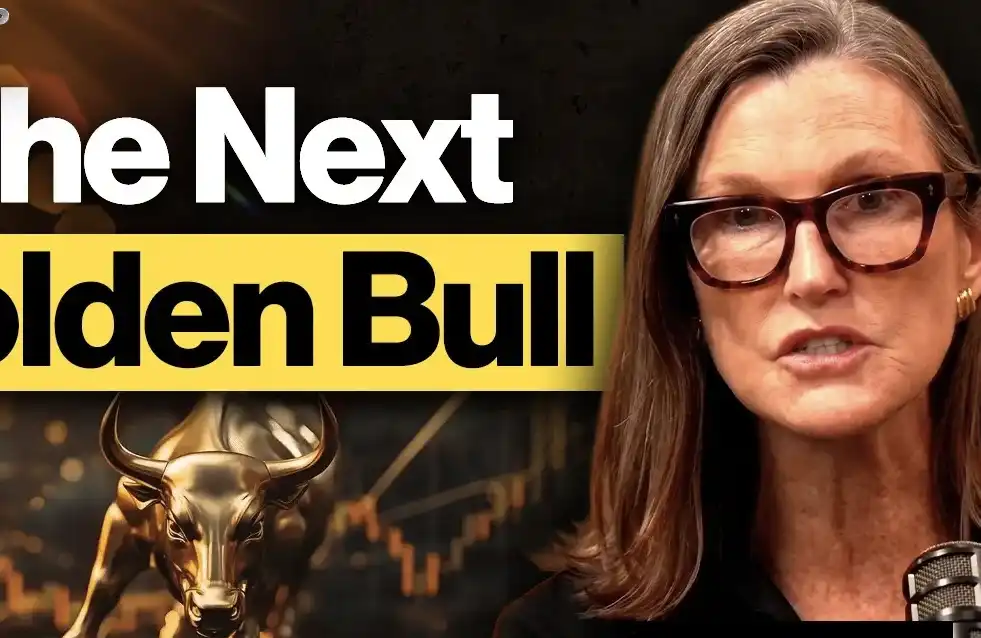
Arak Invest, founder of ARK Invest, Cathy Wood, recently visited The Rollup, where she gave clear Bitcoin price projections: $730,000 under the 2030 baseline scenario, $1.5 million under the cattle market scenario, currently at the bottom, with chain analysis showing absolute bottom ranges of $50,000 to $55,000。
At the same time, she makes a macro-judgment that is ignored by the market, that AI training costs are down 75% annually, that reasoning costs are down 85-95% annually, that will trigger a "good deflation" round, that Trueflation (a real-time inflation indicator based on a block chain) has been reduced to 1.3%, and that the Fed’s likely rate has been forced to shift to easing, which will be a catalyst for the next wave of digital assets. In addition, she disclosed that the ARK encryption research team had reduced the quarterly report production time by 75 per cent with Claude Co-work, and concluded that the payment layer of Agenic AI would inevitably be built on block chains。
Expensive Notes
Bitcoinpricing and periodicity
• "Our baseline predicts that bitcoin will reach $730,000 in 2030 and $1.5 million in the cattle market scenario."
"The drop of 50% doesn't count for Bear City, and the previous drop of 85%, 95%, it's practically paediatric."
"Our chain analyst David Puell says the absolute bottom is between $50,000 and $55,000. But I doubt it
· "The relevant coefficient for gold and bitcoin is 0.14. Gold has been activated before bitcoin in the last two cycles, and this time as well.”
Stable Currency and DeFi Evolution
"I AGREE WITH CZ THAT FROM THE EARLY DAYS OF BITCOIN TO THE PRESENT, THE BIGGEST ACCIDENT WAS THE RISE OF THE STABILIZEDCOINS."
– "The irony is that the delay in the CLARITY Act has given Tether and Circle more time to enjoy the Internet effect."
• “We thought Bitcoin would take on the role that the currency is now playing, especially in emerging markets. But the stabilization currency became a bridge from traditional finance to DeFi
A turning point for institutions
• "Larry Fink's transformation is too complete." He finally understood that the Internet never had a financial layer, and that monetization could fill that layer. His shift gave the whole industry permission, and if he says it's important, I'd better find out too."
"We were mocked when we first bought bitcoin in 2015, and many people thought it was just marketing. This collective sarcasm only strengthens my conviction that we were right.”
Macro and deflation logic
• “Federal fund interest rates have been reduced by 175 basis points, but the market narrative is still talking about the Fed's Eagles.”
· "AI TRAINING COSTS ARE DOWN 75% A YEAR, DEDUCTION COSTS ARE DOWN 85% TO 95% A YEAR. WE'LL SEE A HUGE WAVE OF BENIGN DEFLATION."
Intersection of Agenic AI and block chains
"We'll have a bunch of chat robots working for us in the future. We have to pay Claude, pay the robot that provides the data. All this is machine to machine, and block chain payment systems are the only reasonable infrastructure.”
"Our encryption team used Claude Co-work to make quarterly reports, cut 75 percent of the time. All the time saved was released to in-depth research.”
ARK FIVE INNOVATION PLATFORMS
RobbieYou have five innovative platforms, derived 15 technologies, which are now being integrated. Before we go deep into digital assets and the public chain, can we have a macro perspective on how you see the subject of subversive innovation
Cathy WoodThe seeds of everything today were planted early in my career. In the '80s and '90s, I watched these seeds go down. But cloud computing didn't really appear until 2006 when AWS came online. At that time I tried to explain to investors and consultants what cloud computing was, and for them it was all a matter of time. The major breakthrough of AI is to wait for in-depth learning in 2012, as well as for Transformer in 2017 (which later gave rise to ChatGPT and natural language programming)。
In the late 1990s, too much capital was chasing too few opportunities and too soon. But today, in complete reverse, five innovative platforms, 15 technologies are ready, and investors are full of fear. As fund manager, I prefer to operate in this environment rather than in this crazy bubble。
Today ' s valuation is much lower than it was during the bubble period, technologies are ready and, most crucially, costs are falling at an alarming rate, which means that these technologies can reach more industries and individuals。
I CREATED ARK IN 2014 BECAUSE INSTITUTIONAL INVESTORS BECAME EXTREMELY RISK-AVERSE FOLLOWING THE COLLAPSE OF THE INTERNET BUBBLE AND THE 2008 FINANCIAL CRISIS. THE WHOLE INDUSTRY TURNED TO PASSIVE INVESTMENT, WHICH BOOSTED THE PROSPERITY OF ETF. EVEN IN THE AREA OF PROACTIVE MANAGEMENT, FUND MANAGERS RELY HEAVILY ON BENCHMARK INDICATORS TO SCREEN CANDIDATES. BUT WE DON'T, AND OUR SELECTION CRITERIA ARE ORIGINAL RESEARCH。
Research teams in traditional finance are divided into sectors such as five consumer analysts and five medical analysts. But we believe that, in order to grasp innovation correctly, the research team has to organize itself by the 15 technologies that cut across all industries。
Robbie:Why are investors so scared? Is it because they don't sort out the structure of the organization to understand the technology convergence
Cathy WoodThis integration is indeed confusing. Tesla is the best example. Most research directors gave Tesla to auto analysts, but in fact at least to technologists and, more precisely, to three people working together. We're moving from the old world to electricization and autopilot。
AI WAS TOO FAST TO DEVELOP AND HIT TOO MANY INDUSTRIES, WHICH IN ITSELF WAS A SHOCK EXPERIENCE. THE RESEARCH DIRECTOR NEEDS TIME TO FIGURE OUT HOW TO REORGANIZE. THEY NEED TO DEPLOY PEOPLE ALONG TECHNICAL LINES, WHILE BUILDING A CULTURE OF COLLABORATION. IN TRADITIONAL INSTITUTIONS, NO ONE CAN TOUCH A STOCK IF IT IS ALLOCATED TO CAR ANALYSTS. THIS MODEL MUST CHANGE, AS TECHNOLOGY IS BEING INTEGRATED AND ANALYSTS MUST COLLABORATE TO UNDERSTAND THE POTENTIAL OF THESE COMPANIES。
Encrypt asset configuration logic
Robbie:WE HAVE ALSO SEEN A LOT OF TRIBALISM IN THE ENCRYPTION INDUSTRY, AND THE STORY OF DIGITAL ASSETS CLEARLY STARTS WITH BITCOIN. WHEN YOU CREATED ARK IN 2014, BITCOIN WAS STILL LOOKING FOR A FOOTHOLD. WHAT DID YOU THINK OF BITCOIN? ARE YOU READY FOR INSTITUTIONAL CONFIGURATION
Cathy Wood: Not yet. I actually started to focus on and discuss bitcoin in a company that was purely curious. I brought my favorite analysis of bitcoin to Ark, which is now our leading future scientist, Brett Winter。
WHEN ARK WAS CREATED IN 2014, THERE WERE ONLY FOUR INNOVATIVE PLATFORMS THAT COMBINED AI AND THE BLOCK CHAIN INTO A CATEGORY CALLED "NEXT GENERATION INTERNET". THAT'S OUR FUND ARK'S NAME FROM. AT THE TIME, AI HAD JUST HAD A BREAKTHROUGH IN DEEP LEARNING, AND IT WAS NEW, AND THE BLOCK CHAINS MADE US MORE EXCITED, BUT WE WEREN'T SURE IT WAS WORTH IT。
In 2015, we published the first Bitcoin White Paper in partnership with Art Laffer (the proponent of the Laffer curve, also a monetary economist, from the Nobel Prize laureate Robert Mundell), the central question being: Can Bitcoin perform three functions of currency, exchange media, value storage, account unit
Art said to me, "This is what I've been waiting for since the American gold window closed in 1971. I asked him how big the idea was, and he said, "What is the monetary base of the United States?" It was 4.5 trillion dollars, and bitcoin's network value was only $6 billion. He's talking about trillions of grades. I immediately made a personal investment。
We're looking for the best openings for our clients, we need permission from NYU and SEC, and we finally found the GBTC. Bitcoin was at $250. When Greece threatened to withdraw from the European Union in the summer of 2015, we built the first slot, because we noticed that bitcoin rose whenever such geopolitical news appeared. It can be a risk-based asset as well as a risk-averse asset, with different roles at different times。
Robbie: LOOKING BACK AT THE TIME, THE MAINSTREAM NARRATIVE WAS "THE AGENCY IS COMING TO BUY THE BITCOIN IN OUR HANDS." NOW, IN 2026, WE DO SEE ETF, THE INTRODUCTION OF STABLE CURRENCY, MONETIZED ASSETS, THE OUTBREAK OF POWER CHAINS, THE INTRODUCTION OF REAL PRODUCTS BY LARGE INSTITUTIONS, THE INTRODUCTION OF TRADITIONAL INSTITUTIONS AND THE INTEGRATION OF ENCRYPTED NATIVE CULTURE AND INFRASTRUCTURE, THE LARGEST INTEGRATION IN THE DIGITAL ASSET FIELD。
But one interesting thing is that encrypted natives, those who are supposed to have the most faith, are now in a state of indifference and internal despair. And the new big institutions and big companies are looking better. How do you interpret this state
Cathy WoodSeveral things happen at the same time. When we bought bitcoin in 2015, we were really laughed at. A lot of people think it's marketing. I'm more interested when so many people laugh at you or don't care。
Here's the pattern: Bitcoin has a global monetary system. On DeFi, Estherum, Solana, in the lead, Hyperliquid (a decentralised permanent contract trading platform) is also taking shape。
In terms of institutional adoption, I think Larry Fink's transformation is a critical turning point. He had led the way in singing bad bitcoin, but his transformation was complete. His transformation comes from a vision, the monetization of everything. He had finally understood that the Internet had been built without a financial layer, because no one had ever thought of e-commerce and online investment, early on only information exchange and even thought that it was gambling and illegal activities。
Fink's awakening gave the whole industry permission. We used to fight him, Jamie Dimon. But when Pink turns, the industry reacts that if he says it's important, we have to learn. And Belet has Aladdin (a technical platform for the management of the industry), and if Fink says that monetization is important, the management company that uses Aladdin can follow up。
And there's another development that's vital to DeFi: the evolution of the currency. I just made a podcast yesterday with CZ. We agree that, from the early days of Bitcoin to the present, the greatest surprise was the rise of the stable currency supported by the French currency. It's quite defiant in the early encrypted ecology. But now even bitcoin OG fully supports, Tether's Giancarlo and Paolo were the first OGs。
The Stable Currency has become a bridge from traditional finance to DeFi. We thought Bitcoin would take on that role, especially in emerging markets。
Even in emerging markets, however, Bitcoin communities see the currency as a humanitarian “transitional step” into an encrypted world, as most emerging market residents cannot afford the swing of Bitcoin, which they live on a daily income. When their wealth grows, they will naturally move from stable currency to more investment varieties in encrypted ecology。
And there's a big question, is it possible that the stabilizer is a winner? The Internet effect suggests so. Ironically, the delay in the Clarity Act has given Tether and Circle more time to accumulate the network effect. CZ thinks there's gonna be an outbreak of stabilization currency, as do Lorenzo, David and Ray of our team. But whether or not there was an outbreak, it was believed that it would eventually be integrated into the hands of a few winners。
Why is tokenization a central narrative
Robbie:What we've been talking about on the show is that the monetization wave starts with non-speculative assets, then goes down the risk curve to the national debt and is now talking about monetized stocks. You wrote in Big Ideas 2026 that the global monetized asset market could exceed $11 trillion in 2030. My question is, will these assets end up in the DeFi agreement? Where do you think the value is built up
Cathy Wood:We tend to agree with you. In the area of innovation, there is usually a division between purely new players who act faster, more flexibly and more creatively, and traditional players who embrace new technologies to reduce costs, increase efficiency and productivity. Among the traditional camps, the most radical and far-sighted companies can use it to integrate traditional markets。
The best examples are Walmart and Amazon. During the Internet bubble, it was thought that traditional retail sales would be destroyed, and it was true that many of the fine stores had been eliminated, but Walmart had built online business on the Internet (buying Jet) and instead integrated traditional retail space。
Amazon is a fast-growing giant, but both coexist. Now Walmart is more radical on drones than Amazon because it works with companies and regulators. Amazon had been ahead of Walmart several generations of drone technology, but had made some regulatory mistakes and had been slowed down。
Encryption of the world. Traditional players are hugging this technology. JP Morgan (Morgan Chase) is particularly interesting, and Jamie Dimon is still the biggest bitcoin opponent in many ways to date, but he is giving technical teams and clients the need to cover his personal judgment。
On the purely player side of DeFi, Ethereum, Solana, Hyperliquid, we're in custody. We bought some DATs for ETF, including Bitmine Immersion and Soulmate。
We know that DAT was created too much, and there's bound to be a massive phase-out. We publish the deal every day, and you can see that we're moving back into position, while turning to the pure openings of Etheum and Solana as far as possible. Some platform providers do not allow flagship funds to hold bitcoin ETF or Etherum, Solana ETF, and we can only operate within the limits。
DeFi will burst into growth. The distribution of the economic value of Layer 1 and Layer 2 is still in the game, and we are watching closely. But we're still looking at the Fours, and now that we have the WBTC, we can move to another platform, and bitcoin's in。
"Good deflation" and the status of macro liquidity
Robbie:People would say that we heard Cathy say long-term more. But we are in geopolitical turmoil. Stock went up yesterday, bitcoin hovering around $75,000. Raoul Pal argues that global liquidity is on the rise, and what do you think about the backwardness of encrypted markets vis-à-vis equities and bulk commodities? What's your macro-mobility judgement
Cathy Wood:I wrote a letter at the beginning of the year containing an asset class correlation matrix. Many people think it's highly related to gold because we call it "digital gold," but it's not. From 2019, when institutional interest began to increase significantly, the relevant coefficient for gold and bitcoin was 0.14. But if we look at the past two cycles, the gold starts before bitcoin, we think the same is true this time。
Bitcoin does have a significant return on gold, but the low point is rising on the long-term trend line. Bitcoin Cow is still fine. Dropping 50%? This is a victory compared to the previous drop of 85% or 95%。
We believe that bitcoin will be innovative in the next cycle. A lot of people don't believe it, but we're clear in the public record: $730,000 in the 2030 baseline scenario and $1.5 million in the cattle market scenario。
I was criticized for saying that some of the role of the stabilization currency had encroached on bitcoin. This did occur in emerging markets, but the other side was ignored, and gold was rising, suggesting that bitcoin ' s value-storage role was synchronizing. The two effects are cross-cutting, and the positive impact on gold is actually stronger。
The chain analysis shows that the absolute bottom is between $50,000 and $55,000. I don't think I'll be there to see how Bitcoin and other assets are doing。
In terms of liquidity, many people are only interested in the Fed’s news that it does not want to reduce interest rates, but Federal Fund interest rates have fallen 175 basis points. The market narrative says the Fed is too hawk, but they're already relaxed. I think inflation will be much lower than expected。
For example, Frito-Lay, a 15 per cent drop in prices about three months ago, has been announced far ahead of expectations today。
This is how a low-inflation world works, with price reductions. This is particularly true in the area of technology, where AI training costs are down 75% a year, and AI reasoning costs (such as the cost of ChatGPT answering a question) are down 85% to 95% a year. And we're going to see a huge wave of benign deflation, with a sharp increase in sales, which is why we expect real GDP growth to accelerate。
Data from Trueflation (an inflation indicator based on block chains that track tens of thousands of commodity prices in real time) show that even when oil prices fluctuate, consumer price inflation is 1.8 per cent and core inflation is 1.3 per cent. Over the past two to three years, inflation indicators range from 2 to 3 per cent, and the figures from Trueflation indicate that they all go down。
If inflation really goes down, the Fed will be relaxed. There is also a reason why, although the unemployment rate is generally low, the breakdown shows that entry-level jobs are under attack and that businesses are not downsizing or recruiting。
The youth unemployment rate of 16-24 years of age, 8.5 per cent (11 per cent at the height), indicates that the labour market has lax space, wages are slowing and productivity is accelerating. The reason for the Fed ' s easing was that the relative supply of monetary demand was rising, as a result of accelerated real economic growth. The role of the Fed is to match real economic growth。
Robbie:The new Federal Reserve Chairman is about to take over, and some have recently found encrypted funds in his portfolio. You see the Fed as a whole identifying "good deflation" and moving towards easing? What is the impact on digital assets? Is the four-year cycle still working? Or is it possible that the Fed's pigeon turn might speed up the situation
Cathy Wood:OF CONCERN IS THE BEHAVIOUR OF THE BITCOIN ETF HOLDERS. THEY'RE PRETTY STRONG IN THE FALL. IF YOU'RE AN INSTITUTIONAL INVESTOR WHO'S JUST LEARNED ABOUT THIS NEW ASSET CLASS, YOU'VE HEARD ABOUT THE FOUR-YEAR CYCLE, AND THEN YOU SEE A 50% DROP IN BITCOIN。
As a traditional resource, this is a serious bear market, an opportunity. We did see the low-intensity behavior. Weak hands withdrew, but were filled back by agencies that really began to understand the asset class。
i'm not sure if this four-year cycle is working. because we went through a crash that triggered automatic deleveraging。
As a result of another wave of tariff turbulence triggering a chain reaction, Binance experienced software failure, resulting in automatic deleveraging. Those who think they've been hedged on two trading platforms have found that the hedges are completely out of effect, resulting in losses of $28-30 billion. But we think this is done。
Perhaps institutional intervention is accelerating the four-year cycle. But the bottom line is that, as we build the bottom line, improved mobility will drive the next wave。
ADD A MORE ECONOMIC PERSPECTIVE: US CURRENCY IS CURRENTLY GROWING AT 4.9 PER CENT, NOMINAL GDP IS ABOUT 5 PER CENT, BASICALLY MATCHING. HOWEVER, TRADE FRICTIONS MAY SLOW THE FLOW OF MONEY, WHICH CAN SLOW DOWN THE REAL IMPACT OF CURRENCY GROWTH. THIS VARIABLE WILL HAVE TO BE FOLLOWED CLOSELY IN THE COMING MONTHS。
AI GRADUAL INTEGRATION OF PROXY AND BLOCK CHAINS
Robbie:You mentioned that the agency holder did not sell. At the same time, the benefits of the bitcoin block are being reduced by half each time, and their impact is diminishing. We have only a few minutes left, but one cannot stop talking about integration. You've been talking about the core topic。
Block chains, encrypted currencies, tokenized assets, DeFi protocols, how do they integrate with broader subversive technologies? Where is the intersection of block chains and AI, health care? Early on, people were excited to put health records on the chain, but now the industry is highly financial. Is that possible
Cathy Wood: You've heard of Agenic AI. We all have a bunch of chat robots working for us in the future。
Our encryption team is a good example. We report using Claude Co-work (Anthropic launched desktop-end AI collaboration tool). We produce a bitcoin report and a DeFi report every quarter. Bitcoin's release today。
We have reduced the time to produce these long reports by 75 percent. And only getting better. This unleashes productivity so that we can do more research than spend on administrative matters。
One step forward, and sooner or later we'll let the robot do these reports. And by that time, we'll need Claude's payment system to pay for the robots of other companies that provide data. It's all machine-to-machine transactions. What's better than Internet financial systems? The real release of such productivity would be achieved by removing traditional financial intermediaries。
The same is true of Agency Commerce. I hate shopping, and in the future I'll have an AI shopping agent who understands my style and is trained by my private shopping consultant Lillian, but the payment chain must be built on block chains。
Changes are also taking place in the health sector. In drug detection and clinical trials, we are seeing laboratories that are emerging without any participation, relying on DeFi and block chain technology to achieve point-to-point collaboration. They're called Self-Drivining Labs, which is becoming hot. In the future, the Agenic AI plus block chain payment ecosystems will become the mainstream。
Robbie:All right. Cathy, thank you for taking the time to talk to us today. We agree on many points, and thank you very much. Have a good life and continue to spread the beliefs of innovation, digital assets and integration。
Original Link
