
The return of marginal areas: a rematch around maritime rights, energy and the dollar
Who controls the ocean, who controls the monetary system; once caught up in inland games, he loses his initiative. Rights
Original title: The Return of Rimland
ORIGINAL BY ALEXANDER CAMPBELL
Photo by Peggy Block Beats
This conflict over Iran has not subsided, but is spilling over. From Hormuz to the Red Sea, from energy corridors to trade order, the centrepiece of the situation is no longer local military confrontation, but a systematic game around "who controls the flow."。
Using the Rimland strategy as a clue, the paper points out that the United States is trying to reshape its energy path through a maritime blockade, shifting conflicts from regional to global issues and including China. With the escalation of sanctions and interdiction measures, the confrontations that had originally revolved around the Middle East are turning into a structural shock that has driven the global energy, supply chain and financial system。
More crucially, the market has not yet fully digested this "chain reaction". The immediate volatility of oil prices is only the first step, and its transmission to liquidity, investment in science and technology, consumption by the population and even agricultural supplies is only beginning to emerge. The real test, after energy price re-evaluations, is how the global economy withstands the second round of shocks that result。
This means that the question now is no longer whether the conflict is escalating, but rather what path its effects will spread along and when the market will begin to pay for these unpricing risks。
The following is the original text:
Well, the situation is on the horizon。
The set of tension that we presented last Wednesday has now proved irreconcilable。
Iran wants nuclear weapons and controls the strait; and Trump cannot accept either. What is the distance between these two "target circles"? To the extent that the Israeli war against Lebanon was not even on the agenda for discussion。
I'm not going to say how precise my judgment is, but we may have already entered the "winner" game. This is not a conflict that can be stopped one afternoon. The core of the problem is very simple: who controls the most important waterway in the world? And is Iran willing to trade for its own leverage to negotiate nuclear weapons at the expense of threatening its neighbours
That's the point。
And now it's clear, it's a set of strategies. Readers all the way from " Fighting for the United States dollar " to " Not the hook " to " Wake the hegemonics " and " fragile peace " should have seen the pattern。
Trump is implementing a Rimland strategy。
interception of shipping. a 50 per cent tariff was imposed on all countries supplying weapons to iran. instead of attacking inland (heartland), china was drawn into the game by controlling the sea lanes of energy transport. for each mine placed by iran and every attack on a tanker, the response was tenfold — seizing their vessels, controlling the tankers and selling their crude oil directly。
In United States dollars。
The cut-off is mainly about Iran’s attempts to use the “Cascading Strait” as leverage, but it is not only a strategic miscalculation of America’s advantages (sea control rather than nodes control) but also a tactical drive to push more neutral countries to the opposite side。
Then is the Abraham Accord. Saudi oil was transported through Jordan to Haifa port; the Trans-Arab Oil Pipeline (Tapline) was reactivated. A corridor consisting of physical infrastructure is linking coastal States into an energy network that completely bypasses the "heartland". This is a "marginal union" with pipes and steel。
It seems to me that much of the reason why we have come to this point is that the process itself — Iran (and China) detonated Israel through Hamas's actions on October 7, thereby disrupting the process of normalization of relations — could have led to an alternative trade path that would have bypassed the Straits of Hormuz and even the “across the road” once the process had progressed。
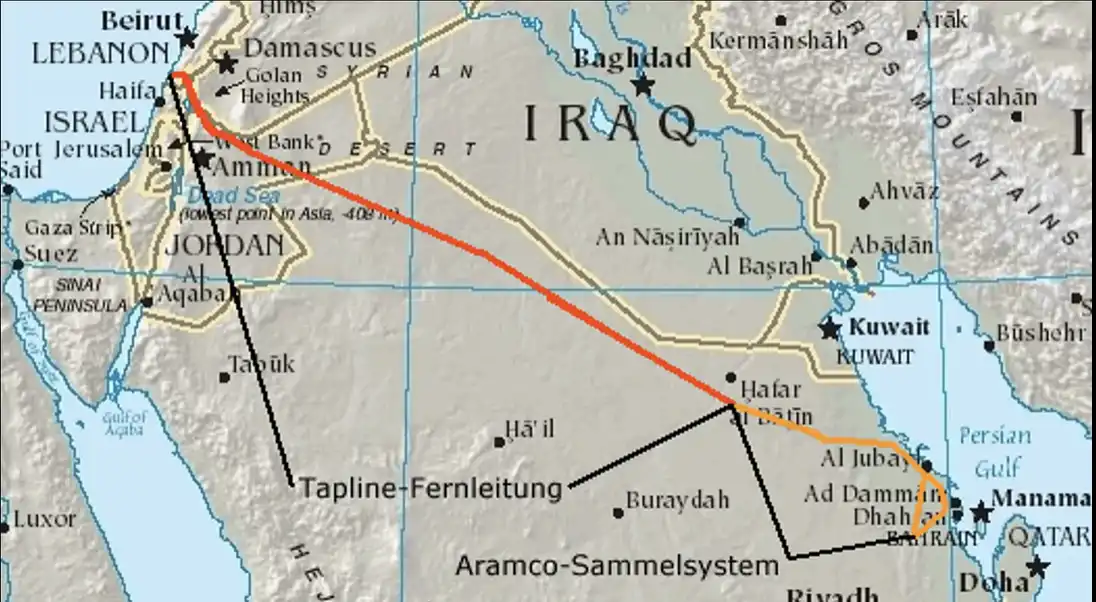
Trans-Arab Pipeline
This explains the differences between Washington and Brussels. The US senses the weight of responsibility; and Europe seems to think that it is possible to place the costs of conflict on “old brothers” while negotiating privately for access to its own energy. France, while preventing the relevant resolutions of the United Nations Security Council, has negotiated with the parties the adoption of bilateral transit arrangements in the Straits and has called for the formation of a “unity of independent States”. It's a classic "heartland" thinking: trading with inland forces, avoiding a positive conflict, as if the sea lanes were running themselves。
Trump has just closed that loophole — and thus turned the United States problem into a worldwide problem。
AT THE TIME OF WRITING, THE PRICE OF CRUDE OIL HAD RISEN BY MORE THAN 6 PER CENT, THE STOCK MARKET HAD FALLEN BY ABOUT 1 PER CENT, AND THE INCREASE BROUGHT ABOUT BY THE CEASEFIRE LAST WEEK SEEMED LIKELY TO BE QUICKLY WIPED OUT. I BOUGHT SOME VIX LAST WEEKEND TO WATCH THE INCREASE, SO YOU CAN SAY I GOT A LITTLE BIT OF A STAND。
The next developments will depend on a more fundamental set of questions:
• Will the ceasefire last another week or will it break in the "reverse" scenario
Trump has indicated that he will intercept ships that have paid “tolls” to Iran. Does this include Chinese vessels? What happens when they try to load crude oil from Kharg
• He also reiterated the threat of a 50 per cent tariff imposed on any country that supplied weapons to Iran - Does this mean that trade wars are back on the agenda
Then there was the Iranian counter-measure: it could activate the Houthi armed forces, which still had the ability to make the Strait of Bab el-Mandeb impassable. It is noteworthy that most of the tankers transporting crude oil from Saudi “west to east” pipelines are super-large tankers (VLCCs) that cannot pass through the Suez Canal. Once the Houthi operation is upgraded, the impact is not only on Red Sea shipping, but rather on forcing these giant tankers, which carry the most critical crude oil, to bypass longer routes。

The main thread is that the conflict continues to grow in scale and spillover。
Trump has clearly drawn China into this game by upgrading the operation to a full-scale interdiction of all vessels that pay “tolls” to Iran and re-emphasizing the customs threat. Beijing has been accumulating crude oil for many years in response to similar situations. But how long can the Chinese market remain calm against the backdrop of a housing drag on the economy? How possible is it to opt for an escalation of confrontation in order to guarantee energy supply
From Venezuela to Iran, the sequence of this chain of actions is increasingly looking like a deliberate strategy。
Rimland is returning。
Next is the chain at the market level:
How bad is Monday? The first-round decline was mainly due to short-term financing and bulk buy-down options. When will long-term funds begin to believe that fluctuations are beyond control and thus be forced to sell or to touch risk limits
• LAST WEEK, HEDGE FUNDS QUICKLY RETURNED TO THEIR POSITION OF "DOING MULTIPLE AI HARDWARE, MAKING EMPTY SOFTWARE". BUT AS OIL PRICES RISE, BONDS FALL, LIQUIDITY TIGHTENS, AND THE GULF HELIUM SUPPLY CHAIN RISKS (KEY RAW MATERIALS FOR CHIP MANUFACTURE) ARE FOLDED, IS IT SUFFICIENT TO RE-PRICING AI EXPECTATIONS FOR ACCELERATED CYCLES
Before the conflict, the economy of the United States grew almost zero in the first quarter. As energy prices skyrocket, the disposable income of the population is consumed by gasoline, heating and aviation fuel — will households cut spending or will they leverage further
The minutes of the Fed meeting show that discussions are already under way at the policy level to address energy-driven inflationary pressures by tightening policies. A new round of debate is under way on how to respond to negative supply shocks. In the face of an energy shock of this magnitude, can the Fed “choice to ignore”
In the end, these questions point to a larger chain reaction。
The "margins" strategy addresses energy and dollars, but does not address the entire system that energy supports. The market is currently priced only for the first point and has not yet been channelled to the second point. Oil prices can be rapidly revalued for news, but not for agricultural production cycles. The price of urea remains at $700, and the United States Department of Agriculture estimates that the area under wheat cultivation will reach a new low since 1919 — which will not be reversed by two diplomats shaking hands. The farmers who can't afford to buy fertilizer in March may not come back in April。
[ Chuckles ]Original Link]
