
From Flying Wheel to sickle: 26-year-old Believe founder facing criminal charges for encryption fraud
He was "the next Zuckerberg" and is now on the New York stand for encryption fraud. 。

Photo by Nicky, Foresight News
On 23 March 2026, a paper petition was filed with the Federal Court of the Southern District of New York, formally listing as defendant the 26-year-old Australian entrepreneur Ben Pasternak and his sub-entities B24, Inc., Building Foundation。
A class action initiated by investors Joshua Lee and Pierre Montmeas accused Pasternak of deceptive business practices and false propaganda resulting in hundreds of millions of dollars in consumer losses through three consecutive issuances and one forced transfer of coins. It was almost six months before his last release of original social media。
At the heart of this lawsuit is a Solana ecological application called Believe。Believe (formerly Clout.me) is a Solana social token distribution platform created by Pasternak in 2025. Users simply need to post the tweet "@launchcoin+ token name" on platform X to create tokens without code, using a curve-bound mechanism, which automatically upgrades to the Meteora mobile pool with a market value of $100,000. The platform is located in the "idea-climbing platform" where the platform currency LAUNCHCOIN reached a peak market value of $370 million in May 2025。
According to the indictment, Pasternak introduced its own denominated token, PASERNAK, in January 2025, and publicly declared on the same day that it had “0 ownership”. This statement was successful in shaping the narrative of trust that was "undistributed" and that the first-day market value of the coin once touched $80 million. In one week, however, prices fell by more than 95 per cent, leaving only about $190,000 in March 2025。
On 28 April 2025, the platform was renamed Believe by Clout; on 2 May, PASERNAK's chain metadata was modified to LAUNCHCOIN, but the token contract itself was not redeployed. According to the indictment, in mid-May, LaUNCHCOIN ' s market value was once more than $240 million, a historic high of $0.3647. Since then, prices have continued to decline, while the official accounts of Pasternak and Believe have made at least 12 public commitments during this period to initiate a "flyer" buyback mechanism, which is to buy coins on the open market to support the price from platform fees。
On October 15, 2025, the Believe team announced the forced relocation of LAUNCHCOIN to the new currency Believe. Holders are required to convert 1:1 by 29 October, and overdue bills will be permanently destroyed。
At the same time, the total supply of new tokens expanded from 1 billion to about 1,333 million, an increase of 33.3 per cent. The indictment details the distribution of the new tokens: about 17 per cent were allocated to current and future contributors, with a four-year attribution period and a one-year lockout; about 5 per cent were allocated to early investors, with a one-year lockout; and about 3 per cent were allocated to the Foundation, without any lockout restrictions and immediate availability。
THE ORIGINAL LAUNCHCOIN HOLDER WAS NOT COMPENSATED WITH ANY ADDITIONAL COMPENSATION AND THE SHAREHOLDING RATIO WAS DIRECTLY DILUTED。
The indictment further states that Pasternak publicly stated on the day of the announcement of the relocation that “no individual or entity has been given a token” for at least one year, a statement that is in clear contradiction to the fact that approximately 4 million of the Foundation's coins were immediately unlocked. In addition, the Believe team described the increase in supply as "25%" and the actual mathematical calculation was about 33%, a difference that caused widespread questioning and ridicule in the encrypted community。
In terms of the platform ' s economic model, Believe charged approximately 2 per cent of the fees for each transaction, initially split between the founders of the tokens and the platform, adjusted to 70 per cent for the founders and 30 per cent for the platform after June 2025. The platform also designed a "star scout" mechanism, with 0.1 per cent of the follow-up transaction fee for the first user who triggers the commissioning of a token. The indictment estimates that Believe has cumulatively processed approximately $6 billion in transactions and that the total revenue from Platform fees is approximately $54 million。
As founders of PASERNAK, LAUNCHCOIN and BELIEVE, Pasternak himself continued to receive a split of the founder ' s fees. At the same time, the indictment states that during the week of the eviction announcement, the chain data indicated that there was a high level of sale at the head wallet address。
The last original text of Pasternak was set for October 16th, 2025. In this long article, for the first time, he admitted that he had never purchased any Solana coin before the introduction of his first token, reiterated that the team had not been allocated a token in the initial issue and clarified that the presentation of the increase in supply had been missing, promising that the Foundation would not sell the warehouse and that the repurchase of the wheel would be initiated after relocation。
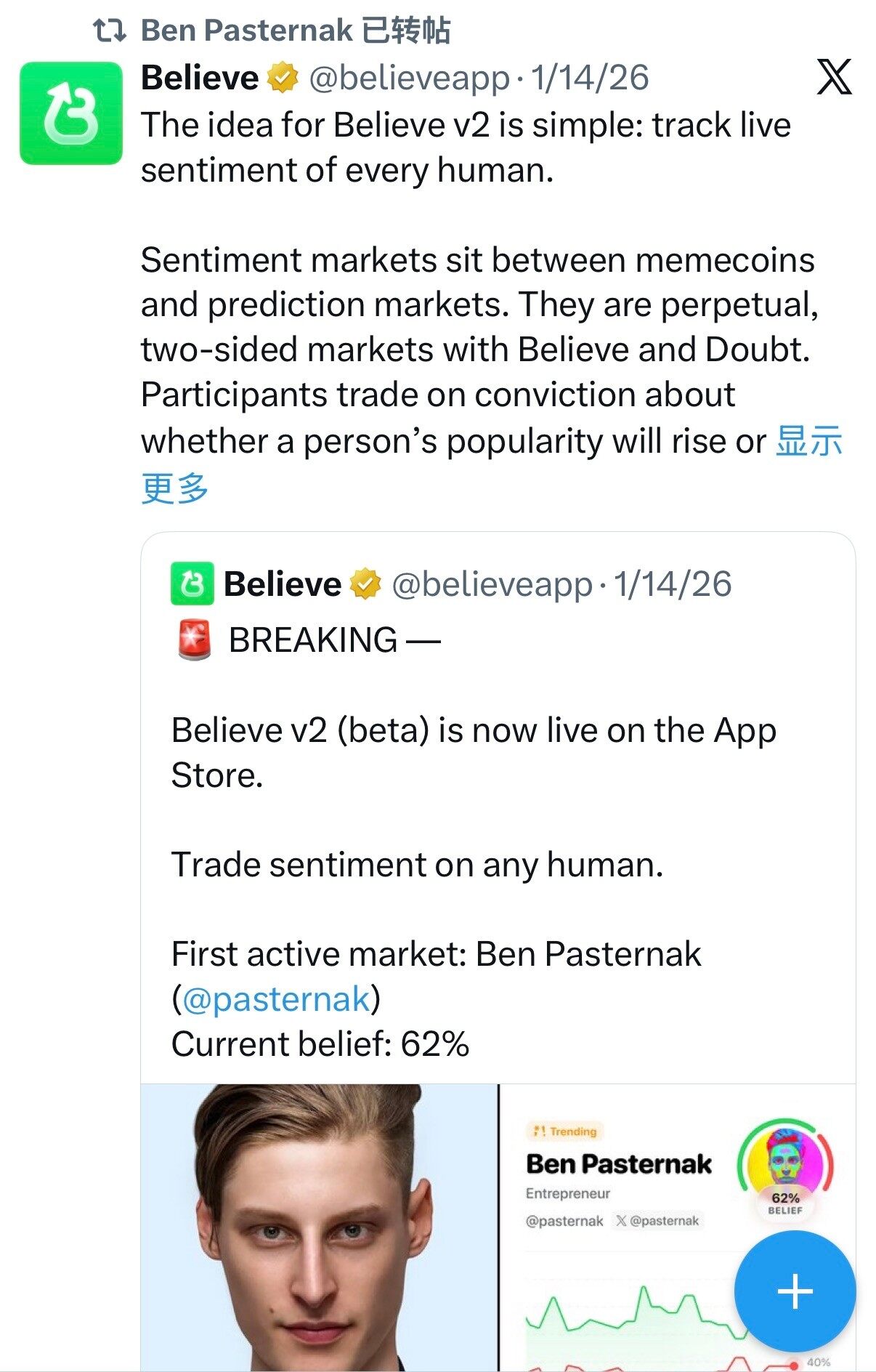
On January 14, 2026, he forwarded a tweet from the Belive official account, which reads: "Believe v2 is simple: tracking everyone's real-time emotions."
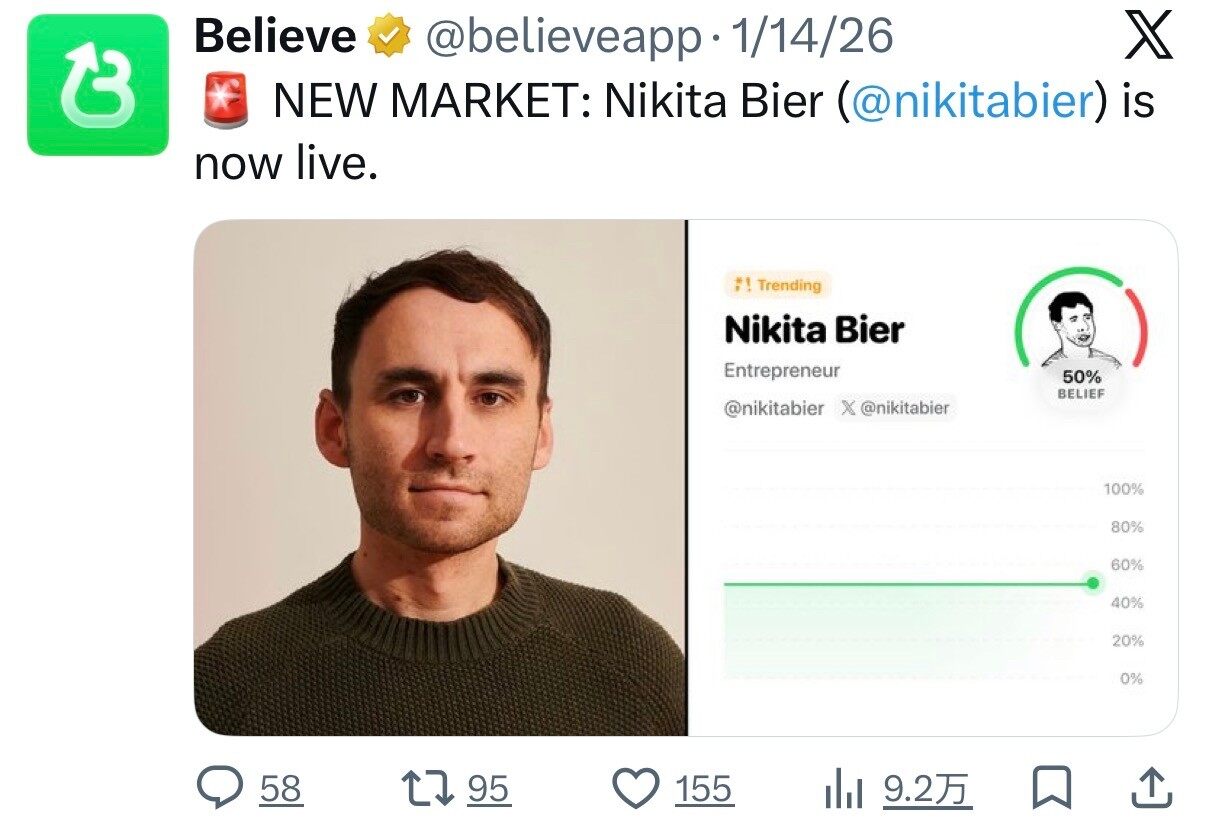
The update of Believe's official account also ended that day, with the last tweet declaring: "New market line: Nikita Bier (@nikitabier) is now open for trading." Since then, social media has been completely silenced, both individually and officially。
Believe v2 who went online in January 2026 tried to turn to the "emotional market" to allow users to reintroduce the real-time personality of public figures through the bilateral market, but failed to regain market interest. By the date of the indictment, Believe tokens had a market value of approximately $1.2 million, evaporating from historical heights。
This action invokes sections 349 and 350 of the New York State General Commercial Law, the California Unfair Competition Law and the False Advertising Law, together with common law claims of misrepresentation and improper enrichment. The plaintiff requested the court to order the defendant to pay compensation for the actual loss, return of the platform and the costs of the founder, and, if necessary, impose a presumption of trust and injunction relief on retroactive digital assets。
The documents show that Pasternak is resident in Manhattan, New York, and its controlled B24, Inc. registered address is also located in New York, where the platform is operated and developed. At the time of the submission, he had not responded publicly to the proceedings and had not disclosed the amount of the individual ' s specific profits from the Belive project。
The legendary youth
Before this legal storm, Pasternak's life history was legendary. On 6 September 1999, he was born in Sydney, Australia, in a Jewish family and grew up in the suburbs of Wokluz. A 13-year-old self-study program, he worked with a Chicago engineer in science class at school in 2014 to finish the iOS game Impossible Rush in a few hours, getting millions of downloads, once in the 16th place on the US App Store list. The media quickly captured the story and called him "the next Zuckerberg"。
In January 2015, 15-year-old Pasternak refused Facebook and Google internships, dropped out of high school and flew only to New York for venture capital. In April of the same year, he founded the Youth Social Shopping Application, Flog, which financed about $2 million from institutions such as Binary Capital and Greylock Partners。
Flogg did not perform as expected and closed at the end of 2016. He then invested resources in a new project, Monkey, a youth video chat application。
Monkey, a cumulative user of over 20 million, was acquired by the Chinese company Holla in 2018 as his first successful start-up in adolescence。

Since 2018, Pasternak has moved to the field of food technology, co-founded Simulate and launched the plant-based chicken block NUGGS. The project was supported by prominent investors, such as Alexis Ohanian, Jay-Z and McCain food, with over $50 million in financing in 2021 and once over $250 million in corporate valuation. In the same year, he was put on the Forbes list of 30 under 30 elites。
From mobile applications to food technology, to Web3, Pasternak, every transformation is on the wind, with enormous controversy and risk. And when he was in the middle of litigation, there was a dramatic turn in personal life。

Since the second half of 2024, Pasternak has been in public contact with TikTok Net Red Evelyn Ha. Evelyn, a three-sister from the Korean Ha, who is influential in social media, Pasternak often shares their luxury interactions on social platforms。
However, in early April 2026, netizens discovered that the Ha three sisters had also withdrawn their interest on Instagram, and Evelyn was subsequently exposed to close ties with a Twitch anchor. This series of actions has been widely interpreted as a sign of termination of the relationship, and some people in the encrypted community have claimed that “it is finally possible to reinvest the budget for the purchase of a horse”。
From the kid who wrote App in the Sydney high school class to the entrepreneur at the Federal Court of New York, Ben Pasternak, 26 years old, caught a double storm of law and emotion。He was the next Zuckerberg in the media, and now his name is more tied to "fraud", "crash" and "pick-up."。
