
The lobster's in the past? Combling the Hermes Agen tools that give you 100 x
What's so special about Hermes, where developers migrate

On February 25, a team called Nous Research quietly pushed a v. 0.1.0 on GitHub. The first Hermes is a model that has only one line of installed commands and a single sentence of product positioning: "An agent that grows with you."。
Very few people noticed it at the time, even though Nous Research had some reputation in a model ring, their Hermes series had accumulated 33 million downloads on HuggingFace, but the interest of the entire community of developers was on the divine OpenClaw "crawfish." Thirty-three days after React became the first in history, and the "crawfish" became the fastest-growing project in GitHub's history, peaking at 710 stars per hour, but at the same time there were security researchers who continued to reveal holes at an average rate of 2.2 CVEs per day, with 63 days accumulated at 138 safety holes. The whole community started rethinking the question: can this be used in the production environment
In this context, Hermes Agent, who is also a contender, has finally taken advantage of his first period of rapid growth。
Hermes wrote a key to the OpenClaw migration tool, and the developers who left OpenClaw needed a place to go, Hermes Agent became a good mouth-to-mouth option。
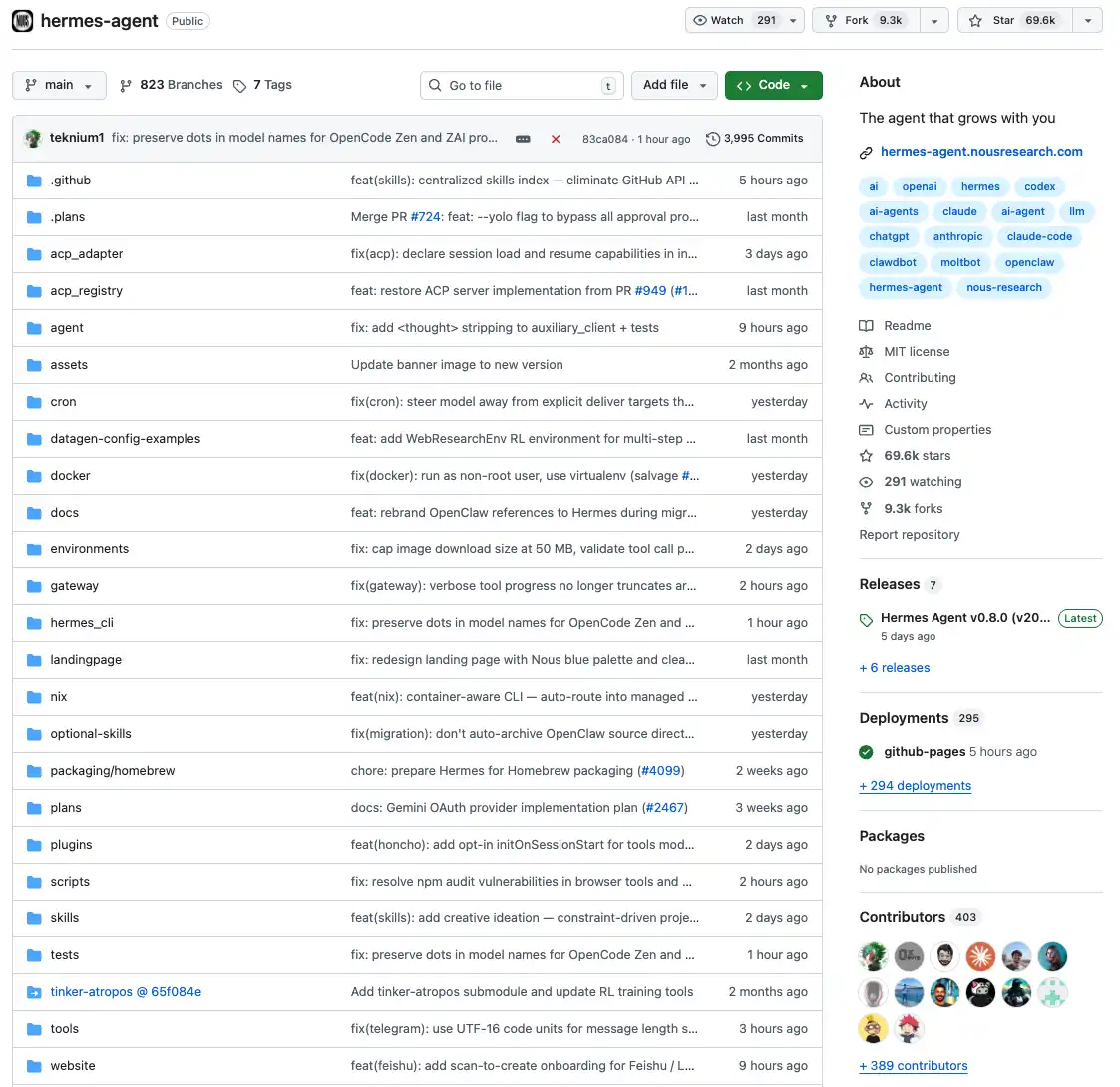
So from the beginning of March, Hermes Agent got into GitHub Trending, up to the 11th spot, and the number of stars went through 2,200. AwesomeAgents describes it as "the most ambitious open source of Agent release since 2026" and now has 69.9k Star and 9k Fork in Hermes。
Today's Activation Blcok Beats talks to you about how different this Agent is。
What's Hermes Agent
Hermes Agent is a self-engineered AI smart body built by Nous Research, and is currently the only one that has built a closed learning loop。
It automatically creates skills from experience, continuously improves them during use, proactively consolidates knowledge into reusable assets, retrieves its own history of dialogue and constantly deepens the understanding of your user in numerous sessions。
So to put it simply, Hermes Agen's greatest advantage is that the more smart the better the better。
Its location is not a programming assistant tied to an IDE, or a chat wrapping for a single API, but an autonomous Agent who actually lives on your server, remembers what it learns, runs longer and longer。
Nous Research has, from the outset, positioned itself as an open source priority and decentrized AI laboratory, with the goal of building an AI that users can control independently, rather than concentrating intelligence in the hands of a few closed companies. Their early work focused on Hermes Model Series, with substantial input at the infrastructure and system levels, and explored DisTrO techniques for modelling across the global distribution of consumer grade GPUs, as well as multi-intelligence interactions and long-range behaviour simulations such as WorldSim and Doomscroll。
Hermes Agent, the team, was the same people who built a series of models for Nomos and Psyche。
What are the good tools
Hermes Agent's central mechanism is its memory and skills systems. Agent maintains two streamlined core documents: EMORY.md Storage of Environmental Information, Engagement and Lessons Learned from Previous Missions; USER.md Storage of Your Preferences and Communication Styles. These two files automatically inject system tips at the beginning of each session, equivalent to the "long-term working memory" of Agent. In addition, all history sessions are stored in the SQLite full-text search database, allowing Agent to retrieve the conversation several weeks ago。
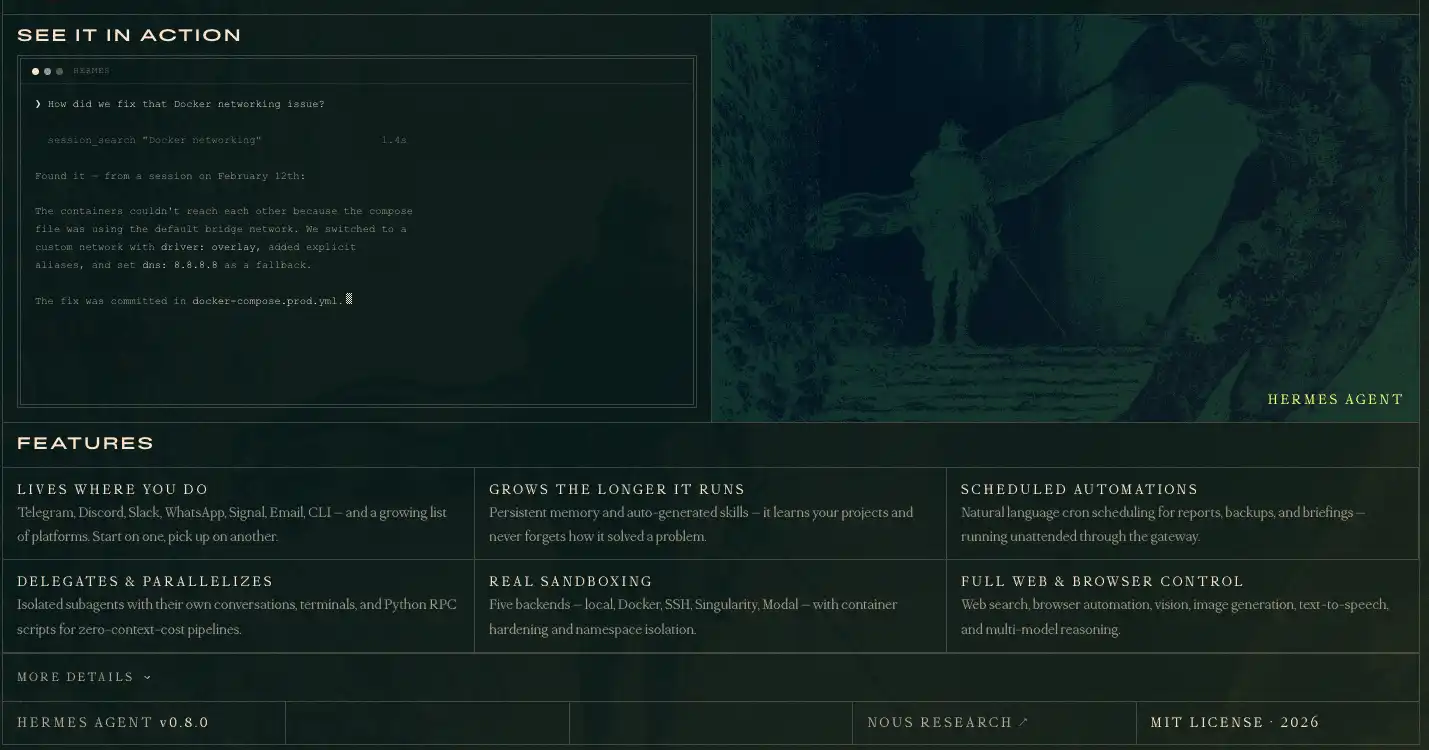
In terms of skills systems, every time a complex mission is completed (usually with more than five calls for tools), Agent will be able to create a structured Markdown "skill document" to document the operational steps, known content and authentication methods for future reuse. Skills files follow a gradual disclosure pattern: Agent defaults to control token consumption by simply looking at the name and description of the skills (approximately 3000 token) and loading the full content of a particular skill when required。
At the tool level, Hermes Agent has more than 40 tools, covering web search, browser automation, visual understanding, image generation, text-to-speeching, and also supports the setting of timed tasks in natural languages to allow Agent to automatically perform periodic work such as report generation, data backup, system monitoring, and so forth, without being observed。
The most popular of these tools, i.e. the most frequently used and feedback from community users, and based on Hermes' functional architecture and the typical needs of the developers' community, are the most popular tools in the worldThese are the tools in front:
Hendsight is currently the most popular single tool in the ecology and the officially recommended long-term memory plugin for Hermes. It automatically recalls the context before each LLM call, supports local PostgreSQL or cloud deployment, which is already the original MemooryProvider integration Hermes。
Anthropic-Cybersecurity-Skills is the top eco-based Stars skill pack with 753+ structured network security skills, a complete mapping of the MITRE ATT&CK framework, suitable for safety research and penetration testing。
mission-control is currently the most popular Agent programming dashboard in the ecology, supporting the Agent fleet management, task distribution, cost tracking and multiple Agent workstreams, and is recommended by the community as the standard for deployment at the production level。
Hermes Agent Self-Evolution is an evolutionary self-improvement technology that optimizes skills, tips and codes using DSPy+GEPA。
Hermes Workspace is the Hermes Native Workspace, an integrated chat interface, terminal and skills manager, the most popular graphical entry。
In addition, it can produce an independent child, Agent, each having its own context for dialogue, an independent terminal and a Python RPC script, thus achieving a parallel flow line at zero context cost。
In terms of infrastructure flexibility, six terminal backends are supported: local running, Docker, SSH remote, Daytona without servers, Singapore packagings and Modal cloud functions. Daytona and Modal sleep when they're free at almost zero. You can run it on a $5 VPS or GPU cluster, give instructions through Telegram to work on a cloud server that you never go directly to SSH。
Hermes Agent currently constitutes the most direct competition with OpenClaw, both of which are open-source Agent frameworks for developers。
The conceptual philosophy of the two is different: OpenClaw is designed at the core of a "control plane", a unified long-term running process that manages the session, route, tool execution and state, and everything flows through this central controller. Hermes, with Agent's own implementation cycle at its core, builds the gateway, time scheduler, tool running time around this "do, learn, improve" loop。
The difference is particularly marked in the skills systems: OpenClaw ' s skills are mostly manual and are loaded from different levels, such as workspace, personal, Shared, or plugins; Hermes ' thinking is to allow Agent to generate skills of his own from experience and form a true self-study closed loop。
How to Install and Use
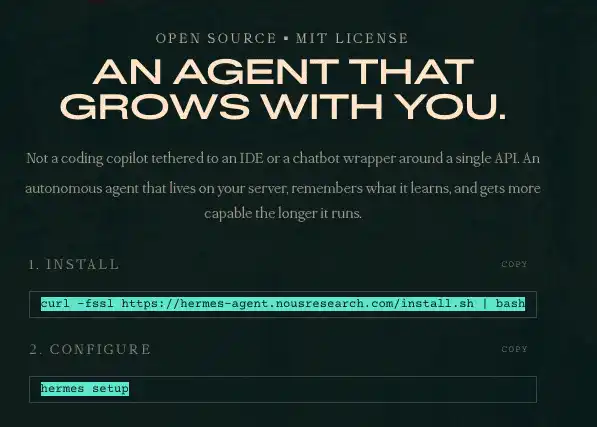
It's extremely simple. A line of command "curl-fsSL https://raw.githubusercontent.com/NosResearch/hermes-agent/main/scripts/install.sh|bash" completes the installation and supports Linux, MacOS and WSL2, Hermes Agent automatically completes the full configuration without manual operation。
Hermes Network
Upon the installation of Hermes Agent, start running the "hermes setup" guide, select your model provider (support Nous Portal, OpenRouter, OpenAi or any custom peer), access your message platform (Telegram, Discord, Slack or WhatsApp) and start the first conversation. From the first interaction, Hermes Agent immediately went into learning mode, building memory, creating skills, becoming more capable after each session。
The core orders used daily include:
(initiating dialogue)
hermes Model (select LLM providers and models)
hermes tools
hermes Gateway (starting the message gateway, accessing platforms such as Telegram, Discord, etc.)
hermes setup (run full setup wizard, one-time configuration of all content)
hermes law migration (move from OpenClaw)
i don't know, shemes update
hermes doctor (diagnosis)
The suitable scenarios for Hermes Agent include: generic AI assistants who need to remember the context and continuously improve their capabilities across sessions; self-defined Agent workflows that need to be combined with tools, plugins, MCP servers, browsers or Shell; the deployment of Agent on local hardware, cloud VM or low cost server-free infrastructure; and the need to maintain a permanent Auxiliary scene across platforms that can search for dialogue history and learn skills。
More specifically, it could be used to carry out its mission on cloud VM while it was talking to it on Telegram, to automate and push reports to any platform to take over cyclical tasks; to access Slack or Discord to provide AI collaborative support to the entire team; or to export its trajectory to generate training data for RL training for the next generation of the Tool-Calling model。
