
Messari report: Filecoin 2025 Q3 status study
To reveal key data such as network utilization, storage volumes, and to demonstrate their ecological and economic dynamics。
Original title: State of Filecoin Q3 2025
Original by Armita, Messari
Original: Filecoin Network
Critical insight
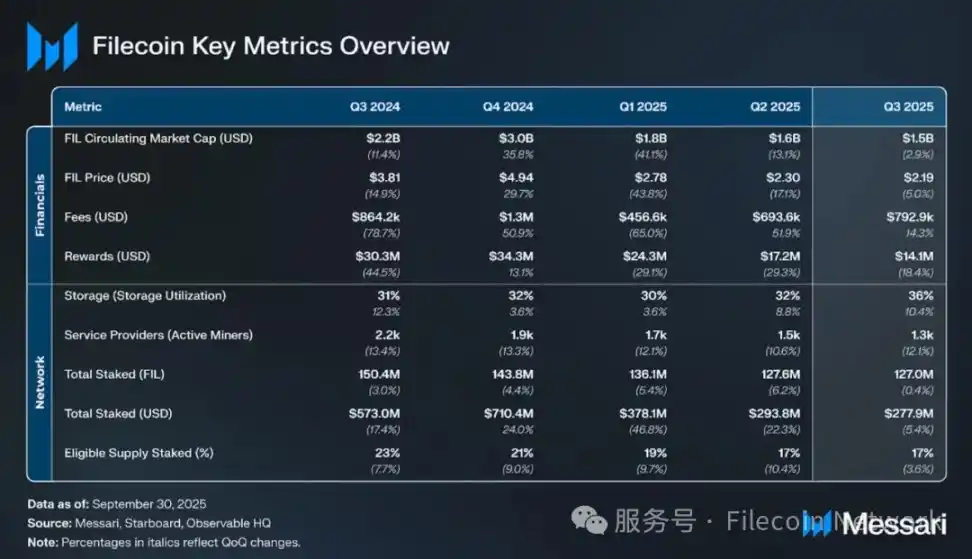
• Network utilization increased to 36 per cent (32 per cent in the second quarter), while the total network storage capacity ring ratio decreased by 10 per cent to 3.0 per cent. This reflects the partial withdrawal of SP and the increased efficiency of the network after the upgrade of the network v27 Gold Week。
:: total network costs increased by 14 per cent to $793 million, almost entirely driven by fines (99.5 per cent). with the removal of the old version of section (legacy sector) method, bulk costs (batch eyes) and base costs (base fees) have been reduced to almost zero。
Active storage needs remain stable, with total stored data being slightly reduced by 1 per cent to 1,110 PiB. Although storage providers and distributors (alloctors) are adapting to the new Fil+ path and operational adjustments, this has led to a 19 per cent decline in the daily average of new transactions。
• The growth of 3 per cent in the ring-based real data set to 2,491 data sets, of which 925 data sets are larger than 1,000 TiB, indicating that the use of large-scale, sustainable storage by enterprises and research institutions is increasing。
• The Filecoin Foundation and the GSR Foundation co-financed an impact project team, including the Oceanic Whispers project of The Starling Lab and COSSLUCID, which further consolidated the critical role of Filecoin in the field of verifiable, socially driven data preservation。
Project Profile
Filecoin (FIL) works to create a decentrized market for data services, the first core service being data storage based on the interstellar file system (IPFS). Filecoin uses a market-driven model whereby users can negotiate price-variable storage transactions with storage providers. Storage transactions are similar to a service agreement, where users pay providers to store their data within a specified period of time。
Filecoin uses an incentive model based on a password certificate - i.e. a copy certificate (Proof of submission, PoRep) and a time and space certificate (Proof of space, Post) - to verify that the storage provider has reliably stored customer data during the period of the agreement. In addition, the Proof of Data Operations, PoDP,1 was launched in May 2025, adding continuous lightweight validation to stored data and providing a thermal storage layer for high-speed data availability. The provider receives an incentive to participate in storage transactions in the form of a network origin token FIL. If the store provider fails to provide reliable online time or is maliciously acting against the network, the pledged FIL will be confiscated。
In terms of data retrieval, Filecoin users pay the search provider for data. Unlike storage transactions conducted on the chain (onchain), search transactions are settled under the chain (offchain) using the payment channel to achieve faster retrieval. In addition to storage and retrieval, Filecoin also aims to provide an open market where computing can be called directly over data and provide more efficient alternatives to traditional centralized systems. The key protocols for achieving the "compute-over-data" service include the Smart Contract (Filecoin Virtual Machine - FVM) and the amplification scheme (Star Consensus - IPC). With the forthcoming launch of the Filecoin Online Cloud, the network ' s infrastructure will be further expanded to support full chain cloud services。
Key indicators
Performance Analysis
The main use of Filecoin is to centralize data storage through two participants:
• The demand side, that is, the storage users who need data storage。
• The supplier, the storage provider with idle storage capacity。
The indicator measuring the storage needs of Filecoin is the total amount of data in a valid storage transaction between the user and the storage provider。
Storage transactions
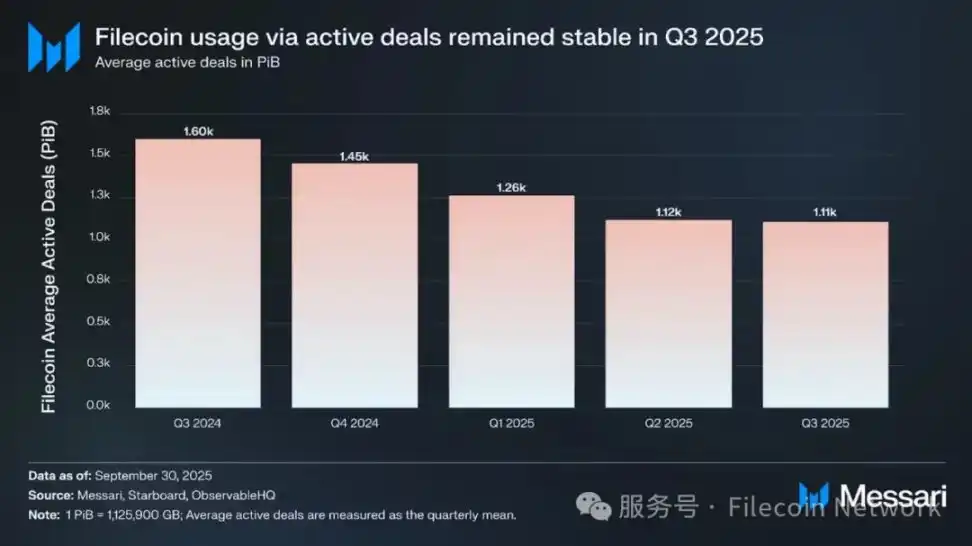
In the third quarter of 2025, the total amount of data stored through active exchanges in Filecoin reached 1,110 PiB, down by only 1 per cent from 1,120 PiB in the second quarter, indicating that the overall storage demand on the chain remained stable. The average number of active transactions dropped slightly by 1 per cent to 35.2 million. Despite the continuing decline in total network capacity, the small drop in data volume highlights the fact that Filecoin is continuously shifting from maximizing raw storage supplies to supporting higher-value, enterprise-level and validated data loads。
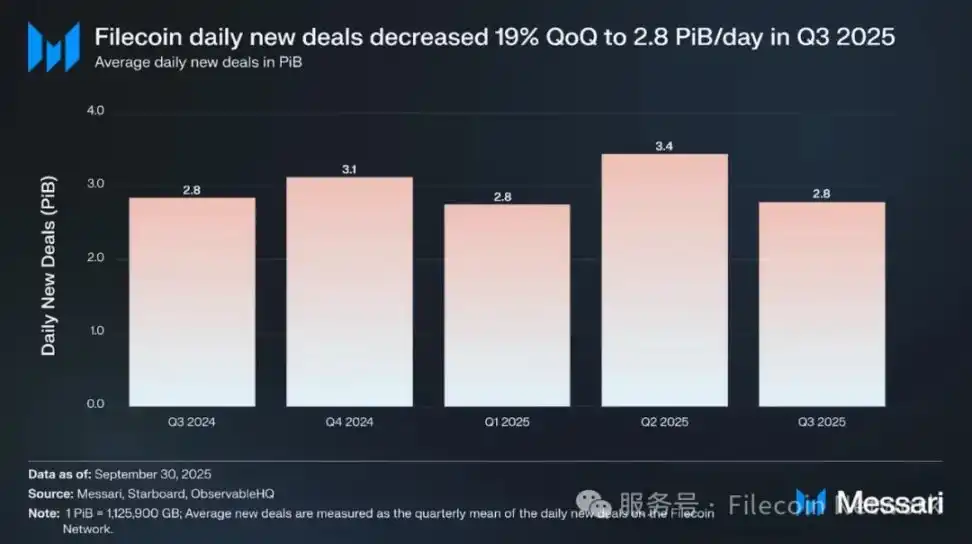
In the third quarter of 2025, the Filecoin daily average of new storage transactions decreased by 19 per cent from 3.4 to 2.8 PiB. This trend contrasts with the growth trend of the previous quarter and reflects a cooling of the up-line activity of the new data, although the total active storage level has remained generally stable (from 1,120 to 1,110 PiB only). This fragmentation indicates that the up-line speed of new data has slowed, but the existing validated data sets have remained stable。
The Filecoin Plus (Fil+) Distributor Path (Allocator Paths), launched at the end of the second quarter of 2025, prioritizes service to large, validated data clients and simplifys the go-live process for enterprise-level users, leading to a reduction in the number of transactions, but the value of individual transactions is higher. Today, certified storage dominates total network activity, while ordinary transactions of smaller size and shorter duration have almost disappeared. At the same time, the upgrade of the network v27 "Gold Week" has simplified SP operations and eliminated several old methods of sealing and aggregation, which has temporarily led to a reduction in new transactions, as storage providers need time to adapt to the new set of tools. The integration of miners is another reason, with many small operators opting out under stricter efficiency standards and increasing pledge requirements。
Despite the short-term decline in the volume of new transactions, the overall utilization rate has improved as existing validated data sets remain active. These data sets are particularly relevant to long-term archiving, scientific research and business applications introduced through projects such as the Culture and Science Conservation Programme launched in the third quarter。
UTILITY VS. CAPACITY
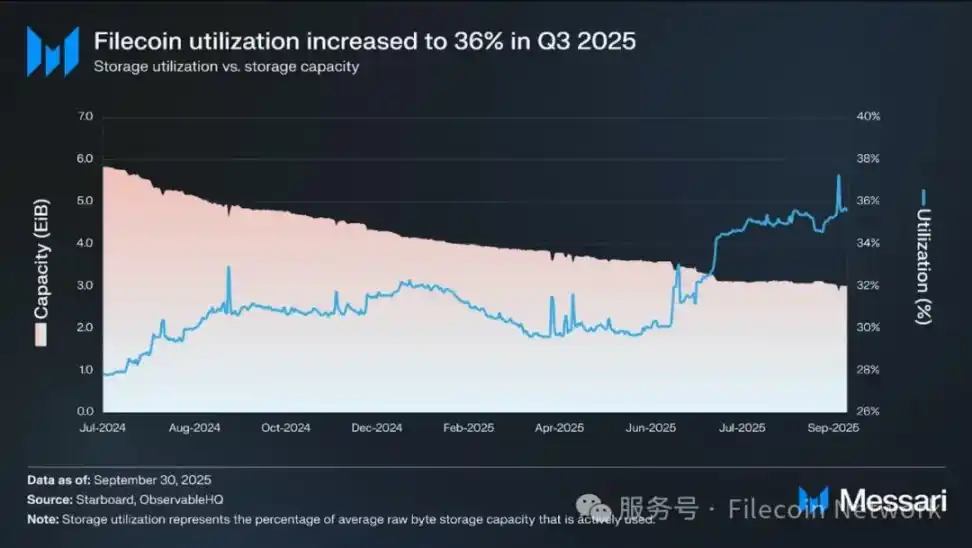
In the third quarter of 2025, the storage utilization rate of Filecoin increased from 32 per cent in the second quarter to 36 per cent, while the total commitment capacity of the network decreased by 10 per cent, from 3.3 EiB to 3.0 EiB over the same period. This reverse trend reflects the ongoing SP integration and rationalization of the size of the network. The decline in total capacity has mainly resulted from the withdrawal of smaller or underperforming storage providers from the network following the introduction of stricter operational and pledge requirements for the upgrade of the network v27 Gold Week. The upgrade, through proposals such as FIP-011, FIP-0103 and FIP-0106, has simplified the sector sealing and maintenance process, eliminated obsolete and inefficient workflows and led some SPs to phase out obsolete infrastructure. At the same time, the daily increase in the number of new transactions fell by 19 per cent, reducing the inflow of new data. As a result, despite the contraction of total network capacity, the remaining storage space has been used more efficiently, thus increasing the utilization rate in the face of a reduced network size。
Client
Filecoin currently provides cold storage solutions (e.g. data archiving and recovery) primarily for businesses and developers. Low storage prices can help to attract traditional enterprises seeking high-value alternatives to big archiving data。
DeStor, a Filecoin service provider linking customers to storage providers, has worked with Qamcom to centralize data security (DDS). Potential data clients of the partnership include YayPal, a Web3 game studio with over 500,000 users, and Fieldstream, an artificial smart marketing analysis platform. Examples of other client solutions are as follows:
• GhostDrive: focus on enhancing privacy and security through encryption, decentrization and innovative storage optimization techniques
CID Gravity: Focus on enterprise integration with open-source platforms such as Nextcloud。
In addition to cold storage, projects such as Lighthouse, Akave and Storacha are promoting the development of other storage solutions。
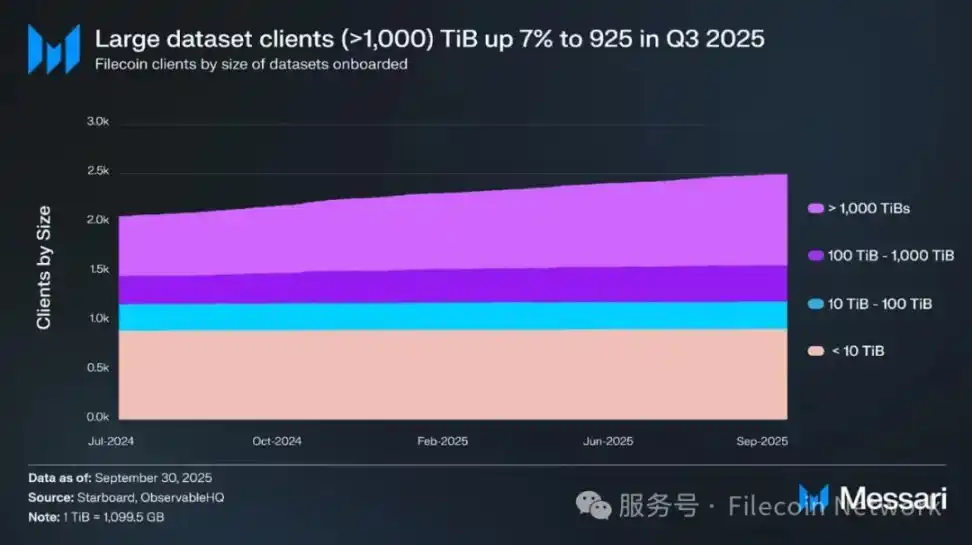
By the end of the third quarter of 2025, Filecoin had hosted 2,491 real data sets on line, up 3 per cent from 2,416 in the second quarter. Of these, 925 data sets were larger than 1,000 TiB, an increase of 7 per cent from 864 in the second quarter, highlighting the continued use of large, sustainable storage in the market. This increase is due to the ongoing Filecoin Plus go-live activities, the addition of the on-ramp integrations programme (lower access to data sets), and the increased burden of business and scientific work。
FVM DEVELOPMENT MOMENTUM
The Filecoin Virtual Machine (FVM) allows developers to deploy smart contracts similar to the Taifung over Filecoin ' s reservoir directly, thus building applications that can automate processes such as online, pricing, retrieval and computing coordination。
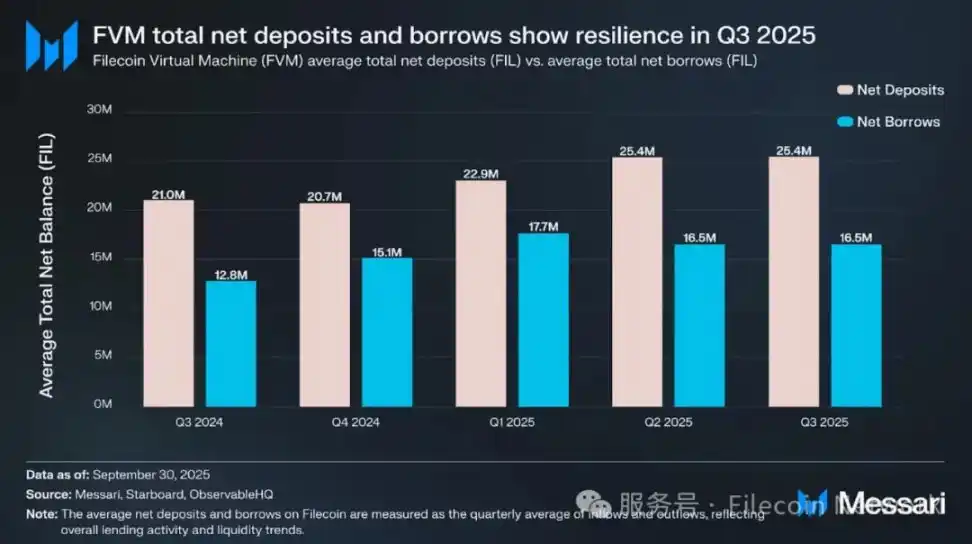
In the third quarter of 2025, Filecoin ' s total inflows (net deposits) were $62.4 million, down 6.5 per cent from $66.8 million in the second quarter; while total outflows and borrowings declined by 6.8 per cent over the same period, from $43.4 million to $40.5 million。
HOWEVER, WHEN MEASURED IN FIL TERMS, TOKEN ACTIVITY SHOWS THE OPPOSITE TREND: INFLOWS INCREASED SLIGHTLY BY 0.16 PER CENT, FROM 25.39 MILLION FIL TO 25.43 MILLION FIL, WHILE OUTFLOWS DECLINED SLIGHTLY BY 0.03 PER CENT, FROM 16.53 MILLION FIL TO 16.52 MILLION FIL. THE DIFFERENCE IS DUE TO A 5 PER CENT FALL IN FIL PRICES IN THE CURRENT QUARTER (FROM US$ 2.30 TO US$ 2.19), WHICH REDUCES THE VALUE OF DOLLAR MOVEMENTS THAT WOULD OTHERWISE HAVE BEEN STABLE。
Financial overview
Filecoin's collection model is similar to the Etherport because it uses the Gas mechanism inspired by EIP-1559, that is, some network costs will be destroyed (burned) to regulate network congestion. Unlike the Taifung, however, Filecoin ' s economic model is storage-driven and is paid for by storage users, who generate income while managing collateral and fines。
Network costs
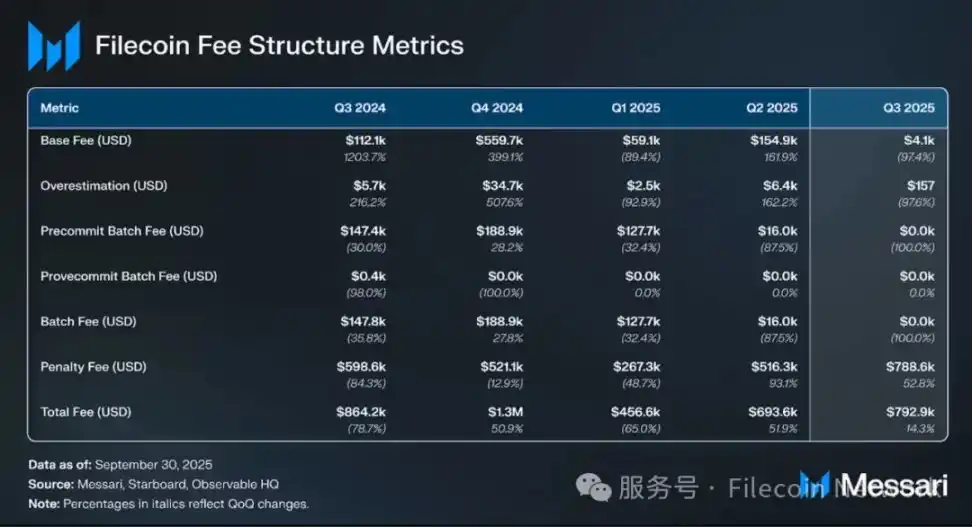
According to Messari ' s collection analysis, the cost of Filecoin consists of the following:
• Base Fees (Base Fees): Depending on the degree of space congestion in the block, any storage certificate would have to be paid。
• Batch Fees: used to bind multiple storage certificates to optimize costs。
• Overestimation Fees: costs incurred to optimize the use of Gas。
:: Fines (Penalty Fees): collected for failure or irregularities of the storage provider。
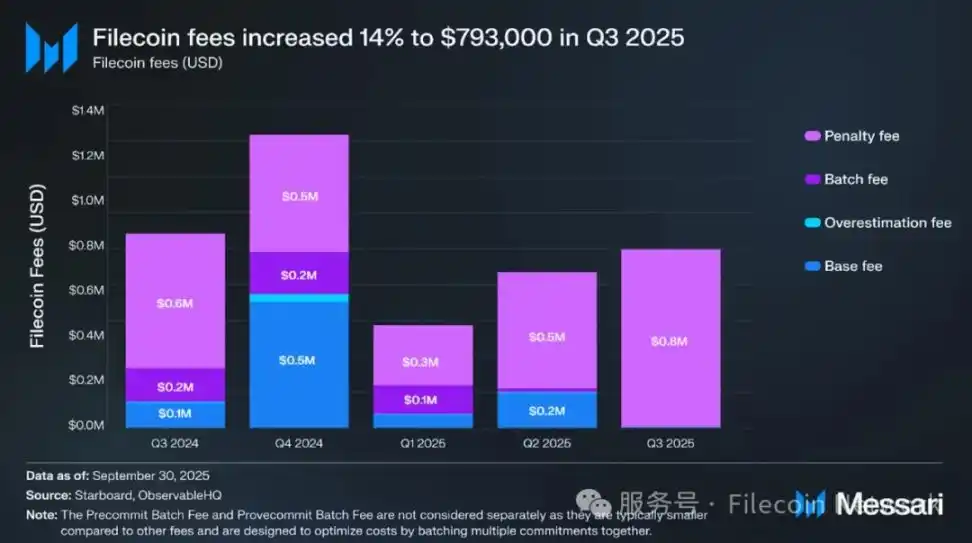
In the third quarter of 2025, Filecoin ' s total network costs amounted to $792,900, an increase of 14.3 per cent over the $693,600 ring in the second quarter of 2025. This increase is almost entirely driven by fines, while base and bulk-related costs have collapsed following the introduction of network v27 upgrades to agreement layers。
• Base cost: a sharp decline of 97 per cent to $4,100 in the ring ratio. This decrease reflects a reduction in chain trade throughput rather than a decline in network demand following the abandonment of several sector-related methods (FIP-0103, FIP-0106, FIP-0101)。
• BATCH COSTS: A DECREASE OF 100 PER CENT TO $0. THIS IS IN LINE WITH THE TREND OF REDUCED SECTOR UP-LINE ACTIVITY AND CONTINUED DECLINE IN THE TOTAL ACTIVE STORAGE VOLUME, LEADING TO A SIGNIFICANT REDUCTION IN VOLUME PRE-SUBMITTED TRANSACTIONS SUBMITTED BY SP。
• Overestimation costs: the ring ratio fell by 98 per cent to only $157 (compared to $6,400 in the previous quarter), reflecting a corresponding decrease in Gas-related activities as the overall transaction frequency decreased。
:: fines: rings rose by 53 per cent to $788,600, or about 99.5 per cent of total network costs. this surge may reflect an increase in incidents of impunity during the reorganization of the network and the withdrawal of miners under stricter operational requirements。
The third quarter is the transition period for the Filecoin economic model, and the network has simplified the operating process under version v27. The reduction in volume and base costs reflects the shift of the network from a high volume of transactions and a short-term up-line model to a smaller but larger number of proven transactions. The proliferation of fines, on the other hand, highlights the operational pressure on small providers to improve quality standards. These trends indicate that the network is going through a period of consolidation and that the expansion has led to a reduction in cost-related activities, but that the implementation and efficiency of existing participants are increasing。
Market value
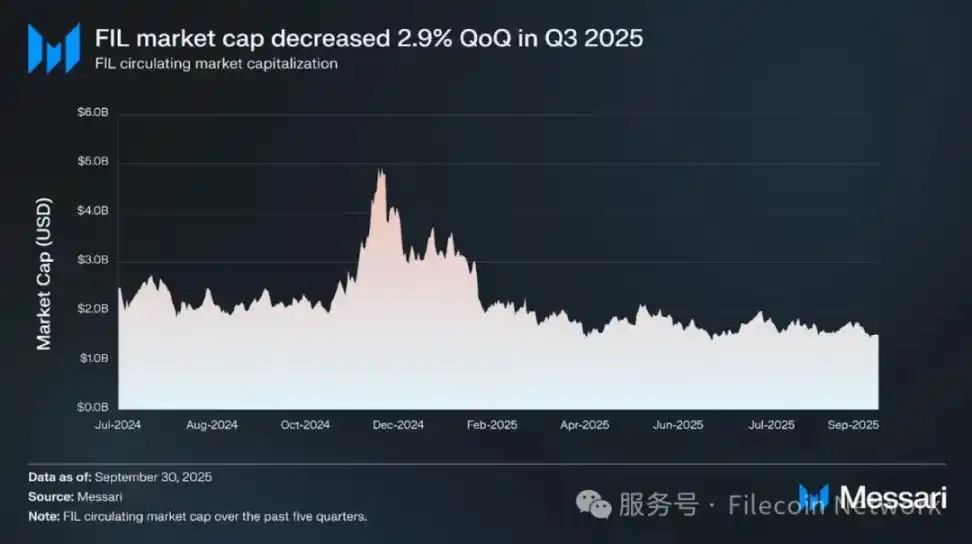
In the third quarter of 2025, the market value of FIL (circulating market cap) declined by 3 per cent to $1.5 billion in dollar terms, down from $1.6 billion in the second quarter of 2025. This decline was driven mainly by a 5 per cent decline in the FIL currency price ring (from US$ 2.30 to US$ 2.19), while the circulation of supplies increased by 2.2 per cent to 692.4 billion FILs over the same period, consistent with previous distribution rates。
DeFi Ecology
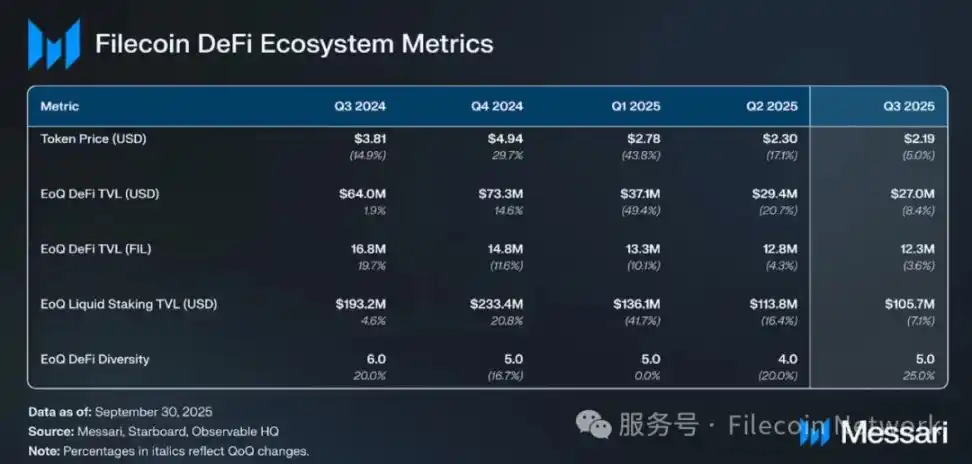
IN THE THIRD QUARTER OF 2025, THE TOTAL VOLUME OF FIL WAS SLIGHTLY REDUCED BY 0.4 PER CENT, FROM 127.6 MILLION FIL TO 127 MILLION FIL, THE FIFTH CONSECUTIVE QUARTER. IN UNITED STATES DOLLARS, THE TOTAL VALUE OF THE PLEDGE DECREASED BY 5.4 PER CENT TO $277.9 MILLION, MAINLY AS A RESULT OF THE 5 PER CENT DROP IN THE FIL PRICE IN THE CURRENT QUARTER, RATHER THAN A SIGNIFICANT CHANGE IN THE LEVEL OF THE PLEDGE PARTICIPATION。
The qualified supply pledge rate remained stable at 17 per cent, the same as in the second quarter, but was below 19 per cent in the first quarter of 2025, reflecting stable but relatively low participation in the network. At the same time, the annualized nominal rate of return dropped significantly from 52 per cent to 24 per cent. This is due to the sharp rise in short-term returns in the second quarter due to declining pledge participation and inflationary-driven incentives, which have returned to normal levels once the pledge activity has stabilized。
TVL TRENDS
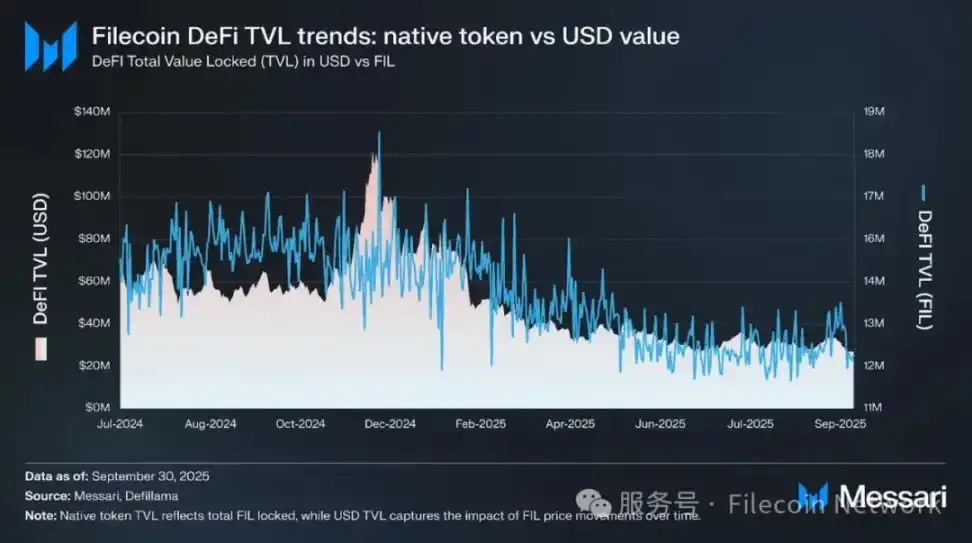
In the third quarter of 2025, Filecoin ' s DeFi activities continued to contract, continuing the downward trend that began in early 2024. At the end of the quarter, the value of the DeFi total lock (TVL) decreased by 8.4 to $27 million, down from $29.4 million in the second quarter, the fifth consecutive quarter. When measured in FIL terms, the decline in TVL was much more moderate, with the ring ratio falling by 3.6 to 12.3 million FIL, indicating that most of the decline in value was due to a 5 per cent drop in FIL prices rather than to a substantial capital outflow。
The same trend has been observed for TVLs of a mobile nature (Liquid staking), with the ring ratio declining by 7.1 per cent to $105.7 million. This is due to the return to normal pledge incentives following the sharp rise in returns in the second quarter, as well as the gradual erosion of network incentives. In FIL terms, core liquid products and pledge participation remain stable, indicating that even if the user's dollar-denominated indicator declines, user participation and network participation remain healthy。
Stable currency
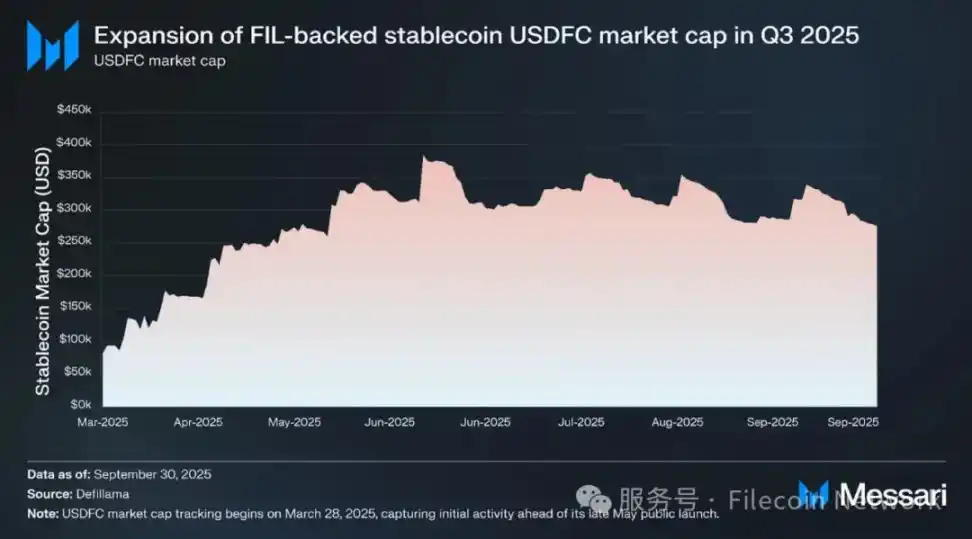
The USDFC is a stable currency launched by Secured Finance in early 2025 and supported by FIL. It aims to increase liquidity within the Filecoin economies by allowing FIL to serve as collateral and reducing FIL's sales pressure. It provides an original dollar-linked asset for trading, borrowing and DeFi applications, which users can use without leaving the Filecoin network。
In the third quarter of 2025, the circulation ratio of USDFC decreased by 8.5 per cent, from $3.01 million at the end of the second quarter to $2.75 million on 30 September, the first contraction since its launch. After reaching a peak of nearly US$ 355,000 in mid-August, the liquidity of the stable currency declined mildly throughout September as DeFi activities and revenue opportunities cooled。
The fall was market-driven and not structural. The 5 per cent fall in FIL prices reduced the value of collateral to support new issuances, while the pledge and DeFi yields recovered from a short-term peak of 52 per cent in the second quarter to a normal level of 24 per cent, reducing casting incentives for liquidity providers and borrowers. After the upgrade of the network v27 Gold Week, participants prioritized the stability of the agreement, which also led to reduced mobility in the wider chain。
Despite this moderate contraction, USDFC has maintained full anchor stability and healthy flow, indicating a steady confidence in it by storage providers and DeFi participants. This contraction is not a sign of weakness, but rather a natural whole-of-the-board phase (consolidation case), following the rapid expansion of the second quarter, laying the foundation for more robust growth as FIL-based markets and FVM-based integration schemes mature in 2025。
Qualitative analysis
Protocol Upgrade
Network v27 Upgrade (coded "Gold Week"): Filecoin Network v27 Upgrade (coded "Gold Week") was successfully deployed at block height 5,348,280 on 24 September 2025 and officially announced the following day (25 September). It focuses on streamlining the operation of the storage provider (SP), enhancing the compatibility of EVM and reducing technical debt。
Key Filecoin Improvement Proposals (FIPs) for implementation include:
• FIP-0105: The BLS12-381 pre-compilation contract (equivalent to EIP-2537) was introduced for Filecoin EVM to support efficient BLS signature certification and cross-link interoperability with the Rollup programme based on the Ether。
• FIP-0077: Introduction of a deposit requirement for the newly created Storage Provider (SP) ID amounting to 10 per cent of the initial pledge of 10 Tib storage capacity (approximately 4 FIL at current rate) aimed at inhibiting the creation of garbage accounts and increasing network efficiency。
• FIP-0103 / FIP-0106 / FIP-01011: The obsolete method (e.g. "extended sector life cycle " , "update of certified copy" and "certification aggregate submission") has been removed to streamline the logic and maintenance of SP Actor。
• FIP-0109: SMART CONTRACT NOTIFICATIONS ARE ACTIVATED FOR DIRECT DATA GO-LIVE (DDO) FUNCTIONS, ALLOWING SUBSCRIPTION STORAGE EVENTS TO BE APPLIED ON THE CHAIN AND THE CORRESPONDING WORKFLOWS TO BE TRIGGERED IN A PROCEDURAL MANNER。
• FRC-0108: A snapshot format has been expanded to include Fast Finality, F3 certificates, thereby reducing the need for synchronization of nodes and bandwidth for new participants。
All major client realizations (Lotus, Venus, Forest, Curio, Boost) were published before the upgrades were activated. The upgrade enhanced the developers ' tool and aligned the Filecoin virtual machine with the Taifung standard, laying the foundation for programmable data services and market retrieval。
Cultural and scientific data storage on Filecoin
On 30 September 2025, the Filecoin Foundation announced a group of new partners who will maintain cultural and scientific archives on the Filecoin network. Based on early collaboration with a number of well-known institutions, the plan highlights the growing role of Filecoin as a decentralised physical infrastructure network (DePIN) in the field of sustainable, verifiable and resistant data storage. New data sets saved on Filecoin include:
• DIGITAL PUBLIC LIBRARY OF THE UNITED STATES (DPLA): A PILOT PROJECT AIMED AT STORING SELECTED MATERIAL FROM ITS COLLECTION OF OVER 50 MILLION CULTURAL ITEMS, SUCH AS PHOTOGRAPHS, ORAL HISTORY AND GOVERNMENT DOCUMENTS。
• The Earth Species Project (ESP): Preservation of the BEANS-Zero baseline data set, which is used to train NatureLM-audio — an audio-linguistic model for animal acoustics to ensure flexible access to these data by researchers worldwide。
• Prelinger Archives: tens of thousands of archival films documenting the social and cultural history of the United States, including Rick Prelinger's Lost Landscape series。
Rohinya Project: a community-led archive aimed at preserving the cultural identity and oral history of stateless Rohingya communities。
• COSSLUCID's Oceanic Whispers: developed in cooperation with the RadicalxChange component, is an experimental data trust (data trust), which stores datasets of marine protected areas on Filecoin and converts them into interactive experiences generated by AI with partial ownership income models。
Together, these collaborations demonstrate how decentrized storage supports open scientific and cultural protection through verifiable, tamper-proof archiving。
Ecological integration and cooperation
Filecoin and GSR Impact Cohort: On 23 July 2025, Filecoin announced the launch of the Impact Project Group in collaboration with the GSR Foundation. This is a joint initiative aimed at supporting five sector-based public goods projects in the Filecoin ecosystem. The GSR Foundation is a charitable arm of GSR, a digital asset-marketer, and in collaboration with the Filecoin Foundation, co-financed the "sea languages" of The Starling Lab for Data Information, Easier Data Initiative, Transfer Data Trust, Akashic and COSSLUCID. Each project will be decentralised for use in areas of social impact, such as digital truth-keeping, geospatial data access, art governance and environmental management. This collaboration highlights the key role of Filecoin as a core technological infrastructure that supports social influence and real world applications。
S3 compatible object storage through Arkave Cloud: On September 16, 2025, Akave announced the launch of an object storage service supported by Filecoin, compatible with the S3 protocol, specifically designed for businesses and DePIN applications. The integration allows developers and organizations to use standard S3 API to store and access data, while benefiting from Filecoin 's verifiable storage and retrieval safeguards. The release of Akave, which aims to connect traditional cloud tools to the decentrized infrastructure, simplifys the process of moving enterprises to block chain storage and achieves a certified, low-delayed "temperature " data by supporting the data holding certificate (PDP)。
Storacha's Bluesky Backup Application: Storacha is a decentralised thermal storage network based on Filecoin and IPFS, which was published on 12 June 2025 bsky.storage (its adoption rate has been expanding in the third quarter). This is a user-oriented application that automatically provides an hourly backup of Bluesky social data. This tool enables users to independently export and restore their post and identity keys, further reinforcing Filecoin ' s ambitious vision of data portability, user ownership and self-sovereign digital identity。
Developer plans and community growth
Seventh Filecoin Developers Summit (FDS-7): In September 2025, it was announced that the Seventh Filecoin Developers Summit would be held online from 16 to 17 October and would be held in Buenos Aires from 13 to 15 November during DevConnect Argentina. The Summit focused on expanding Filecoin to fit enterprise-level and data-intensive applications and explored the progress made by Web version V27, including direct data access (DDO), BLS pre-compilation contracts and fast finality (Fast-finality) snapshots, and new retrieval markets and AI data workflows。
Filecoin Onchain Cloud (Alpha Project Group): On 12 August 2025, FIL-Builders and FilOz launched the Alpha Project Group (Onchain Cloud Alpha Cohort). The plan introduced modules such as chain payments, temperature storage, standardized retrieval interfaces and service level agreements (SLAs) based on smart contracts, enabling developers to deploy decentrized data services as easily as using smart contracts。
PL Genesis – "Use Filecoin to break sovereign data layers": As part of the "Modularized World" series of events organized by the Protocol Laboratory (Protocol Labs), the hackers began in early June and continued until July 6, 2025. Developers were invited to undertake decentrization of data ownership and retrieval experiments using the Filecoin chain technology stack to explore new applications for programmable storage and verifiable data access. The award-winning project, published on September 5, 2025, showcases innovative results such as search logic based on smart contracts, validated AI datasets and the developer tool for data DAO (Data DAOs). The hacker pine prize, which totals $15,000, enhances the participation of developers in the cloud ecology of the growing chain of Filecoin。
Orbit Programme and Community Activities: During September 2025, FIL Builders ' track plan expanded the reach of global developers through a series of community seminars and hackers. The highlight events included FIL Warsaw (5 September) and ETHAccra (4-6 September), which included the AI and DeFi bounty challenges; the Code & Corgi seminars held in Pune (12 September) and Delhi (25 September); and the Tentrolid Storage 101 (18 September), organized jointly with Pacific Meta in Japan. These meetings focused on the education of developers around the Filecoin Virtual Machine (FEVM), data online tools and community-led open source development。
Key governance developments
ProPGF First (Batch 1): On 11 August 2025, the protocol laboratory completed its first set of Filecoin public goods grants (ProPGF) and allocated $3.68 million to 14 ecosystem projects, including IPNI, CID Gravity Gateway, Curio Storage, Fil Ponto and FilCDN Retrieva Services. It supports forward-looking infrastructure and developers ' plans to strengthen the core ecological and long-term sustainability of Filecoin。
RetroPGF Round III (Rund 3): On 25 August 2025, RetroPGF Round III was announced to be launched, distributing 58.50 million FILs to retroactively finance contributors who delivered verifiable impacts throughout the ecosystem. The round adopted the Optimism-style Public Goods Funding Model, which rewards open-source contributions in infrastructure, tools, research and customer access, reinforcing Filecoin ' s commitment to sustainable, impact-driven ecological growth。
Filecoin Plus (Fil+) Distribution Path: As of September 2025, the Fil+ Governance Team reviewed over 140 Allocator applications, with a approval rate of approximately 75%, and distributed over 450 PiB DataCap. A new path for the meta-allocator has been introduced to simplify business go-live processes and automated distribution tools. Regular governance teleconferences in August and September and sound recordings issued improved transparency, accountability and operational efficiency within the plan。
Summary
In the third quarter of 2025, Filecoin ' s market value ratio declined by 3 per cent to $1.5 billion, mainly as a result of a 5 per cent to $2.19 fall in FIL prices, while the volume of liquidity increased by 2.2 per cent. Network activity remained stable, with a slight decrease in active storage from 1 per cent to 1,110 PiB. Network utilization increased from 32 per cent to 36 per cent as a result of a 10 per cent reduction in capacity due to SP integration。
An upgrade of the network v27 "Gold Week" has simplified storage operations, abandoned the old version of the sector and enhanced FVM compatibility, which, while temporarily slowing the formation of new transactions, has increased long-term efficiency. Economic activity returned to normal, with the total network cost increasing by 14 per cent to $793 million, driven mainly by fines; pledge participation was maintained at 17 per cent, with the return rate from 52 per cent to 24 per cent. As the rate of return on the chain cooled, DeFi TVL declined by 8 per cent to $27 million, and the USD-supported stabilization currency, USSDFC, contracted by 8.5 to $275 million。
On the ecological front, the Filecoin Foundation has promoted the protection of culture and science and has launched a group of co-financed projects with the GSR Foundation; Akave and Storacha have announced new applications for the network; FIL-Builders and Filoz have expanded the developer's programme through the Alpha Project Group and PL Genesis hackers. The team also announced FIL Dev Summit 7, scheduled to take place in Buenos Aires in November 2025, during DevConnect Argentina, to showcase the evolution of Filecoin to a verifiable, programmable data infrastructure。
overall, the third quarter reflects a whole phase (consolidation case) where the network becomes more streamlined and efficient, focusing on validated data, enterprise storage and laying the foundation for data computing (compute-over-data) services。
