
ENI's RWA ambition: building a business-level BaaS platform that allows Web2 institutions to “not just chain up”
Author:momo, ChainCatcher
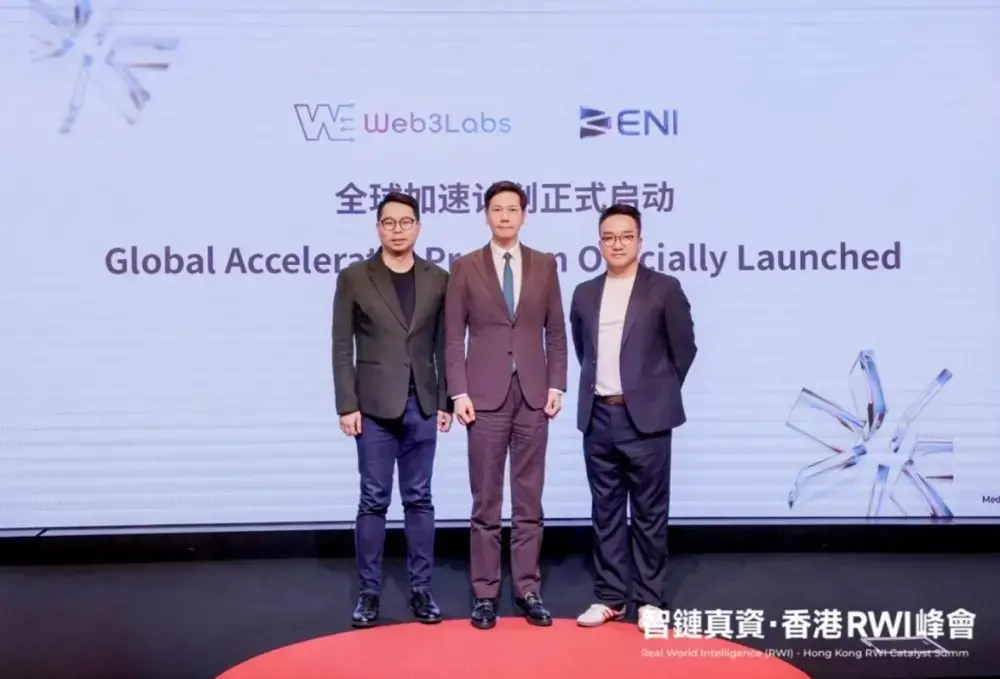
At the recently concluded Hong Kong Block Chain Week RWI Summit, the founder of the RWA Infrastructure Project ENI, Arion Ho, launched a $1 million global acceleration plan with Hong Kong Legislative Assembly Member U Jie-Jan, Hong Kong's famous incubator Web3Labs CEO Casper. On the same occasion, ENI also signed an institutional-level RWA strategic cooperation agreement with a digital asset bank with the licensed financial group Ed Finance。

This is not an isolated appearance. Just a few days ago, ENI just entered into a partnership with Republic Crypto, a group of agencies, such as Hamilton Lane, Hasshed, Morgan Stanley, and others, covering over 2,500 businesses. Less than a month, in a matter of weeks, ENI has completed a “triple strike” in which political endorsements, traditional financial institutions cooperate with top encrypted capital。
BUT MORE THAN THESE FREQUENT MOVEMENTS, IT'S A MATTER OF CONCERN THAT ENI'S RWA AMBITION。
ENI is an enterprise-level modular L1 for large-scale business scenarios, emphasizing unlimited TPS processing capacity, and is being extended from the bottom-up network to the enterprise-level BaaS platform。
Unlike the traditional public chain, which focuses on asset issuance and transactions, ENI focuses on “how the system works on the chain” — the integration of the enterprise's assets, financial flows and business processes into the chain through a bottom-up settlement network (ENI), a payment and authorization layer (ENI PAY) and an AI Agent enforcement system, and the continuity of operations under the compliance framework。
On this basis, ENI also gave a judgement about the next phase of RWA: RWA 2.0 is not just "asset-up", but is a chain-driven business system. And ENI is trying to become the "Chief Architect" of Hong Kong 2.0。
What kind of market opportunities did ENI see? How can we try to achieve this? During the Hong Kong Block Chain Week, its founder, Arion Ho, was interviewed by ChainCatcher。
From RWA public chain to Enterprise level Baas platform
If you want to understand the path of ENI, you have to start with the background of the man Arian Ho。
He's not a typical Cripto entrepreneur. Prior to entering Web3, Arion had long worked in the traditional financial system, working in Hong Kong's institutions, the Swiss Bank, and in slags, which had accumulated more than two decades of experience. He then entered the field of regulated digital assets, worked in OSL and under the flag of Zodia Markets, at the borderline between traditional finance and encrypted worlds。
And it is in this position that he is gradually seeing a structural contradiction that has been repeatedly ignored: On the one hand, there is a traditional financial system that is stable, compliant and able to support the functioning of the real world; on the other, there is a rapidly innovative world, but more of it is in the “transaction” world of Web3。
The problem is not one of which is more advanced, but one of which is a completely different proposition。
In the Arion context, RWA 1.0, currently supported by most block-chain infrastructure, is essentially “tradable”, i.e. assets can be transferred, priced, circulated; but they are far from “operational” enough to carry complex business logic, long-term operations and compliance systems. And the RWA 2.0 defined by ENI is the solution。
“The real point for institutions is never `capable of being chained up', but whether the system can be stable for years or even decades, to whom control over the books is vested, to whom the rules are made, and to whom the problems arise. These problems are rarely addressed positively in the existing mainstream public chain systems.”
Neither Etheum nor Solana was designed to serve complex enterprise-level scenarios: privacy and performance were difficult to achieve, compliance and control were not embedded, and institutions were difficult to move smoothly while maintaining their original governance structures。

It also led to a relatively anti-intuitive judgment by Arion that “there is a real need for a block chain, rather than a Crypto-native project. Rather, they are the subjects that already possess real assets, stable cash flows and mature business systems, listed companies, asset management agencies, cross-border enterprises.” What they need is not a chain ticket, but a long-term commercial system。
From this perspective, market space is beginning to become clear. Market data show that the global enterprise-level block-chain market was about $57.7 billion in 2025, and is expected to reach $1.4 trillion by 2030. Over the next five years, it is widely recognized that the gold on this track will become a long-term market of the hundreds of billion-class Blue Sea, which is still in its early stages but potentially large。
ENI WAS ORIGINALLY CUT INTO THE RWA PUBLIC CHAIN. HOWEVER, AS PRODUCTS CONTINUE TO EVOLVE, AND AS MORE AND MORE TRADITIONAL INSTITUTIONS BECOME INTERFACED, THE TEAM BECOMES AWARE THAT PROVIDING ONLY ONE CHAIN IS FAR FROM SUFFICIENT。
During the recently concluded Web3 Festival event, ENI completed a key self-weight definition, moving from an "enterprise-level RWA public chain" to an "enterprise-level block chain BaaS platform (Blockchain as a Service)。
Behind this change is a re-understanding of its role. Arion explains that the name ENI is from ENIAC, the first universal computer in human history, which symbolizes the evolution of computing from theory to infrastructure。
IN HIS VIEW, TODAY'S BLOCK CHAINS ARE AT SIMILAR POINTS. WHAT ENI WANTS TO DO IS NOT TO CREATE ANOTHER “FACING CHAIN”, BUT TO PROVIDE A SET OF SYSTEM CAPABILITIES THAT ENABLE ENTERPRISES TO TRULY “GO ALONG THE CHAIN”。

How to build this “bridge” between Web2 and Web3
“Bridge” is a keyword that almost all RWA projects will refer to, and ENI is no exception, but it appears to Arion that, in a complex enterprise-level scenario, “bridge” cannot be just a technical module, but must be a full set of system works。
The complexity of the problem continues to rise with the introduction of AI Agent. Arion mentioned that if the former block chain served primarily “people” transactions, the future system would probably be “human definition rules, machines perform transactions”. Under this structure, the chain requires not only the processing of assets, but also the carrying of automated business logic, from order generation, funds transfer, to settlement and audit, all by AI。
THIS MEANS THAT A SINGLE “CHAIN” IS NO LONGER SUFFICIENT. ENI SOLUTIONS ARE BUILT AROUND THIS CHANGE。
FROM A STRUCTURAL POINT OF VIEW, ENI DID NOT REMAIN IN THE TRADITIONAL PUBLIC CHAIN'S SINGLE-LAYER DESIGN, BUT RATHER BUILT A LAYERED SYSTEM STRUCTURE THAT DECOMPOSES “OPERATIONAL” INTO THREE KEY COMPONENTS: EXECUTION, PAYMENT AND SETTLEMENT。

-
Top level, is AI Agent Executive Level。At this level, humans need only define rules and strategies, and specific transactions, calls and business processes are done automatically by AI. ENI has reserved support capacity for Agent at the bottom so that it can directly mobilize resources in the chain rather than remain at the level of the tool under the chain。
-
IN THE MIDDLE, IT'S ENI PAY PAYING AND AUTHORIZING。ENIPAY is the core product of the newest ecological incubation of ENI and the official payment entry for the entire architecture linking the chain to the world below line. ENI provides bottom chain and settlement capability, and ENIPAY provides payment services and assumes real-world payment settlement and authorization functions. This is a missing link in most of the current public chain systems. In the past, assets could be moved along chains, but it was difficult to access real payment networks, much less to sustain continuous commercial flows. ENIPAY was born to address this fault by opening the “last kilometre” between the transaction and settlement, providing an enforceable capacity to pay for AI Agent and the enterprise system. In terms of physical landings, ENI PAY has started to have real-world interface capacity, supporting multi-country QR scan payments, accessing the Visa and Mastercard networks and providing virtual and physical card services. This means that the chain of assets is no longer merely “tradable”, but can be accessed directly into consumption, settlement and cross-border circulation。
-
The bottom is the ENI settlement layer and the Appchain architecture。Unlike the public-chain design of a single shared book, ENI provides each agency, through Appchain, with an independent accounting environment that allows its own defined rules, audit paths and compliance modules, while achieving cross-chain settlements and uniform security through the main network。
One direct change brought about by this structure is that the institution no longer needs to adapt to the public chain rules, but can access the chain system while retaining its own governance structure。
By comparing this whole set of systems with the mainstream public chain, a clear separation can be seen: the public chain, represented by Etheleum, Solana, essentially provides the “book + implementation environment”; and ENI is trying to provide a complete system of “implementation + payment + settlement”, which is closer to the traditional financial infrastructure。

This difference is also beginning to manifest itself in practical cooperation。
AT PRESENT, ENI HAS WORKED WITH TRADITIONAL ASSET MANAGEMENT AGENCIES, INCLUDING JLL, TO EXPLORE THE SYSTEMATIC OPERATION OF LARGE-SCALE PROJECTS ALONG THE CHAIN. IN A SCENARIO SUCH AS THE NORTHERN METROPOLITAN AREA, THE CHAIN IS NO LONGER A SINGLE ASSET BUT A COMPLETE COMMERCIAL SYSTEM ENCOMPASSING LAND, CASH FLOWS, FINANCING STRUCTURES AND OPERATING RULES。
AND THAT'S PROBABLY WHY ENI HAS REPEATEDLY EMPHASIZED "SYSTEM LAYERS." THE MEANING OF THE BRIDGE IS NO LONGER TO CONNECT THE TWO ENDS, BUT TO ALLOW THE SYSTEM TO CONTINUE TO FUNCTION。
SEAL HONG KONG, SPEED UP THE EXPANSION OF THE ENI PARTNERSHIP
IF THE FIRST TWO ANSWERS ARE “WHY” AND “HOW”, ENI IS TRYING TO ANSWER THE THIRD QUESTION IN A SERIES OF ACTIONS AFTER THE MAIN ONLINE LINE: IS THE SYSTEM REALLY WORKING。
IN TERMS OF CHAIN-BASED ECOLOGICAL DATA, THE SYSTEM HAS BEGUN TO DEVELOP ITS INITIAL OPERATIONAL SCALE: THE CURRENT CHAIN HAS MORE THAN 3.6 MILLION ADDRESSES AND ABOUT 17 MILLION ACTIVE DAILY ADDRESSES; TVL HAS REACHED OVER $82 MILLION, AND 24-HOUR TRANSACTIONS HAVE STABILIZED AT AROUND 32,000。
However, ENI tends to disclose “system-level indicators”, including network stability, nodal operation and enterprise access progress, rather than emphasizing short-term transaction volumes or chain dynamics. Based on the information currently disclosed, its bottom network already has a processing capability of 10,000-grade TPS and can support multi-chain parallel Appchain deployments, allowing the chain to develop the capability to carry real business systems。
THE REAL EXPRESSION OF ENI'S “ACCELERATION” IS ON THE INSTITUTIONAL SIDE. DURING THE PAST PERIOD, THE TARGET OF ENI ' S COOPERATION HAS SHOWN A CLEAR TRAJECTORY OF CHANGE, AND COOPERATION BETWEEN TRADITIONAL FINANCIAL AND REAL ECONOMIC AGENTS HAS ACCELERATED。
In a recent round-table discussion in Hong Kong during Web3 Federal, ENI revealed a number of key partners that are working against each other in the RWA system, ranging from asset supply, structural design to compliance, to funding organizations。
-
Capital and distribution portals, represented by Republic Crypto。Such institutions are naturally linked to Web3 projects and global funding, more like a network of financial organizations that have been in operation for many years. It was also repeatedly mentioned in the round table that RWA is not currently asset-poor and that the real bottleneck is how funds are effectively organized and allocated to assets. The point of Republic is precisely to connect the chain to the financial end of the chain, so that assets are not just “emerging” but “buying and moving”。
-
A licensed financial institution, represented by Edbank。THIS TYPE OF COOPERATION ADDRESSES A THRESHOLD THAT IS AT THE HEART OF THE RWA AND IS THE MOST REALISTIC: TRUST AND COMPLIANCE. MORE CONCERNED THAN TECHNOLOGY ITSELF IS WHETHER THE ASSET HAS A CLEAR LEGAL STRUCTURE, WHETHER THE EXPRESSION IN THE CHAIN IS REPRESENTATIVE OF THE TENURE RELATIONSHIP IN THE REAL WORLD, AND WHETHER THE ENTIRE TRANSACTION PROCESS IS WITHIN THE REGULATORY FRAMEWORK. IN OTHER WORDS, WHAT THIS TYPE OF INSTITUTION IS DOING IS GETTING THE CHAIN SYSTEM INTO THE “REALISTIC LEGAL SYSTEM” AND GIVING THE RWA THE BASIS FOR ACCEPTANCE BY MAINSTREAM FINANCE。
-
TRADITIONAL ASSET MANAGEMENT AND OPERATORS SUCH AS JLL REPRESENT THE CAPACITY OF THE ASSET AND THE OPERATOR。THIS MEANS NOT ONLY THAT THERE ARE REAL ASSETS THAT CAN ENTER THE CHAIN, BUT ALSO, AND MORE IMPORTANTLY, THAT THERE IS COMPLETE CAPACITY, FROM ASSET SCREENING, STRUCTURAL DESIGN TO SUBSEQUENT CASH FLOW MANAGEMENT. AS MENTIONED AT THE ROUND TABLE, THE KEY TO RWA IS NOT SIMPLY ASSET MONETIZATION, BUT HOW TO KEEP THE PROCEEDS, DISTRIBUTION AND OPERATING MECHANISMS BEHIND THE ASSET GOING. THE INVOLVEMENT OF SUCH INSTITUTIONS MAKES THE CHAIN MORE THAN A “ISSUE END” AND BEGINS TO EXTEND TO AN “OPERATIONAL END”。
-
In addition, there are equally critical but more “intermediate” participants such as Ink Finance。Their role is to bridge between traditional financial structures and chain systems: to decide which parts are suitable for uplinking and which remain on-line, and to achieve a gradual transition through hierarchical structures such as feeder fund. The presence of this layer has allowed RWA to scale up gradually without putting itself in a single “chain” of step。
THE ROLE OF HONG KONG HAS BECOME PARTICULARLY CRITICAL IN THIS ACCELERATION. ON THE ONE HAND, THE REGULATORY ENVIRONMENT IS BECOMING FAST CLEAR. IN FEBRUARY THIS YEAR, CHINA ' S EIGHT MINISTRIES ISSUED COMMUNICATION NO. 42, WHICH OPENED UP A SYSTEM-CENTRED COMPLIANCE ROUTE FOR THE ISSUANCE OF RWA, A DOMESTIC ASSET, SO THAT THE EXPECTATIONS FOR INSTITUTIONAL ENTRY BECAME CLEARER。
But for ENI, the reason why Hong Kong was chosen as a bridgehead is the team itself. The founder, Arion Ho, has long established the Hong Kong financial system, from traditional investment banks, card-holding platforms to digital asset markets, with experience spanning multiple cycles. This background makes it familiar not only with the real needs of the institution but also with the local regulatory logic and compliance boundaries。
TO SOME EXTENT, ENI IS NOT “ENTERING HONG KONG”, BUT IS FROM HONG KONG。
On this basis, its target audience has also become more explicit: the subjects with real assets and stable cash flows, including listed companies, asset management agencies and enterprises with cross-border business needs。
TO FURTHER ACCELERATE THE PROCESS, ENI HAS ALSO BEGUN TO INTRODUCE MORE STRUCTURAL INCENTIVES ON THE ECOLOGICAL SIDE。
Among them, the 100 Corporate Node Plan is essentially to introduce more participants with resource and operational capacity to work together to maintain networks and expand applications. These nodes are not just certifiers but are more likely to be business entry and ecological organizers. This is complemented by the 100-Ecoast Matrix and the DAOaAS (DAO as a Service) framework, which attempts to modularize organizational governance, incentive distribution and so on, enabling enterprises to quickly build collaborative structures that are responsive to their needs in the chain。
THIS MEANS THAT ENI IS NOT ONLY BUILDING A TECHNOLOGICAL INFRASTRUCTURE BUT IS ALSO TRYING TO PROVIDE A SET OF “ORGANIZATION AND OPERATION” TOOLBOXES。
TECHNOLOGY BASE: WHY CAN ENI CARRY ENTERPRISE-LEVEL SYSTEMS
IF INSTITUTIONAL RESOURCES AND COMPLIANCE CAPABILITIES ARE THE "BACKSTAGE" OF ENI, THEN THE BOTTOM-UP TECHNOLOGICAL ARCHITECTURE IS THE "BACKSTAGE" BEHIND ALL OF THIS。
UNLIKE MOST OF THE PUBLIC CHAINS DESIGNED FOR TRADING SCENARIOS, ENI WAS BUILT FROM THE OUTSET AROUND “SYSTEMS RUN”, AND ITS CORE COMPETENCIES CAN BE GROUPED INTO THREE LEVELS。
-
First, it is a hierarchical architecture designed for enterprises。Using the structure “Mainline + Hub + Appchain”, which is responsible for final settlement and global consensus, the Hub chain is responsible for cross-chain communication and coordination, while Appchain provides an independent implementation environment for each institution. This means that an enterprise no longer needs “shared rules” in the unified books of accounts, but can define business logic and mode of operation in its own chain, while working across systems through Hub to create a “stand-alone” structure。
-
Second, there is a system design around control and compliance。For institutions, the central concern in the chain is not technology, but the attribution of control. Through Appchain, ENI returned the rules of account, the system of authority and the audit path to the enterprise itself to enable it to operate along the chain, subject to regulatory requirements, without having to depart from the default logic of openness and transparency in the public chain。
-
Thirdly, it is a supporting capacity for real business parallelism。FINANCIAL ACTIVITY IN THE REAL WORLD HAS NEVER BEEN LINEAR, BUT HAS RUN PARALLEL TO MULTIPLE LINES. ENI EXPANDS ITS CAPACITY THROUGH PARALLEL IMPLEMENTATION STRUCTURES AND HORIZONTALLY, ENABLING THE SYSTEM TO SIMULTANEOUSLY ADDRESS LARGE-SCALE TRANSACTIONS AND COMPLEX BUSINESS LOGIC. THE CURRENT NETWORK TPS HAS REACHED A LEVEL OF 10,000 AND SUPPORTS FURTHER EXPANSION, NOT IN TERMS OF “FACILITY”, BUT IN TERMS OF CAPACITY TO CARRY ONGOING BUSINESS FLOWS。
On this basis, ENI has further complemented the security and collaboration capabilities required for enterprise-level systems. Its core contracts have been audited by CertiK and combined with traditional audit institutions such as HLB to ensure that the chain of assets is representative of the legal tenure of the real world. At the cross-chain level, coherence and security in multi-chain collaboration is ensured through atomic-level communication mechanisms。
ON THE WHOLE, ENI IS NOT OPTIMIZING THE PERFORMANCE OF A CHAIN, BUT BUILDING A FUNCTIONING SYSTEM THAT CAN BE USED BY THE ENTERPRISE OVER TIME。
When will the breaking point of the enterprise block chain arrive
Arion judged that the real turning point of the enterprise-level block chain would not come from a technological breakthrough, but from a more realistic condition, when the institution found that the system was more efficient, safer and sustainable than the previous system. This point of time, it's getting closer。
IN RETROSPECT, THE STRENGTH OF ENI CAN ACTUALLY BE REDUCED TO FOUR WORDS:Compliance, enterprise-level architecture, Hong Kong feeder, AI Agent forward layoutI don't know. Twenty years of traditional financial experience in Arion has taught ENI from the outset that what institutions need is not a faster chain, but a system that can operate over time. The main web site, together with the Appchain architecture, addresses the most important control and privacy concerns of enterprises. As a bridgehead, Hong Kong provides a unique entry point for linking inland assets, international capital and global regulation. The early layout of AI Agent allowed ENI to stand at the beginning of the next era。
AND WHETHER OR NOT ENI'S AMBITION TO BECOME A RWA2.0 "CHIEF ARCHITECT" WILL BE REALIZED DEPENDS ON THE ANSWER TO A QUESTION: IS ENI THE MOST MATURE AND RELIABLE OPTION WHEN A BUSINESS IS READY TO GO UP THE CHAIN。
